
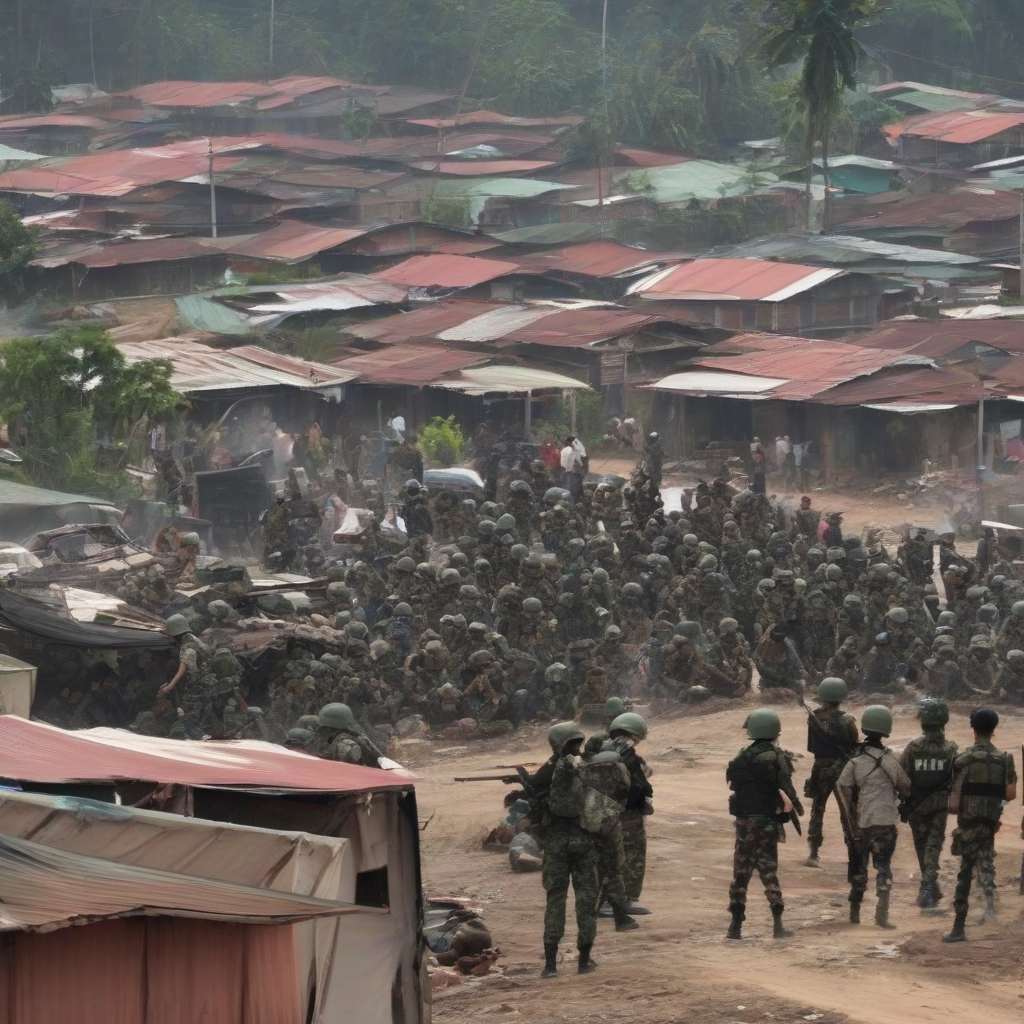
SUGAPA – A large-scale military operation conducted by Indonesian Security Forces across the Agisiga, Sugapa, and Hitadipa districts of Intan Jaya Regency has resulted in civilian deaths, the destruction of religious and residential property, and the displacement of more than 2,000 residents.
The operation, which spanned from mid-May to late July 2026, was launched to pursue local units of the West Papua National Liberation Army (TPNPB). However, the campaign has been marked by reports of indiscriminate force, including alleged drone strikes and extrajudicial killings of non-combatants.
The National Human Rights Commission (Komnas HAM) has identified at least seven major violent incidents during this period. The commission is now calling on the Indonesian government to review its security approach in West Papua and launch independent investigations into the reported abuses.
Timeline of Military Escalation
Violence intensified on 17 May 2026, when an explosive device, reportedly dropped from an unmanned aerial vehicle, detonated near St Paul’s Catholic Church in Mbamogo Village, Agisiga District. The blast occurred following Sunday mass, injuring four people; one victim, Luter Nabelau, later died from his injuries.
Throughout June, further alleged drone strikes were reported in the Agisiga and Hitadipa districts. Operations increased in intensity following reports that TPNPB commander Aibon Kogoya had returned to Intan Jaya, prompting security forces to reinforce existing deployments and expand aerial surveillance.
On 26 June, security forces initiated coordinated air and ground assaults involving drones, helicopters, and joint ground units. This phase of the operation saw the establishment of new military positions within civilian areas and reports of exchanges of fire between security forces and TPNPB fighters, including in close proximity to churches, schools, and residential compounds.
Documented Civilian Casualties
Between 17 May and late July 2026, five civilians were reported killed and four injured. Local human rights defenders have documented several specific incidents of violence against non-combatants, which Komnas HAM has indicated could form the basis for formal inquiry:
- 29 June: Daud Hagisimijau (18) and Kiko Hagisimijau (16) were reportedly shot by security personnel while assisting in the construction of St Francis Xavier Catholic Church in Titigi Village.
- 29 June: Rev. Elianus Agimbau, a pastor of the Indonesian Tabernacle Church (GKII), was fatally shot while fleeing violence near Mbamogo Village. A vehicle carrying clergy and civilians attempting to recover his body was also struck by gunfire, forcing the group to withdraw.
- 29 June – 1 July: Okto Tigau (19) was arbitrarily detained by the Rajawali Task Force. His body was discovered on 1 July near a military post in Mamba Village, Sugapa District, showing multiple gunshot wounds and signs of severe mutilation.
- 2 July: Merkiana Duwitau, who was pregnant, and her unborn child were killed during an exchange of fire in the Sugapa District while residents sought shelter from clashes nearby.
Indonesian authorities have not publicly released a detailed account of these incidents or clarified whether any of the victims are officially regarded as combatants or civilian casualties.
Humanitarian Impact and Infrastructure Loss
The military campaign has caused significant displacement and the destruction of essential civilian infrastructure. Metadata analysis of video evidence confirms that security forces set a dozen residential houses and a GKII Church on fire on 27 June 2026, in an area where no prior evacuation of civilians had been documented.
The scale of the operations prompted more than 2,000 residents to abandon their homes, seeking refuge in surrounding forests or fleeing to Sugapa town. Local authorities, church leaders, and humanitarian actors reported significant obstacles in accessing affected communities to evacuate casualties or provide aid, citing road closures, checkpoints, and continued exchanges of fire.
Displaced families are reported to be sheltering in temporary sites with limited access to food, clean water, and medical care, raising concerns that the security operation is creating a parallel humanitarian emergency in a remote regency where basic services are already fragile.
Legal Obligations and Oversight
The conflict in West Papua is classified as a non-international armed conflict. Under international humanitarian law, including the obligation to distinguish between civilians and combatants set out in Additional Protocol II to the Geneva Conventions, all parties-including the TPNPB and Indonesian security forces-are required to take constant care to spare civilians and civilian objects from the effects of hostilities.
The reports of drone attacks on worshippers, the burning of homes, and the alleged torture and execution of detainees raise questions regarding Indonesia’s compliance with international human rights law and its own constitutional guarantees. Available evidence indicates the victims were engaged in ordinary civilian activities at the time of the incidents, with no public evidence suggesting participation in hostilities.
Komnas HAM, an independent state institution mandated to monitor and investigate human rights violations, has urged the Indonesian government to adopt a human rights-based security approach and ensure a transparent investigation to provide victims’ families with access to justice and reparations. It has also called for stronger civilian oversight of operations in Papua, including clearer rules of engagement, public reporting on casualties, and protection guarantees for witnesses.
The Indonesian government has been called upon to establish a prompt and effective investigative process to determine if the conduct of the operations complied with applicable international legal standards and with national legislation governing the deployment of military forces in domestic security operations, including parliamentary and judicial review mechanisms. Regional church leaders and local officials have echoed those calls, warning that failure to address allegations of abuse risks deepening distrust between Papuan communities and the state.
- Urban Infrastructure Resilience: How European and Asian Megacities Are Adapting to Extreme Climate Oscillations in 2026
- UN General Assembly 2026 Framework on Autonomous Systems: International Diplomacy Faces Algorithmic Governance
- South African Human Rights lawyer Navi Pillay wins Nobel Peace Prize (globallypulse.com)
