
WASHINGTON —
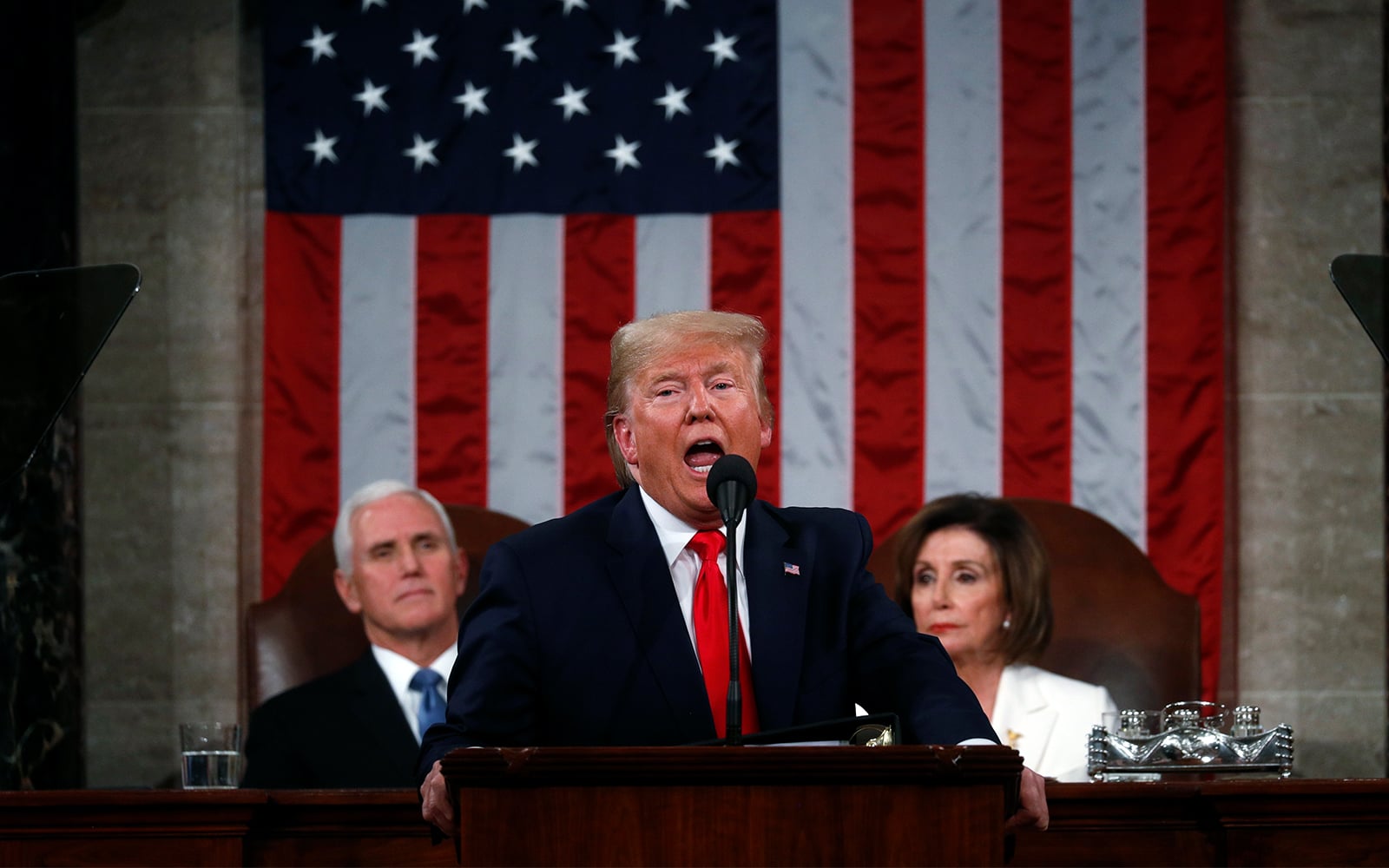
President Donald Trump will use Tuesday night’s State of the Union address to press his case for a tougher line on Iran, seizing a prime-time platform as the United States concentrates the largest array of air and naval power in the region in decades and last-minute nuclear talks teeter in Geneva. The speech is scheduled to begin at 9 p.m. Eastern in the House chamber.
Military buildup sets the backdrop
Hours before the address, the U.S. Navy’s newest and largest aircraft carrier, the USS Gerald R. Ford, pulled into the U.S. naval facility at Souda Bay on Crete, a highly visible symbol of the firepower Washington has assembled within range of Iran. The Ford’s port call follows weeks of deployments that U.S. officials say are meant to deter Tehran and, if diplomacy fails, enable rapid, sustained strikes supported by long‑range bombers and regional bases.
From the White House podium and on social media, Trump has cast himself as the architect of de-escalation even as he threatens force. On Monday he rejected reports of military dissent and warned Tehran, writing: “I am the one that makes the decision, I would rather have a Deal than not but, if we don’t make a Deal, it will be a very bad day for that Country and, very sadly, its people,” a message aides say foreshadows a central theme of tonight’s remarks: that the same military buildup he ordered is designed to keep the peace by convincing Iran it has no better option than a negotiated climbdown.
THE PEACE PRESIDENT.
The White House posted the slogan in an earlier message tied to Gaza cease-fire diplomacy, underscoring the image Trump is likely to amplify as he argues that credible military power, coupled with economic sanctions, can compel concessions and avoid a wider war.
Negotiations and a narrowing window
Even as strike options are refined, the administration’s special envoy Steve Witkoff says the United States still wants a deal — but warns Iran is “probably a week away from having industrial-grade bomb-making material,” citing enrichment at roughly 60% and arguing that Tehran has crossed a red line. Negotiators are due back in Geneva this week for what officials describe as a decisive round. Iranian officials, for their part, say they will consider diluting 60% stockpiles under international supervision in exchange for sanctions relief, while rejecting a permanent end to enrichment or closure of key facilities.
The stakes are amplified by the collapse of the 2015 nuclear bargain’s formal architecture. UN Security Council Resolution 2231, which endorsed the Joint Comprehensive Plan of Action (JCPOA), reached its termination date last October, removing key international constraints and verification mechanisms built into the deal. Under that accord, Iran had been limited to enrichment at 3.67% and a 300‑kilogram cap on low‑enriched uranium — benchmarks widely cited by nonproliferation experts to hold “breakout” timelines at roughly a year.
Trump has argued that last summer’s U.S. strikes — conducted alongside Israel during a brief, intense regional war — “obliterated” key elements of Iran’s nuclear infrastructure, adding: “It would take years to bring them back into service.” But the UN nuclear watchdog and independent analysts say Iran has retained or rebuilt significant enrichment capability, including advanced centrifuge cascades, keeping the proliferation risk acute and raising questions about how much additional leverage further strikes would provide.
A year after the Twelve‑Day War
The current standoff is inseparable from the 12‑day Israel‑Iran war of June 2025, when Israel launched large-scale strikes on Iranian military and nuclear sites and Iran answered with salvos of ballistic missiles and drones at Israeli cities. On June 22, the United States entered the fight with bunker‑buster strikes on Natanz, Fordow and Isfahan; Iran retaliated by firing missiles at a U.S. base in Qatar. A U.S.-brokered ceasefire took effect on June 24.
Key milestones, June 13–24, 2025:
- Israel conducts multi‑axis strikes on Iranian targets, including nuclear facilities.
- Iran fires hundreds of ballistic missiles and drones at Israel; casualties on both sides mount and air defenses are tested across the region.
- June 22: U.S. airstrikes hit three Iranian nuclear sites, marking Washington’s most direct role in attacks on Iran’s nuclear infrastructure to date.
- Iran answers with missile fire at a U.S. base in Qatar, underscoring the risk to tens of thousands of U.S. personnel stationed across the Gulf.
- June 24: A ceasefire brokered by Washington begins holding, but leaves core disputes over Iran’s nuclear program and regional activities unresolved.
Domestic politics and the law
Trump returns to the House rostrum with Republicans holding both chambers of Congress following the 2024 elections, but with party strategists warning the November midterms will be fought in increasingly hostile terrain. Tonight’s address — formally delivered under Article II’s requirement that the president “from time to time” report to Congress on the state of the union — is framed around the economy and immigration but, in practice, also serves as an early national referendum on whether Americans will back a new confrontation abroad.
Polls suggest skepticism. A Reuters/Ipsos survey found that 69% of Americans say the United States should avoid military action in the Middle East unless facing a direct and imminent threat; an Ipsos poll last month reported only 16% back U.S. missile strikes on Iran’s government, and Quinnipiac measured 70% opposition to U.S. military involvement in Iran. Strategists in both parties say those numbers help explain why Trump is emphasizing the possibility of a “great Deal” with Tehran rather than preparing the public for an open-ended campaign.
On Capitol Hill, the legal ground for any sustained action has shifted in ways that will shape tonight’s reception. Congress repealed the 1991 and 2002 authorizations for the use of military force (AUMFs) in December as part of the FY2026 defense bill, increasing pressure on the White House to seek fresh authorization or rely narrowly on the president’s Article II powers; under the War Powers Resolution, any introduction of U.S. forces into hostilities without such authorization triggers a 48‑hour reporting requirement and a 60‑day clock for congressional approval.
Senator Tim Kaine, a longtime proponent of restoring congressional war powers, accused Trump on Tuesday of squandering diplomacy: “Trump is bumbling his way toward war with Iran in a feeble attempt to accomplish what had already been done by a diplomatic deal that was effectively curbing Iran’s nuclear program — until Trump tore it up, over the objections of his then-Secretaries of Defense and State,” he said. Allies of the White House counter that Iran has repeatedly violated the spirit of past agreements and that only sustained pressure can force a more durable arrangement.
Inside the Pentagon, some senior officers have voiced caution about munitions stockpiles, base access and the scale of a campaign that could extend beyond nuclear infrastructure into air defenses and missile forces. Trump has dismissed suggestions that his top general is wary, but recent reporting indicates Joint Chiefs Chairman Gen. Dan Caine has outlined significant operational risks and potential escalation ladders if Iran targets U.S. forces or Gulf partners in response.
A volatile global energy calculus
Any new U.S.–Iran clash would reverberate through energy markets. Roughly 21 million barrels of crude and condensate transited the Strait of Hormuz each day in 2023 — about one‑fifth of world petroleum liquids consumption — alongside around one‑fifth of global LNG trade, mostly from Qatar. Even temporary disruption could rattle prices and supply chains from Asia to Europe and complicate central banks’ efforts to tame inflation.
That risk sharpened last week when Iran briefly closed sections of the strait during live‑fire drills, an unusual move timed to nuclear talks. International financial institutions have warned that sustained conflict or shipping interruptions at Hormuz would threaten global growth, pressure consumer prices and test emergency stockpile systems built after earlier oil shocks.
Trump’s record and the message tonight
The White House has telegraphed that the president will highlight what aides call coercive diplomacy — pointing to the October Gaza truce he championed and the January capture of Venezuela’s Nicolás Maduro on U.S. narcoterrorism charges — while insisting he still prefers a negotiated outcome with Tehran. Allies see Iran as a far more formidable adversary than Venezuela, with a large ballistic‑missile arsenal, cyber capabilities and the ability to strike U.S. forces and partners across the region through both direct and proxy attacks.
Trump’s envoys say diplomacy remains the “first option.” Yet the president has already previewed the ultimatum at the core of tonight’s address: “I am the one that makes the decision, I would rather have a Deal than not but, if we don’t make a Deal, it will be a very bad day for that Country and, very sadly, its people.” For lawmakers in the chamber — and for foreign capitals watching closely — the unanswered question is whether that warning is primarily a negotiating tactic or an indication that the United States is prepared to cross into a new phase of conflict if Geneva fails.
Status: Trump is slated to deliver the State of the Union at 9 p.m. ET on Tuesday, February 24, as U.S. and Iranian negotiators prepare to reconvene in Geneva later this week and the USS Gerald R. Ford remains at Souda Bay, a reminder that the decisions outlined in an ornate House chamber could, within days, be tested in the skies over the Gulf.
Keep reading
- Global Food Security Alliances: How Climate-Resilient Agricultural Corridors Are Stabilizing Wheat and Rice Supplies
- Cross-Border Renewable Energy Grids: North Sea and Mediterranean Subsea Cable Networks Enter Phase Two
- Jay Clayton named White House AI czar by Trump to lead task force (globallypulse.com)
