
WASHINGTON –
President Donald Trump has signaled a pivot in Republican midterm strategy, employing aggressive anti-communist rhetoric to frame the Democratic Party as an existential threat to the United States. Speaking to a gathering of religious conservatives, the president characterized recent progressive electoral gains in New York as evidence of a “godless” movement intent on the systemic persecution of Christians.
The rhetorical shift arrives as the administration faces a precarious polling environment, with voters expressing dissatisfaction over stagnant inflation and the persistence of U.S. involvement in overseas conflicts. By centering the upcoming elections on an ideological battle against “extremism,” strategists aim to redirect the national conversation from economic performance toward a high-stakes cultural conflict that could define control of Congress for the remainder of Trump’s term.
The trigger for this messaging was the success of democratic socialists in New York, specifically those backed by Zohran Mamdani. Trump used these local victories to argue that the Democratic Party has been subsumed by an ideology that he claims is fundamentally incompatible with American values, collapsing distinctions between progressive factions and the party’s national leadership.
The Ideological Pivot
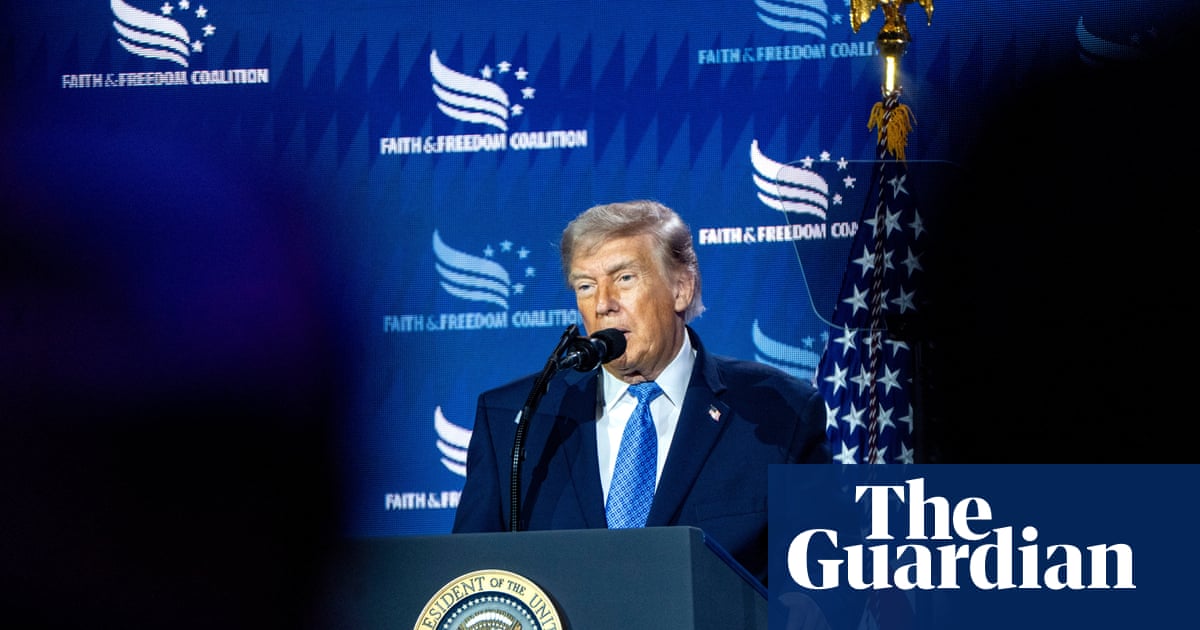
Addressing the Faith & Freedom Coalition’s annual Road to Majority conference at the Washington Hilton, Trump sought to link modern progressivism to the historical specters of the 20th-century Red Scare. He positioned the rise of the democratic left not as a political shift, but as a religious and national security crisis that he says justifies an emergency-style response at the ballot box.
“All communists are godless. They do not believe in God … These ruthless communists attack all religions, but in particular Christianity. They always do. They’re after Christianity more than any other religion,” Trump told the audience.
The president described the New York election winners as “very troubling people,” alleging without providing evidence that they “want to destroy our country, and they hate our country and our people.”
This strategy reflects a long-standing playbook within the American religious right, utilizing “wedge issues” to mobilize a base that perceives a decline in traditional social hierarchies. By claiming “The Democratic party is in big trouble” and asserting that “this is not stopping with New York,” Trump is attempting to nationalize local progressive wins to create a narrative of a spreading “communist” contagion and to portray Democrats as outside the constitutional mainstream.
The White House has not presented policy proposals that would translate this rhetoric into new legal authorities, but Trump’s framing could shape how Republican lawmakers approach upcoming battles over federal spending, education standards and religious liberty protections, including litigation under the First Amendment’s guarantees of free exercise and free speech.
The rhetoric was occasionally punctuated by geopolitical contradictions; for instance, while railing against communist persecution of Christians, Trump cited U.S. military intervention in Nigeria-a non-communist state-as a primary example of the administration’s commitment to protecting the faith. Advisers later said the president was using Nigeria as shorthand for broader U.S. advocacy on behalf of persecuted religious minorities, rather than as an example of communist rule.
Escalation in the Strait of Hormuz
While the president focuses on domestic ideological warfare, the U.S. military has engaged in a targeted escalation in the Middle East that carries its own domestic political risks. On Friday, the U.S. carried out strikes against Iranian missile and drone facilities near the Strait of Hormuz and on Qeshm Island.
The operation was a direct response to an Iranian drone strike on a Singapore-flagged cargo ship, according to U.S. officials. The Strait of Hormuz remains one of the world’s most critical maritime chokepoints, through which approximately one-fifth of the world’s total oil consumption passes. Any miscalculation there could quickly feed back into U.S. gasoline prices and consumer sentiment heading into the midterms.
Officials at the Pentagon described the strikes as “limited,” intended to deter further Iranian aggression without triggering a full-scale regional war. They emphasized that the action fell within existing congressional authorizations for the use of military force rather than a new declaration of war. Even so, the incident marks the most significant test of the current ceasefire between Washington and Tehran, raising concerns among international energy markets regarding the stability of global shipping lanes and inviting fresh calls on Capitol Hill for clearer war powers constraints.
Institutional Friction and Human Rights
The administration’s narrative of “law and order” and “national security” is currently colliding with significant legal and diplomatic challenges that cut across multiple branches of government.
In a notable legal development, former National Security Adviser John Bolton pleaded guilty on Friday to charges of mishandling classified information. Bolton, who became a caustic critic of Trump after his dismissal, now faces the possibility of imprisonment, highlighting the ongoing volatility within the U.S. national security apparatus and underscoring the Justice Department’s continued use of criminal penalties to police leaks and document handling.
Simultaneously, the administration is facing intensifying international scrutiny over its immigration policies. United Nations High Commissioner for Human Rights, Volker Türk, issued an urgent call for “prompt, independent, impartial and effective investigations” into deaths occurring within U.S. government immigration custody, a demand that goes beyond routine reporting and presses Washington to open its facilities and records to outside review.
Türk’s intervention coincides with internal probes by the Department of Homeland Security (DHS) regarding the use of force against detainees. DHS, created in the wake of the September 11 attacks to centralize border and security functions, oversees both Border Patrol and Immigration and Customs Enforcement detention operations, placing the department at the center of the unfolding scrutiny.
This pressure extends to the environmental aftermath of the “Alligator Alcatraz” migrant detention center. Despite the facility’s recent closure under Governor Ron DeSantis, environmental advocates are demanding an independent inquiry into the ecological damage inflicted on the Florida Everglades during the center’s year of operation, arguing that state and federal regulators failed to fully enforce wetlands protections and permitting requirements while the site was active.
Further complicating the administration’s domestic agenda, the Food and Drug Administration (FDA) is preparing to discuss the easing of restrictions on research peptides. The move is controversial among health experts due to a perceived lack of clinical evidence supporting the safety and efficacy of these substances and could test how aggressively the agency interprets its authority under the Federal Food, Drug, and Cosmetic Act in an era of booming gray-market therapeutics.
Collectively, the disputes over detention deaths, environmental oversight, classified information handling and emerging biomedical products underscore the extent to which Trump’s election-season message of spiritual and ideological confrontation is intersecting with-and in some cases being undercut by-the slow, rules-bound machinery of U.S. and international governance. The U.S. Department of State has not issued a formal response to the UN High Commissioner’s demands regarding immigration custody deaths, leaving a widening gap between the administration’s rhetoric of toughness and the diplomatic obligations it is being pressed to acknowledge.
Keep reading
- Global Food Security Alliances: How Climate-Resilient Agricultural Corridors Are Stabilizing Wheat and Rice Supplies
- Cross-Border Renewable Energy Grids: North Sea and Mediterranean Subsea Cable Networks Enter Phase Two
- Jay Clayton named White House AI czar by Trump to lead task force (globallypulse.com)
