
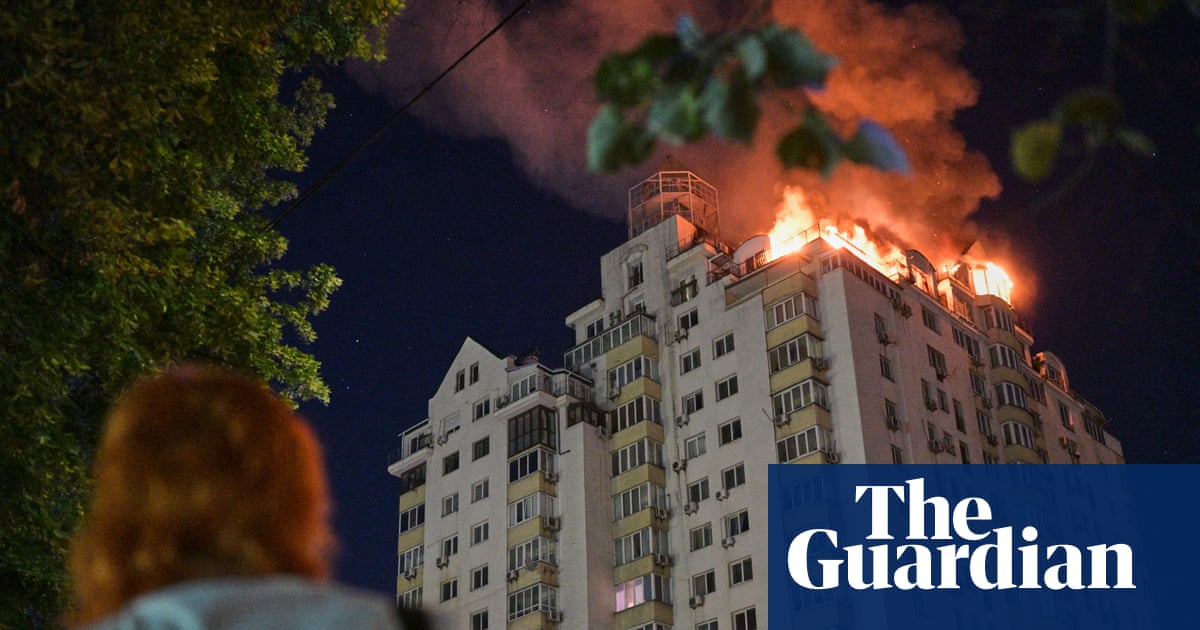
KYIV – Russia launched a massive coordinated wave of cruise missiles, ballistic missiles, and one-way attack drones against the Ukrainian capital overnight into Thursday, causing significant structural damage and leaving at least two people dead and more than a dozen injured.
The strikes, which targeted all 10 districts of Kyiv on both sides of the Dnipro River, represent one of the most intense aerial bombardments of the city since mid-June. The attack underscores a volatile cycle of escalation as Moscow intensifies its strikes on urban centers in response to Ukraine’s expanding long-range drone campaign against Russian energy infrastructure.
The bombardment hit multiple residential areas, including a high-rise apartment building where the first through sixth floors collapsed following a direct hit. Kyiv Mayor Vitali Klitschko described the event as a “furious enemy attack,” urging residents to remain in shelters as emergency crews worked to rescue people trapped in the rubble of a nine-storey residential complex.
Tymur Tkachenko, head of the capital’s military administration, confirmed that two people were killed and 16 injured. A hotel on a central boulevard also caught fire during the strikes.
As air raid sirens echoed across the capital and much of the country, thousands of civilians sought refuge in the city’s deep-level metro stations. The images of families carrying pets, children, and tents into the underground network have become a recurring symbol of the war’s attrition, as Kyiv’s Soviet-era subway system serves as one of the most effective bomb shelters in Europe.
The attack forced President Volodymyr Zelenskyy to cut short a high-level diplomatic visit to Dublin. Zelenskyy had been in Ireland for the commencement of the country’s six-month rotating presidency of the European Union, a role that places Dublin at the center of EU coordination on security and sanctions.
The President warned that intelligence reports had indicated a high probability of an overnight strike before departing Ireland to return to Ukraine. Ukrainian officials said the episode once again exposes gaps in the country’s air defense coverage and the limits of existing commitments made under the NATO-Ukraine Council and broader Western security guarantees.
Regional Security and NATO Response
The volatility of the strike triggered an immediate military response from NATO member Poland, which scrambled fighter jets to secure its airspace. The move highlights the persistent tension on NATO’s eastern flank, where the proximity of Russian missile trajectories to allied borders necessitates constant vigilance under Article 5 collective-defense planning.
The Polish armed forces issued a statement via X regarding the deployment:
“These actions are of a preventive nature and are aimed at securing and protecting the airspace, especially in areas adjacent to the threatened regions.”
Poland has consistently acted as a primary logistics hub for Western military aid to Ukraine, and its air force frequently monitors the border during large-scale Russian aerial campaigns to prevent accidental incursions into sovereign Polish airspace. Warsaw’s actions are coordinated within NATO’s Integrated Air and Missile Defence System, the allied framework that governs cross-border radar sharing, early warning, and the rules for scrambling jets along the alliance’s eastern perimeter. [NATO Integrated Air and Missile Defence]
Diplomats in Brussels say such incidents also feed into ongoing debates among member states over whether to further relax restrictions on the use of Western-supplied weapons against launch sites inside Russia, and whether additional long-range systems should be deployed to front-line NATO states.
Strategic Escalation Patterns
This surge in aerial assaults comes amid a shift in Ukrainian military strategy. Kyiv has increasingly deployed long-range drones to strike military sites and energy facilities deep within Russian territory.
These operations have targeted refineries and fuel depots, causing documented fuel shortages and disrupting internal Russian supply lines. Military analysts suggest that Russia’s intensified focus on Kyiv is an attempt to degrade Ukrainian morale and force a reallocation of air defense resources away from the front lines in the Donbas and Kharkiv regions.
The current trajectory of the conflict remains defined by these asymmetric strikes:
- Russian Strategy: Targeting critical civilian infrastructure and urban centers to exert psychological pressure, undermine economic resilience, and strain limited air defense stockpiles.
- Ukrainian Strategy: Utilizing low-cost drone technology to strike high-value economic and military targets inside Russia, aiming to raise the cost of the invasion and disrupt the Kremlin’s war financing.
- Allied Position: Continued provision of advanced air defense systems, such as the Patriot and IRIS-T, alongside the evolving commitments set out in Ukraine’s bilateral security agreements and the broader framework of the Ukrainian state’s Association Agreement with the European Union, which anchors cooperation on security, energy, and civilian protection. [EU-Ukraine Association Agreement]
Emergency services in Kyiv continue to clear debris from residential sites, while Ukrainian air defense commands assess the intercept rate of the overnight wave and prepare after-action reports for the Security Council and international partners. Authorities have warned residents of potential rolling power disruptions and renewed air alerts as they brace for the possibility of follow-on strikes.
Worth a look
