
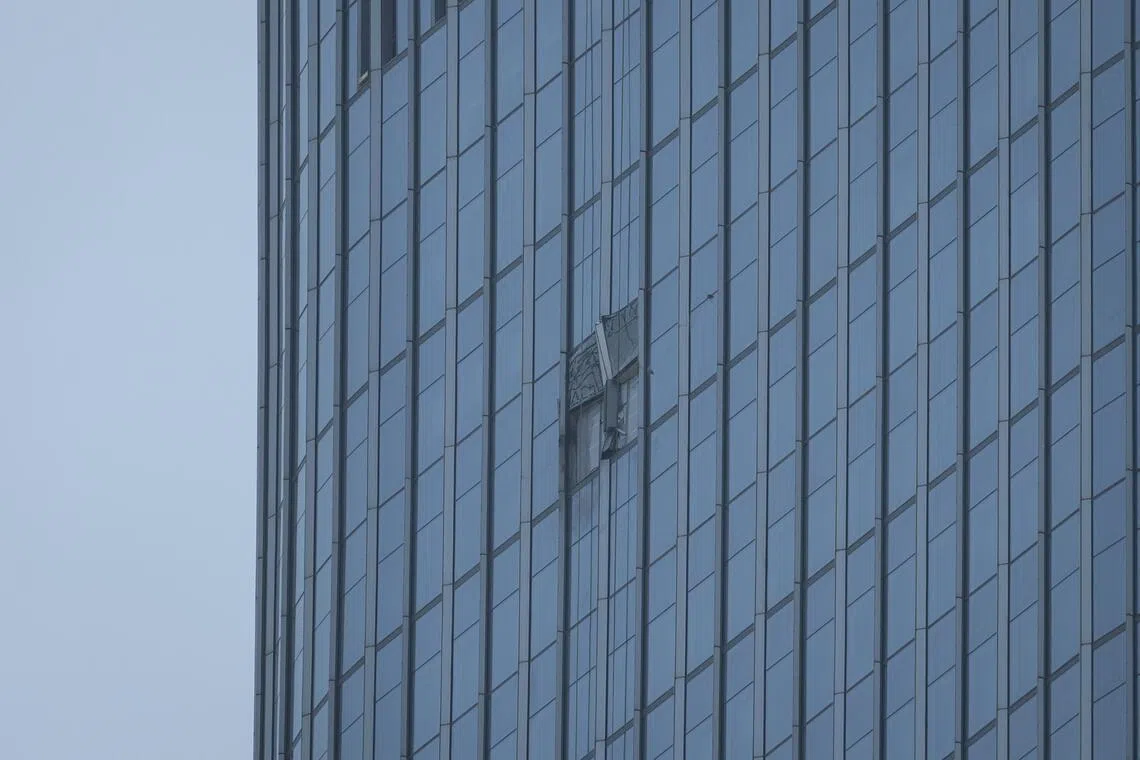
BEIJING – A Hainan Airlines Airbus A330 narrowly avoided a mid-air collision with a rogue light aircraft shortly before the smaller plane crashed into Beijing’s tallest skyscraper on June 26.
The incident, revealed through public flight-tracking data, indicates that the commercial jet was forced to take emergency evasive action as the light aircraft penetrated one of the most restricted corridors of airspace in the world.
The breach of security over the heart of China’s capital-and the subsequent near-miss with a widebody passenger jet-exposes critical vulnerabilities in the state’s aviation oversight and its ability to intercept unauthorized flights within sensitive zones. It also raises questions about how effectively China’s highly centralized airspace management system, led by the Civil Aviation Administration of China (CAAC) under the country’s Civil Aviation Law, is functioning in the low-altitude airspace above major cities.
The Mid-Air Near-Miss
Flightradar24 records show the light aircraft flew directly into the arrival path of the Hainan Airlines jet, which was traveling from Urumqi to Beijing Capital International Airport, one of Asia’s busiest hubs.
As the A330 lined up for its final approach over Beijing’s sixth ring road, it descended to approximately 990 meters. In a sudden maneuver lasting six minutes, the jet climbed sharply to 2,790 meters and deviated from its established flight path to avoid the encroaching aircraft, according to the tracking data.
The two planes came within 457 meters of each other. For context, the standard vertical separation for aircraft on approach is typically 305 meters, meaning the gap between the two aircraft was only modestly greater than the minimum safety threshold.
The disruption extended beyond the single near-miss:
- At least two aircraft were forced to abort their landings as the light plane cut across the arrival corridor.
- Air traffic controllers ordered multiple flights to switch their landing approach from the south to the north, a rare shift during peak arrival banks.
- Operations were severely strained at Beijing Capital International Airport, where takeoff and landing intervals often occur every 30 seconds, leaving little margin to absorb an unexpected intrusion.
It remains unclear if the Hainan Airlines crew acted on instructions from air traffic control or if the aircraft’s Traffic Collision Avoidance System (TCAS) triggered an automated Resolution Advisory that the pilots were obliged to follow. Aviation safety experts note that authorities will be under pressure to clarify this sequence as part of the air-safety investigation.
Impact at Citic Tower
Following the near-miss, the light aircraft continued on its path and crashed into the upper floors of the 109-story Citic Tower, also known as China Zun, in Beijing’s Central Business District. The skyscraper, which serves as the headquarters of state-owned conglomerate CITIC Group and anchors the city’s modern skyline, stands only several kilometers from the headquarters of the Communist Party and the residences of senior leadership.
The pilot, who was flying solo, was killed upon impact. Thirteen other people were injured in the crash, including building occupants and people on the ground affected by falling debris, according to local hospital and emergency services tallies.
The crash occurred in an area where Beijing typically enforces rigid low-altitude airspace controls designed to protect the political and administrative core of the capital. Under current Chinese regulations, all flights-including drones and small private planes-require explicit official approval to operate within the capital’s limits. In practice, that approval is rarely granted for privately operated aircraft above central Beijing, making the intrusion of an unidentified light plane into this airspace highly unusual.
Systemic Security Failures
The failure to intercept the light aircraft before it reached the arrival corridor of a major international airport and subsequently struck a landmark building highlights a lapse in coordination between the Civil Aviation Administration of China and military security officials, who jointly manage most of the country’s airspace. The episode will likely intensify scrutiny of radar coverage, identification protocols for low-flying aircraft, and real-time communication channels between civilian controllers and the People’s Liberation Army.
Historically, the Chinese military has maintained control over the vast majority of the nation’s airspace, a factor that has frequently led to civilian flight delays and complex bureaucratic hurdles for private aviation. That structure, codified through CAAC regulations and military directives, was intended to prioritize national security and state operations. The Citic Tower crash now raises the question of whether a system built to prevent unauthorized flights over the capital failed precisely in the scenario it was designed to stop.
The CAAC and Hainan Airlines Holding did not respond to immediate requests for comment. Beijing Capital International Airport declined to comment on the incident or on any temporary changes to approach and departure procedures.
China has temporarily grounded all light aircraft nationwide as the investigation into the crash and the airspace breach continues. Authorities are expected to examine potential gaps in pilot vetting, aircraft registration and real-time flight authorization systems, with any findings feeding into possible amendments to the existing regulatory framework governing low-altitude operations over major Chinese cities.
