
The Orbital Sampling Advantage
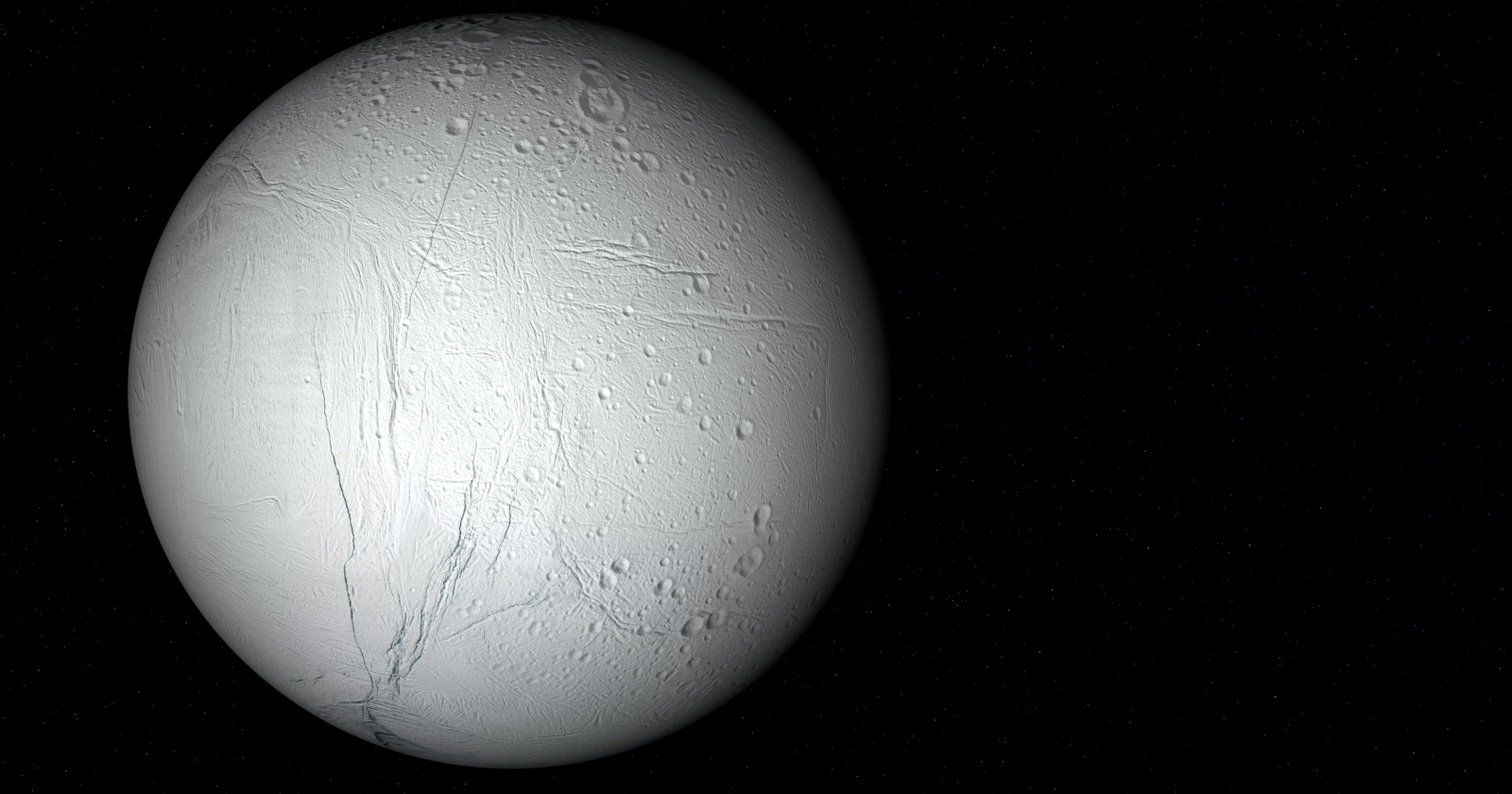
Enceladus represents a unique intersection of planetary geology and aerospace engineering. While most moons requiring the search for life necessitate complex, high-risk landing missions, Enceladus effectively delivers its own samples into space. Through a series of fractures near its south pole-informally known as tiger stripes-the moon continuously ejects water vapor and ice grains, creating a natural conduit from a subsurface salty ocean to the vacuum of space.
This mechanism allows spacecraft to conduct “fly-through” sampling. Rather than risking a landing on unstable ice, instruments can analyze the chemical composition of the plumes at orbital velocities. This approach transforms the moon into a relatively low-cost natural laboratory, providing direct access to the internal chemistry of an alien ocean without the need for drilling through kilometers of frozen crust. For space agencies facing constrained exploration budgets, Enceladus therefore offers one of the most cost‑effective test cases for searching for life beyond Earth.
Molecular Benchmarks for Extraterrestrial Life
The identification of habitability relies on a specific chemical checklist. The presence of liquid water is the baseline, but the transition from a “wet” world to a “habitable” one requires energy sources and the building blocks of biological structures. Data gathered from plume analysis has confirmed the existence of several critical components, turning Enceladus from a curiosity into a priority target in mission planning:
| Chemical Marker | Significance | Implication for Life |
|---|---|---|
| Molecular Hydrogen | Indicator of hydrothermal activity | Provides a chemical energy source for microbes |
| Phosphates | Essential element for DNA and ATP | Required for genetic storage and energy transfer |
| Organic Molecules | Carbon-based compounds | The structural foundation of all known biological life |
| Silica/Salt | Evidence of rock-water interaction | Confirms an active, mineral-rich ocean floor |
The detection of phosphorus is particularly pivotal. As a primary component of cell membranes and genetic material, phosphorus is often the limiting factor in biological growth. On Enceladus, these concentrations appear significantly higher than those found in Earth’s seawater, suggesting a highly enriched environment and elevating the moon in the hierarchy of astrobiological targets.
For policymakers and mission designers, these molecular benchmarks are more than scientific curiosities: they are decision tools. They help space agencies, legislative bodies that oversee national space budgets, and international partners assess whether the next generation of spacecraft should be optimized for reconnaissance, for sample return, or for direct life‑detection experiments in the plumes themselves.
Planetary Protection and Sterilization Protocols
The potential for life on Enceladus elevates the technical requirements for future missions from simple exploration to strict planetary protection. Under international standards coordinated through the Committee on Space Research and reflected in national adherence to the Outer Space Treaty, any mission targeting a “habitable” world must prevent forward contamination-the accidental introduction of Earth-based microbes into an alien ecosystem.
Ensuring the integrity of a potential biological discovery requires rigorous system design and early regulatory scrutiny by national space agencies and their oversight bodies:
- Bioburden Reduction: Extreme heat sterilization and chemical cleaning of all spacecraft components, documented and audited to meet planetary protection categories before launch.
- Trajectory Control: Precision navigation to ensure that a failed spacecraft does not crash into the moon’s surface, potentially seeding the ocean with terrestrial bacteria, and end-of-mission disposal plans that regulators can certify as compliant.
- Biosignature Discrimination: Developing instruments capable of distinguishing between abiotic organic chemistry and actual biological signatures, so that any detection stands up to scientific and political scrutiny.
- Sampling Integrity: Designing capture systems that do not degrade organic molecules through heat or friction during high-velocity plume transit, preserving evidentiary value for any future claims of life.
These requirements will shape procurement decisions, industrial partnerships and international cooperation agreements. Any Enceladus mission serious about life detection will need not only engineering excellence but also a clear compliance pathway through planetary protection policy, export controls and public transparency demands.
The Tidal Engine
The longevity of Enceladus’s ocean depends on a process known as tidal kneading. As the moon orbits Saturn, the gas giant’s massive gravity stretches and compresses the moon’s interior. This mechanical friction generates internal heat, preventing the subsurface ocean from freezing solid and powering the hydrothermal vents on the sea floor.
While the existence of the ocean is confirmed, its stability over geological time remains a subject of technical debate. For life to emerge, the environment must remain stable for millions of years. If the tidal heating is inconsistent, the ocean could undergo cycles of freezing and thawing, which would likely disrupt the development of complex biological systems and complicate interpretations of any future measurements.
The current data describes a world that is habitable, but not necessarily inhabited. The gap between these two states can only be closed by missions specifically engineered for biosignature detection, moving beyond the identification of ingredients to the search for the “tenant” itself. As spacefaring nations weigh competing priorities-from lunar infrastructure to Mars exploration-Enceladus now stands as a test of how quickly exploration policy, planetary protection norms and mission funding can adapt to the possibility that one of the most promising oceans for life is already venting into space, waiting to be read.
Keep reading
