
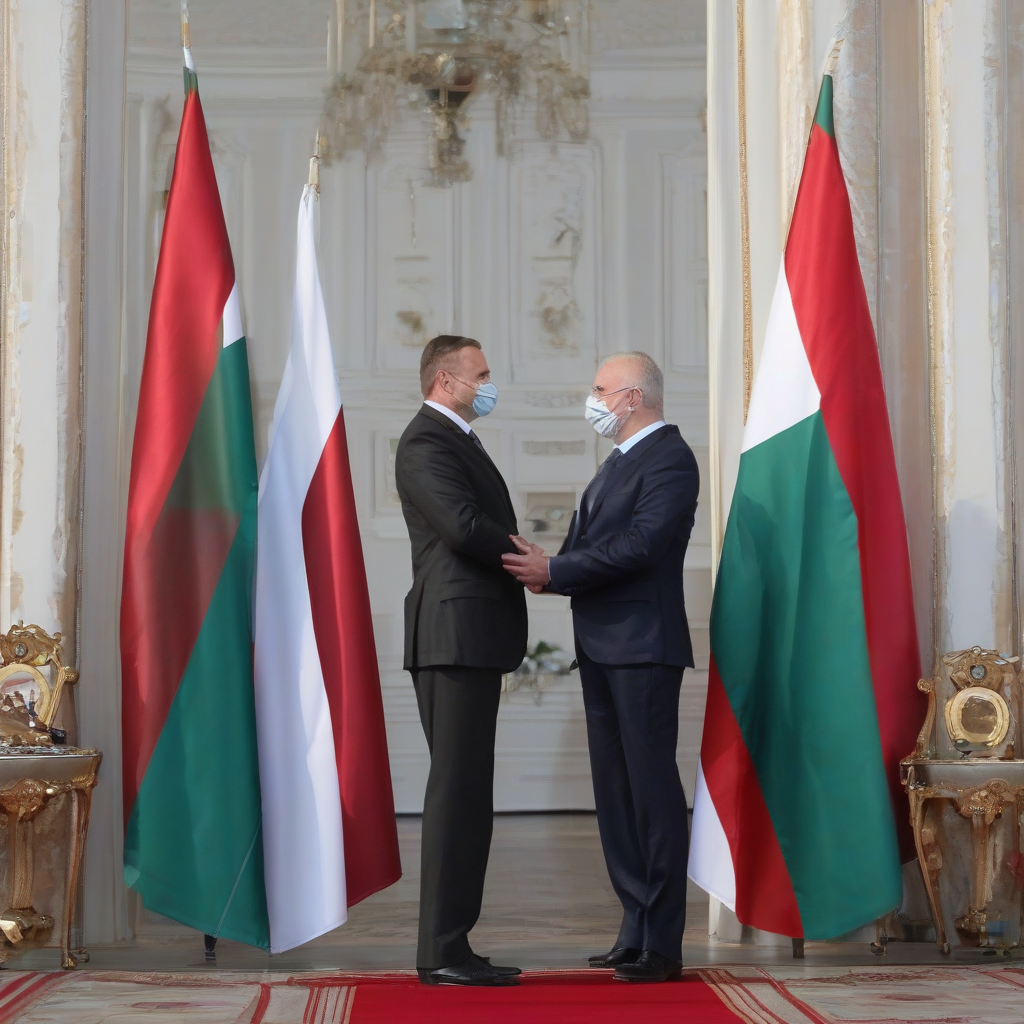
POZNAŃ – Hungarian President Tamás Sulyok attended the 70th anniversary commemorations of the 1956 anti-communist Poznań Uprising on June 28, 2026.
The visit, conducted at the invitation of Polish President Karol Nawrocki, marks a potential shift in bilateral relations. The joint appearance follows a period of strained diplomatic ties between Budapest and Warsaw, largely driven by divergent positions regarding the conflict in Ukraine.
The meeting occurs amid observations that the Polish right may be reassessing its relationship with Hungary following the emergence of authoritarian indicators in Hungary after the April elections.
President Sulyok confirmed the purpose of his visit via social media, stating: “at the invitation of Polish President Karol Nawrocki, we are commemorating today the 1956 Poznań workers’ uprising which is rightly viewed as one of the precursors to the Hungarian Revolution 70 years ago.”
At the invitation of Polish President Karol Nawrocki, we are commemorating today the 1956 Poznań workers’ uprising which is rightly viewed as one of the precursors to the Hungarian Revolution 70 years ago.
President @NawrockiKn and I also had the opportunity to discuss the… pic.twitter.com/J63niyet0R— Dr. Tamás Sulyok (@DrTamasSulyok) June 28, 2026
Regional Diplomatic Implications
The rapprochement between Sulyok and Nawrocki suggests a calculated effort to stabilize the “Visegrád” axis of Central European cooperation and to restore routine presidential-level dialogue after a de facto freeze in contacts. The previous pause in high-level engagement was characterized by disagreements over security architecture, sanctions policy, and the handling of the war in Ukraine within European Union and NATO forums.
The timing of the event is significant, coming shortly after Hungary’s April elections, which have drawn international scrutiny regarding democratic standards, and ahead of key debates in Brussels on rule-of-law conditionality and budget allocations. Any thaw between Warsaw and Budapest could influence their coordination on EU decision-making, including positions under the Treaty on European Union where unanimity or qualified majorities are required on foreign and security policy.
Poland’s participation in the commemorations alongside Hungary also has implications for the informal balance inside the Visegrád Group, where Prague and Bratislava have taken a more hawkish line on Russia. Diplomats in the region will be watching whether the symbolism in Poznań is followed by coordinated votes or joint initiatives on defense, energy security, and Ukraine-related reconstruction policy.
The Legacy of the 1956 Uprisings
The 1956 Poznań Uprising was a worker-led protest against the communist government of the People’s Republic of Poland. Centered in an industrial city that had long been a hub of trade and manufacturing, the movement demanded better living conditions, wage justice, and political freedoms, and it served as a catalyst for broader unrest across the Eastern Bloc.
Chronological milestones of the 1956 unrest include:
- June 1956: The Poznań workers’ uprising breaks out, leading to mass demonstrations in the city’s industrial districts and the Old Market Square and resulting in a violent crackdown by state security forces.
- October 1956: The Hungarian Revolution begins in Budapest, inspired in part by the preceding unrest in Poland and the perception that change was possible within the Soviet sphere.
During the commemorations, President Nawrocki emphasized that the memory of these events provides a foundation for modern national identity and remains central to contemporary debates over sovereignty, democratic accountability, and the limits of external influence in Central Europe. The choice of Poznań – whose Old Market Square and town hall are enduring symbols of civic autonomy – underlined the link between historic resistance and present-day constitutional order.
“Our identity, built also on the experience of Poznań 1956, is not a burden. It is a great asset we received thanks to our heroes, and which we are able to turn into an even better, more beautiful future in the 21st century for our nations, the countries of Central and Eastern Europe, and my homeland, Poland.”
Combatting Totalitarianism
President Nawrocki used his address to argue that totalitarian structures are inherently incapable of internal reform. He referenced the period following the 1953 death of Joseph Stalin, noting that early hopes for a liberalized communist system were misplaced and that only sustained social pressure, operating within and alongside constitutional frameworks, had produced meaningful openings.
“But the totalitarian communist system cannot be reformed – it must simply be abolished. It must be fought,” Nawrocki stated.
The Polish President concluded his speech by highlighting the role of ordinary citizens in achieving political breakthroughs, attributing the success of the uprising to a “readiness for values, courage in defense of sovereignty, and above all human dignity.” In this reading, Poznań 1956 functions not only as a historical episode but as a reference point in current governance debates over media freedom, judicial independence, and executive power in the region.
From Ceremony to Policy Conversation
Against that backdrop, the symbolism of the commemoration fed directly into a policy-oriented conclusion to the visit. According to both delegations, President Sulyok and President Nawrocki used their bilateral conversation to review current political challenges facing both nations, including security on NATO’s eastern flank, energy diversification, and coordination inside EU institutions on migration and enlargement files.
Officials described the talks as an opportunity to “recalibrate” rather than to declare a full reset. Any lasting impact will likely be measured not in anniversary speeches but in how Warsaw and Budapest align – or diverge – in the coming months on concrete legislative and regulatory files at EU and national level, where the legacy of 1956 is now being consciously invoked as part of the region’s contemporary political vocabulary.