
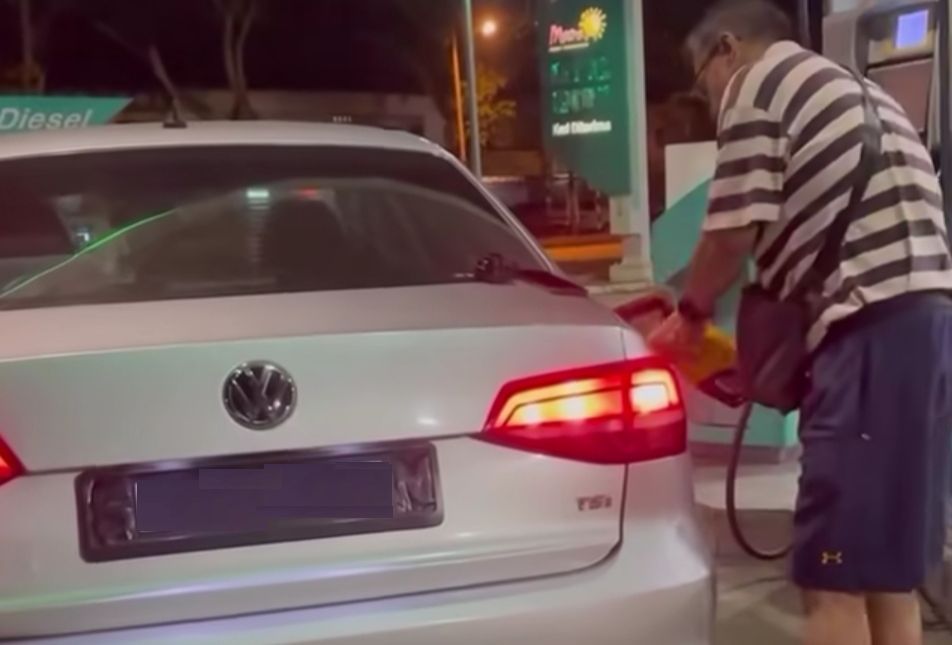
JOHOR BARU – The Johor Domestic Trade and Cost of Living Ministry is investigating claims that a foreign-registered vehicle with its number plate covered attempted to fill up with subsidised RON95 petrol at a local petrol station around 10:30 p.m. on January 2, according to state director Lilis Saslinda Pornomo.
The ministry says the incident drew attention after circulating widely on social media, prompting officers to conduct inspections and open an investigation following a public complaint.
“The RON95 petrol was purchased using a cashless method at one of the pumps.
“From the transaction record, only part of the purchased amount was successfully pumped before it was stopped.
“Closed-circuit television (CCTV) footage was obtained and reviewed to assist the investigation,” she said in a statement on Saturday (Jan 3).
Lilis said action would be taken under Subregulation 12A of the Control of Supplies Regulations 1974, under the Control of Supplies Act 1961, for suspected violation of the Supply Controller’s directive prohibiting the sale of RON95 petrol to foreign-registered vehicles.
What officials have confirmed
- Allegation: A foreign-registered vehicle, with parts of its number plate allegedly obscured, was involved in an attempt to purchase RON95 petrol.
- Time and place: Around 10:30 p.m. on January 2 at a petrol station in Johor Baru, a key transit point for Singapore-registered vehicles entering Malaysia.
- Trigger: Viral social media posts prompted a public complaint, after which ministry officers conducted on-site inspections and opened a formal investigation.
- Evidence gathered: Transaction records show that only part of the authorised RON95 amount was dispensed before the pump was stopped; relevant CCTV footage from the station has been secured and reviewed by investigators.
- Legal path: The case is being examined under Subregulation 12A of the Control of Supplies Regulations 1974, which empowers the authorities to act against breaches of directives on controlled goods such as subsidised fuel.
Why RON95 sales to foreign vehicles are restricted
RON95 is a price-controlled, subsidised petrol grade in Malaysia, intended primarily to cushion living costs for local consumers and domestic businesses. To prevent leakage of subsidies across borders and protect federal fuel subsidy allocations, the Supply Controller has directed that RON95 cannot be sold to foreign-registered vehicles at retail stations.
Petrol station operators are required to enforce this rule at the pump, alongside broader obligations under the Domestic Trade and Cost of Living Ministry’s oversight of strategic goods and subsidies. Breaches may expose both the operator and those seeking to circumvent the restriction to investigation and action under the Control of Supplies Act 1961 and its regulations, including possible fines, licence suspensions, or other administrative measures.
Disclosure and timing notes
The ministry did not disclose the petrol station’s exact location, the country of registration of the vehicle involved, or details of the cashless payment instrument used.
The statement and chronology supplied by the department refer to events on January 2 and a statement issued on January 3. Both dates are described as Saturdays in the ministry’s communication; January 2 and January 3, 2026, however, fall on a Friday and Saturday respectively, a discrepancy GlobalHeadlinez cannot immediately reconcile from available documentation.
Investigation status and next steps
Officials say the case is being handled under the Control of Supplies Act 1961. The ministry has not indicated a timeline for completing its probe but has signalled that enforcement action may extend to both the individual involved and the petrol station operator if non-compliance with the Supply Controller’s directive is established.
The investigation forms part of broader efforts by domestic trade authorities to tighten compliance at border-adjacent fuel stations and to reassure the public that Malaysia’s fuel subsidies, particularly for RON95, remain targeted at eligible users within the country.