
WOLFSBURG – Volkswagen is initiating an aggressive global product offensive to stabilize market share as the company faces intensifying pressure from Chinese electric vehicle (EV) manufacturers and a shifting consumer preference toward affordability.
The strategic pivot focuses on expanding the entry-level EV segment and reinstating hybrid powertrains, marking a departure from the company’s previous singular focus on high-margin, premium electric offerings. This realignment comes as the group manages a complex transition between its corporate portfolio and the necessity of mass-market volume to sustain industrial scale. It also reflects the pressure of tightening emissions rules and industrial policy frameworks that are reshaping how global automakers allocate capital and production across regions.
Mass-Market Electrification and the Entry-Level Pivot
The centerpiece of the 2026 strategy is the ID. Polo, a front-wheel-drive electric hatchback designed to lower the barrier to EV entry in Volkswagen’s core European markets. Starting at €24,995 in Germany, the model is positioned to capture a demographic previously priced out of the ID. series and to keep the brand compliant with fleet CO₂ targets without relying solely on higher-priced flagships.
The ID. Polo is available in three motor configurations: 114 hp, 133 hp, and 208 hp. The high-performance ID. Polo GTI, launching in mid-October, increases output to 223 hp with a starting price just under €39,000, signaling that Volkswagen intends to preserve its performance sub-brand even in the value-focused end of the EV range.
| Battery Type | Capacity | Estimated Range |
|---|---|---|
| LFP (Lithium-Iron Phosphate) | 37.0 kWh | 204 miles (329 km) |
| NMC (Nickel-Manganese-Cobalt) | 52.0 kWh | 283 miles (465 km) |
| GTI Exclusive (NMC) | 52.0 kWh | 263 miles (424 km) |
Complementing the hatchback is the ID. Cross, a subcompact crossover debuting in fall 2026. Utilizing the same battery architecture as the Polo, the ID. Cross targets the high-growth SUV segment with a starting price of approximately €28,000 in Germany and a maximum range of 261 miles (420 kilometers). Together, the two models are designed to anchor Volkswagen’s volume EV strategy in segments directly exposed to both Chinese new entrants and cost-conscious European buyers.
Iterative Refinement and Interface Correction
Volkswagen is simultaneously addressing systemic criticism regarding its user interface, which has become a reputational and resale-value risk in key European and North American markets. The ID.3 Neo, a mid-cycle facelift of the rear-wheel-drive hatchback, removes capacitive-touch buttons and touch sliders in favor of physical buttons and a volume knob, reversing a widely criticized design direction and aligning the brand more closely with consumer-safety and usability expectations from regulators and testing bodies.
The ID.3 Neo offers battery packs of 50.0, 58.0, and 79.0 kWh, with the largest configuration providing 228 horsepower and a maximum range of 391 miles (630 kilometers). Charging speeds for the top-tier battery reach 183 kilowatts, enabling a 10-to-80 percent charge in under 30 minutes. An ID.3 GTI variant is scheduled for release in September, aimed at retaining enthusiast interest as the nameplate transitions fully to electric.
Similar updates are slated for the ID.4. The upcoming mid-cycle facelift is expected to mirror the ID. Cross’s design language and will also see the return of traditional physical controls. While known internally as the ID. Tiguan, the model is unlikely to undergo a formal name change, a sign that Volkswagen is prioritizing continuity for regulators, dealers, and residual-value forecasters even as it reshapes the underlying product.
In a consolidation of the lineup, the ID.5 coupe is expected to end production in 2027. Furthermore, while the ID.4 was recently discontinued in the United States, the model is expected to return following the implementation of these updates, giving Volkswagen a refreshed compliance and volume tool in a market where federal and state EV incentives remain in flux.
Volkswagen ID. Tiguan Rendering
The Hybrid Hedge and North American Volume
To mitigate the volatility of EV adoption rates and meet European fleet emission standards, Volkswagen is returning to the full-hybrid market. Rather than abandoning combustion outright, the company is building a portfolio that can flex with national subsidy regimes, charging-infrastructure build-out, and consumer income trends.
The 2026 Golf Hybrid and T-Roc Hybrid combine a 1.5-liter turbocharged gasoline engine with a 1.6 kilowatt-hour lithium-ion battery. The system utilizes a serial drive mode, where the combustion engine acts as a generator for the electric motor to optimize fuel economy in urban and mixed driving. Both models will enter the European market in the fourth quarter of 2026, giving policymakers and fleet buyers additional low-emission options that do not depend on dense public charging networks.
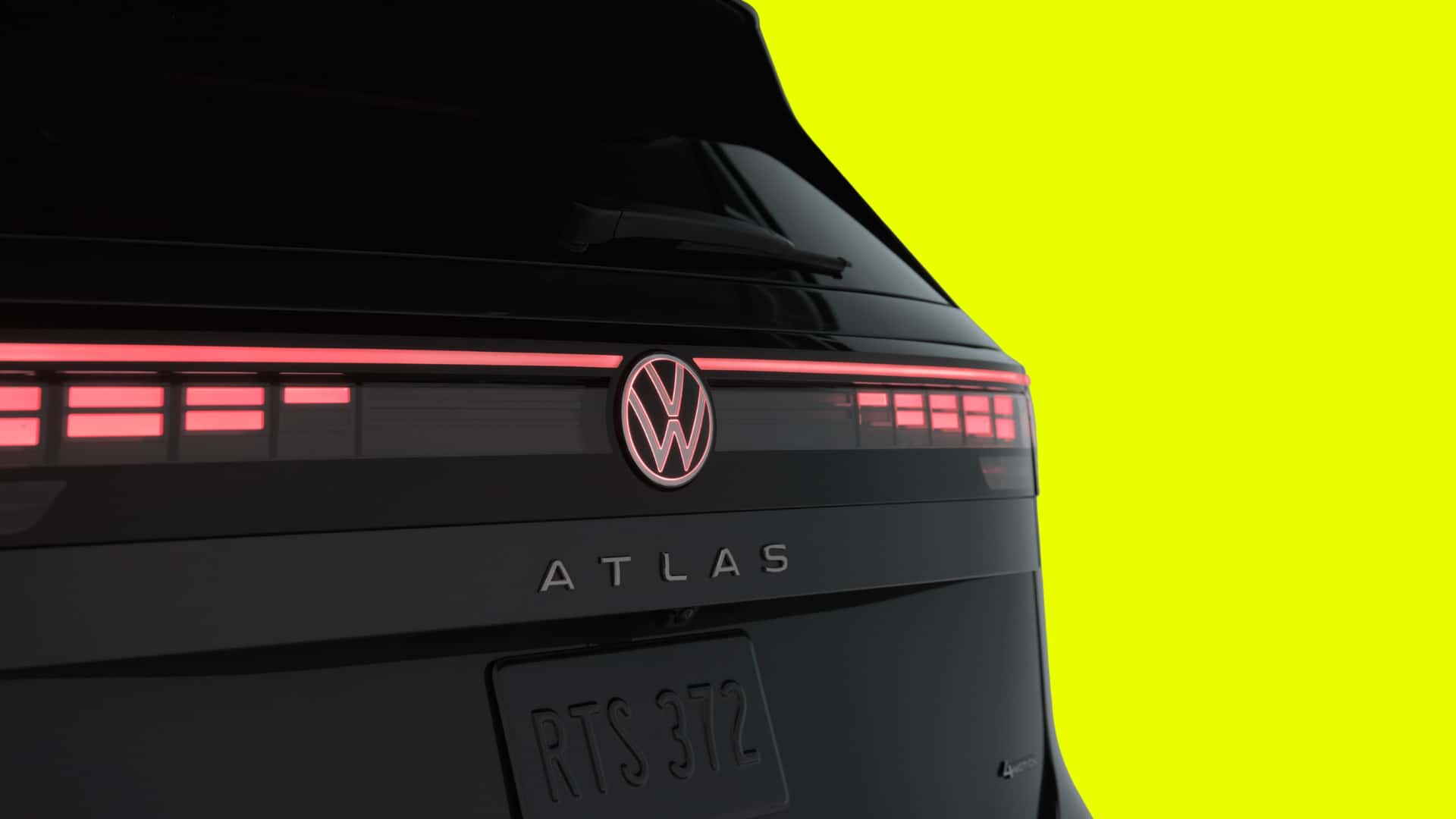
In North America, the company is launching the second generation of the Atlas in fall 2026. Based on the Teramont Pro launched in China in early 2025, the 2027 Atlas features an upgraded EA888 evo5 2.0-liter turbocharged engine producing 282 horsepower and 253 pound-feet of torque. The model is intended to secure Volkswagen’s presence in the profitable three-row SUV category while it scales up future electrified offerings.
- Atlas FWD Efficiency: 22 mpg city / 29 mpg highway / 25 mpg combined
- Atlas 4Motion Efficiency: 20 mpg city / 27 mpg highway / 23 mpg combined
These efficiency figures will be central to Volkswagen’s ability to navigate U.S. fuel-economy and emissions rules while maintaining competitive towing and payload capabilities for family and fleet buyers.
China Strategy and Local Alliances
Volkswagen is restructuring its operations in China, the world’s largest automotive market, where domestic brands have steadily eroded its market share and set new price and software benchmarks. The company is now relying on local partnerships to accelerate development cycles and to comply more nimbly with national industrial and data-governance requirements.
A key outcome of this shift is an alliance with Xpeng, resulting in the ID. UNYX 09, a sleek electric sedan designed specifically for the Chinese market. This offensive includes the ID. Era 9X, the ID. Unyx 08, and a new SUV concept from the Jetta brand, all tuned to local preferences for connected services, over-the-air updates, and aggressive pricing.
However, the difficulty of the Chinese market is evidenced by the decision to pull the Skoda brand out of the region following a decade of declining sales. That retrenchment underscores the risk facing legacy foreign automakers whose portfolios cannot be localized quickly enough or priced sharply enough to compete with Chinese incumbents in lower and mid-tier segments.

The company’s current operational status involves the phasing out of legacy models, such as the Touran minivan, to clear capacity for the ID. series and hybrid expansions. For European governments seeking to safeguard domestic employment and battery supply chains, Volkswagen’s ability to manage that transition smoothly will be a bellwether for the wider industry.
Volkswagen remains in a critical transition period, balancing high-volume internal combustion engines with a diversified EV portfolio to counter Asian competitors. The success or failure of this product offensive will shape not only the group’s own future but also the credibility of Europe’s broader attempt to maintain industrial leadership while delivering on climate and energy-security commitments.