
DUBAI, United Arab Emirates – Iran’s paramilitary Islamic Revolutionary Guard Corps (IRGC) said it is “more ready than ever, finger on the trigger,” as U.S. warships moved toward the Middle East, with the Guard’s ground forces chief warning the United States and Israel “to avoid any miscalculation,” according to a statement carried by a state‑linked outlet.
The remarks come amid heightened tensions following a crackdown on protests that began on Dec. 28 after Iran’s currency, the rial, collapsed. Washington has signaled potential military red lines, and several European airlines have adjusted flights to the region as carriers monitor security conditions.
Guard commander warns U.S. and Israel
Nournews, a platform close to Iran’s Supreme National Security Council, said IRGC Ground Forces commander Gen. Mohammad Pakpour issued a message of readiness and deterrence aimed at what he called “external threats” to the Islamic Republic.
“The Islamic Revolutionary Guards and dear Iran stand more ready than ever, finger on the trigger, to execute the orders and directives of the Commander-in-Chief,” Nournews quoted Pakpour as saying.
Nournews also reported that Pakpour cautioned the United States and Israel “to avoid any miscalculation” that could trigger a broader confrontation.
In Iran’s system, the commander‑in‑chief of the armed forces is the country’s supreme leader, who holds ultimate authority under the country’s constitution over the IRGC and the regular military.
U.S. carrier group heads to region; Trump outlines red lines
U.S. President Donald Trump, speaking aboard Air Force One, said the United States was moving warships toward Iran “just in case” he wants to take action and added: “We have a massive fleet heading in that direction and maybe we won’t have to use it.”
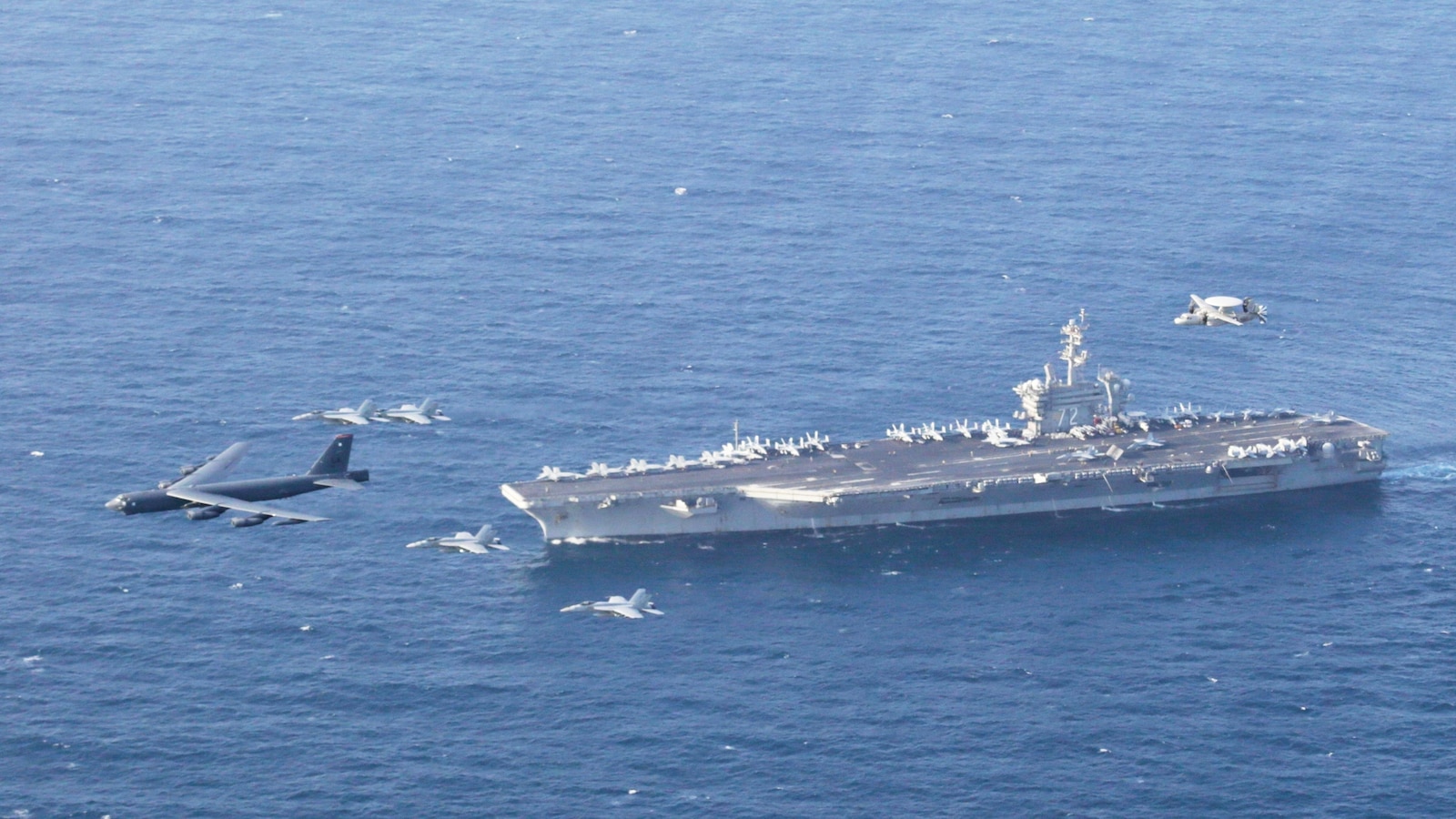
A U.S. Navy official, speaking on condition of anonymity to discuss ship movements, said the aircraft carrier USS Abraham Lincoln and warships traveling with it were in the Indian Ocean and positioned to move toward the Arabian Sea and Persian Gulf if ordered.
Trump has repeatedly warned Tehran and publicly described two triggers for potential U.S. military force: the killing of peaceful demonstrators and the mass execution of people arrested in the protests. He has also said Iran halted the execution of 800 detainees, a claim Iran’s top prosecutor, Mohammad Movahedi, strongly denied in comments carried by the judiciary’s Mizan news agency.
Referring to earlier talks between U.S. and Iranian officials on the nuclear program, Trump said there had been multiple rounds before what he described as a 12‑day war launched by Israel against Iran in June, adding that U.S. warplanes also bombed Iranian nuclear sites during that period. He warned that any prospective U.S. military action now would make earlier strikes on uranium enrichment sites “look like peanuts,” and said, “They should have made a deal before we hit them.”
Trump did not provide evidence for several of his more detailed operational claims, and officials in Washington and Tehran have not publicly released matching accounts. But his comments added to a climate of uncertainty for regional capitals weighing their own security and energy‑supply risks.
Casualty claims from protests diverge
Accounts of the recent unrest vary sharply, and verification has been complicated by severe restrictions on connectivity and access for independent observers.
– Human Rights Activists News Agency (U.S.-based) said the death toll reached 5,137 and reported more than 27,700 arrests.
– Iran’s government announced 3,117 deaths, saying 2,427 were civilians and security forces and labeling the remainder “terrorists.”
The protests began on Dec. 28 amid a currency collapse and spread nationwide for about two weeks, according to the accounts cited. Activists have described an unprecedented internet blackout during the unrest, saying it limited the ability of families, lawyers and journalists to track detentions and casualties.
Authorities have not released a formal breakdown of charges faced by those detained, and courts operating under Iran’s Revolutionary judiciary have broad latitude in handling national‑security and protest‑related cases. Figures from both sides were presented with attribution, and the disparity could not be independently reconciled from the statements provided.
Airlines trim or delay services
Air France canceled two Paris-Dubai round trips as it monitored conditions and said it would resume service later the same day, citing the need to comply with evolving security guidance for overflight and approach routes. Luxair postponed its Luxembourg-Dubai flight by 24 hours and said a decision on operating the flight would be made based on an ongoing assessment.
Arrivals information at Dubai International Airport also listed cancellations of scheduled flights from Amsterdam operated by Dutch carriers KLM and Transavia. Some KLM services to Tel Aviv were canceled, according to online flight trackers. The carriers said they were closely tracking developments and coordinating with national aviation regulators on any changes to routes over Iranian or adjacent airspace.
The adjustments, while limited, underscore how fast‑moving security scares in the Gulf can ripple into commercial aviation planning and consular advisories for travelers.
Why the IRGC’s words carry weight
The IRGC was created after Iran’s 1979 revolution as a parallel force to the regular army and answers directly to the supreme leader. It oversees ground, aerospace and naval branches and a foreign operations arm known as the Quds Force, which has backed allied militias across the region. Over the past decade, IRGC units and proxies have expanded their footprint in conflicts in Syria, Iraq and Yemen, as well as along strategic shipping lanes.
The United States designated the IRGC a foreign terrorist organization in 2019 under its domestic terrorism list, a move that complicates diplomatic engagement and exposes foreign businesses and officials to sanctions if they are found to provide material support. For Western governments and regional states, statements by IRGC commanders can therefore signal not only military posture but also potential shifts in sanctions risk and diplomatic room for maneuver.
In domestic crises, IRGC units and allied forces have historically played a central role in crowd control and internal security, which lends additional significance to statements issued by its commanders at a time of contested protest casualty figures and continuing economic strain.
The USS Abraham Lincoln and its escorts were in the Indian Ocean, according to a U.S. Navy official, with Washington and Tehran each publicly warning the other to avoid steps that could turn the standoff into direct confrontation.