
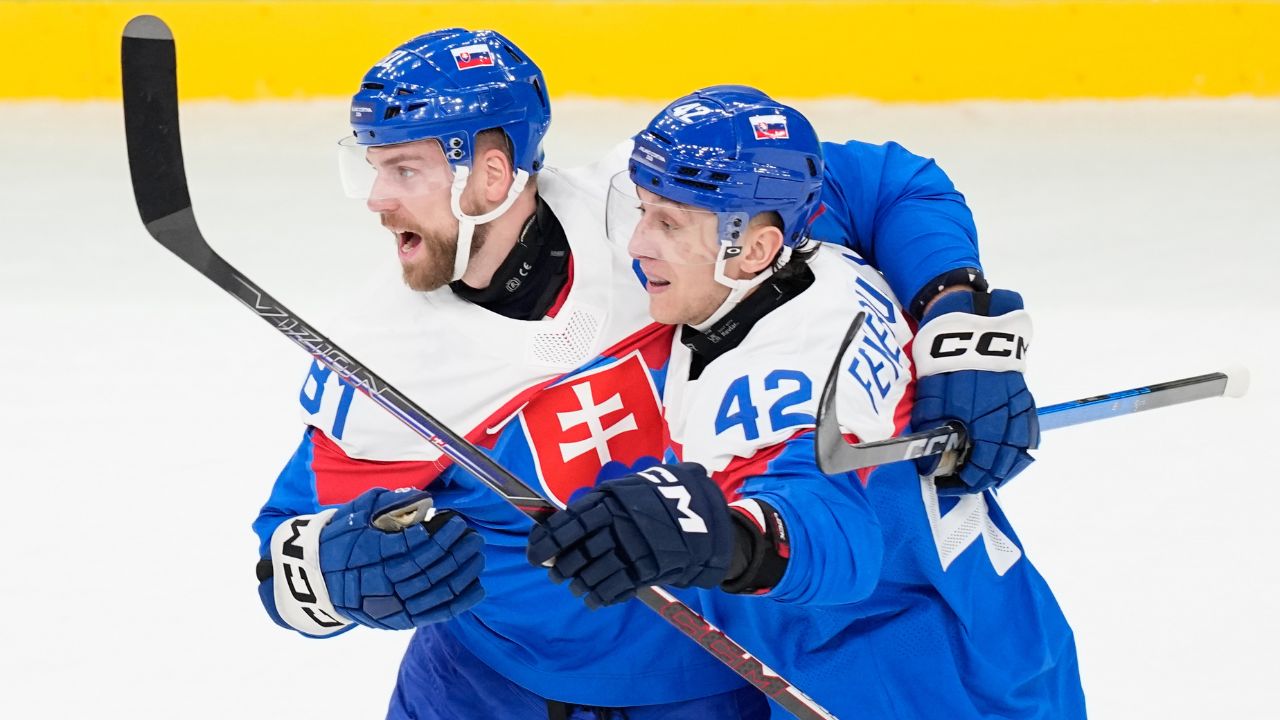
Slovakia’s depth powers 6-2 win over Germany to clinch Olympic semifinal — and a medal game — in Milan
A statement built on balance, not stardom
MILAN — Slovakia arrived at the Olympic tournament prepared to lean on Juraj Slafkovsky, but just as importantly determined not to rely on him alone. That balance defined a commanding 6-2 quarterfinal over Germany on Wednesday, with Dalibor Dvorsky posting a goal and an assist and Pavol Regenda striking twice as part of a three-point night to send the No. 3 seed into Friday’s semifinals — and, by extension, into one of the two medal games.
“We were saying, ‘It doesn’t matter who’s going to score,’” Slafkovsky noted before the puck dropped. “We just need that one extra goal.” Slovakia found several, while holding Germany to two at the other end behind composed goaltending from Samuel Hlavaj and a checking game that smothered Germany’s top line for long stretches.
Match facts
- Result: Slovakia 6, Germany 2 (men’s ice hockey quarterfinal, Milan-Cortina 2026)
- Slovakia scoring leaders: Pavol Regenda (2 goals, 3 points); Dalibor Dvorsky (1 goal, 1 assist); Milos Kelemen (goal off a Dvorsky feed); Tomas Tatar (empty-net goal assisted by Juraj Slafkovsky with 3:27 left); one additional Slovak goal via secondary scoring
- Germany goals: Lukas Reichel (assisted by Leon Draisaitl); Frederik Tiffels (power play)
- Goaltending: Samuel Hlavaj made 25 saves for Slovakia; Germany’s tandem combined for 27 saves
Slafkovsky scare, then reassurance
There was a brief second-period jolt when the 21-year-old Slafkovsky — the reigning Olympic MVP — went head-first into the boards and was slow to get up, silencing a heavily pro-Slovak section of the crowd. With an ice pack applied to the back of his neck, he later returned and finished the game, logging regular shifts down the stretch.
“I’m OK,” he said. “I was a little shaken up, but after a couple minutes I felt OK again. I went out there, and head wasn’t spinning. I was seeing normal.” Held off the scoresheet until late, he still had a hand in sealing it with the assist on Tatar’s empty-netter — a reminder that on a night when others carried the goal-scoring load, Slovakia’s headline star still found a way to close the door.
Young core delivers; back end holds
Dvorsky, who plays in North America for St. Louis, drove play again and is up to three goals at these Games after a strong individual finish that pushed the game out of Germany’s reach. Regenda, who split time this season between San Jose and its AHL affiliate, provided the multi-goal punch Slovakia sought, finding pockets of space around the German net and winning battles below the goal line.
On the blue line, Martin Fehervary underscored the wider point about this roster’s construction. “I don’t think it does matter if Slafko has some points,” he said. “He can do some other work for us, and we have plenty of players who can score, as well.” That depth has been central to the Slovak federation’s long-term strategy in the Olympic cycle, blending NHL regulars with emerging talent developed through its domestic and junior programs.
At the other end, Hlavaj handled Germany’s best looks, beaten only by Reichel off a Draisaitl feed and by Tiffels on the power play. Alternate captain Erik Cernak captured the moment’s significance: “Before the tournament, if we would say we’re going to make semifinals, probably people would laugh at you. But we did it, and it’s not done yet.” For a country of just over five million people, routinely fighting for resources and ice time against larger European programs, that statement carries institutional weight.
Why the semifinal berth changes the calculus
Reaching the final four guarantees Slovakia a place in either the gold-medal game or the bronze-medal game within the Olympic structure overseen by the International Olympic Committee. Under the men’s ice hockey format in Milan-Cortina, both semifinal losers advance to the bronze-medal game, while the winners play for gold — a bracket design that places outsized importance on simply getting into the last four.
It is a meaningful step for a program four years removed from its first Olympic hockey medal of any color — the 2022 bronze, delivered in large part by Slafkovsky’s seven goals after the NHL withdrew late from Beijing due to pandemic-related scheduling issues. That medal triggered a new round of funding debates and youth-hockey investment in Bratislava, and this run will inevitably feed back into those conversations among sports officials and policymakers charting Slovakia’s national sporting priorities.
This time, the field features stars who were absent in 2022, including Draisaitl, Finland’s Mikko Rantanen and Sweden’s William Nylander, reflecting the formal NHL–Olympic participation agreements put in place for 2026. As Slafkovsky put it, “You’ve got the best players over here, and we managed to come here and go to semi-finals. It’s big for me, big for our country, big for every supporter we have.” Head coach Vladimir Orszagh added: “We are a band of brothers who work for the team, for each other, and living our dream. And we’re still living.”
Semifinal permutations and the road ahead
As the No. 3 seed, Slovakia can face any of the United States, Finland, Switzerland, Sweden or Czechia in Friday’s semifinal, depending on the remaining quarterfinal results. Whoever emerges, it will be a meeting framed not just by tactics but by contrasting national systems — from the U.S. college-heavy pathway to Finland’s centralized development model — with Slovakia now clearly demonstrating it belongs in that strategic conversation.
Regenda framed the team’s immediate approach simply: “We just have to keep working, and whatever opening comes next, we’re going to be ready for whoever.”
- Quarterfinals in Milan: Top-seeded Canada vs. Czechia; United States vs. Sweden
- Across town: Finland vs. Switzerland
U.S. defenseman Noah Hanifin, looking ahead to Sweden — which advanced from the qualification playoff by beating Latvia — emphasized tempo and edge. “I think for us it’s just about having a good start,” he said. “They played last night. Just got to get on them early and kind of establish that physical game that makes us a good team. Play fast. It should be a lot of fun, though.” His words doubled as a preview of the pace and physical standard Slovakia can expect next.
The broader Olympic context
Slovakia’s surge arrives at a Milan-Cortina 2026 tournament widely viewed as a more complete global showcase, with elite NHL talent spread across contenders and national federations working under tighter coordination with the league than in past cycles. For Slovakia, depth scoring around Slafkovsky and sturdy defensive work have created a platform that travels against any opponent and validates the federation’s emphasis on spreading minutes and responsibility beyond a single line.
Within the broader Olympic and national-policy context, another medal would strengthen the case for sustained public investment in rinks, coaching and grassroots participation at home — issues that sit on the desks of sports ministers and budget committees as much as on coaches’ whiteboards. With a medal game now secured, the next 60 minutes will determine whether that platform propels Slovakia to play for gold or to defend a bronze podium return, and whether this run is remembered as a breakthrough moment in the country’s long-term hockey strategy or the start of something even larger.
Worth a look
