
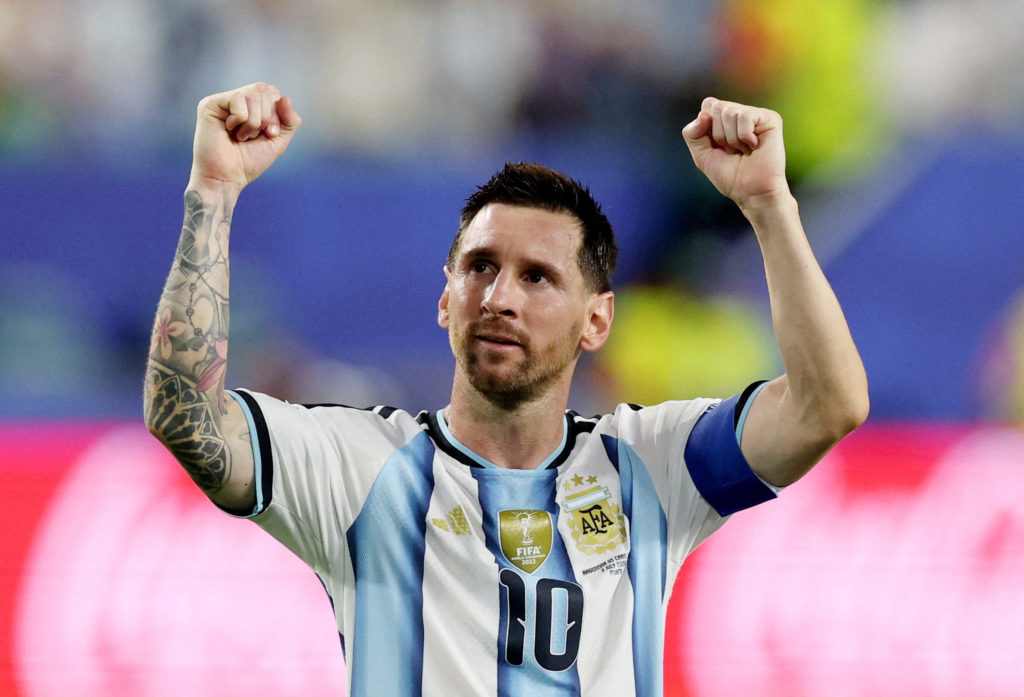
Messi’s Record Extends, but Argentina Are Pushed to the Limit by Cape Verde
MIAMI GARDENS, Fla. – Lionel Messi’s World Cup goals record is still growing. Argentina’s title defense, however, is already living on a knife edge.
The defending champions needed extra time to squeeze past Cape Verde 3-2 in Miami Gardens, surviving one of the shocks of the tournament so far and relying once again on their captain’s ability to decide games under pressure.
Record goal underpins a fragile advantage
Messi’s goal in the 29th minute was the 20th of his World Cup career, stretching his all-time men’s scoring record at the tournament and moving him two clear of France’s Kylian Mbappé on the list.
The strike opened the scoring on a night that rapidly shifted away from any sense of routine. Messi timed his run perfectly onto a ball from defender Lisandro Martínez, stayed onside, brought the pass under control and lifted his finish over goalkeeper Vozinha’s left shoulder from close range. It was his 124th goal for Argentina, with only Portugal’s Cristiano Ronaldo ahead of him in the men’s international scoring charts with 146.
For bookmakers, Argentina entered as overwhelming favorites – some had Lionel Scaloni’s side at minus-3500 to win, implying a game bordering on formality for the reigning champions. Instead, the contest in South Florida became a test of resilience and concentration that will shape how this title defense is viewed inside the Argentinian camp.
Cape Verde refuses to follow the script
Rather than collapsing after Messi’s early breakthrough, Cape Verde repeatedly exposed Argentina’s vulnerability in transition and on set pieces. The island nation twice came from behind, making it 1-1 and then 2-2 to force an extra 30 minutes and stretch a heavily favored opponent deep into the night.
Messi had already signaled his threat with the first clear chance of the match in the 15th minute, when his left-footed effort skidded across goal and just past the right post. Minutes later, after being brought down, his 25-yard free kick was comfortably handled by Vozinha, the first of several important interventions from the Cape Verde goalkeeper.
In extra time, Cape Verde’s resistance finally broke from a corner. Messi delivered the set piece that led to the deciding goal, his delivery sparking a scramble and a sequence of headers before the ball crossed the line midway through the second half of extra time. The captain did not get credit for the goal, but again was central in the decisive action.
“As this team has demonstrated many times, and as I’ve said many times, it competes,” Messi said afterward. “And we competed to the end.”
Cape Verde left the tournament with credit intact. “Our team did everything we could to win the game,” Vozinha said, summing up a performance that complicated Argentina’s path but enhanced Cape Verde’s reputation on the global stage.
Physical toll and immediate aftermath
Messi emerged from the contest with visible marks of the battle. At his post-match media conference he appeared with a noticeable bump above his right eye, the result of an apparent knee-to-head collision with a Cape Verde player.
“It hurts a little but I’m good,” he said in Spanish of the goose-egg swelling, as a FIFA post on X showed a clear welt near his eye. The injury did not require him to leave the match, but underlined the physical intensity of Cape Verde’s challenge and the risks Argentina’s key player assumes in a long tournament.
The captain, who has now scored in eight consecutive World Cup matches dating back to Argentina’s successful 2022 campaign, described the performance in balanced terms. “We did good things,” he said, “and we have to correct the bad things.” Those comments align with the reality that, while Argentina advanced, their defensive structure and game management will be under close internal review before the Round of 16.
Golden Boot race tightens at the top
Messi’s seventh goal of this World Cup – one more than Mbappé at this stage – keeps him in front of the Golden Boot race and extends his tally to 12 goals over his eight-game scoring streak at the tournament.
He has never finished as the World Cup’s top scorer. Messi scored seven times in 2022, one fewer than Mbappé, and four goals at the 2014 tournament, when he tied for third. That history adds an individual dimension to Argentina’s collective pursuit: this may be the last opportunity for one of the game’s greatest players to pair a second world title with the one major honor absent from his World Cup résumé.
The competition for the scoring award remains congested. Alongside Messi and Mbappé, Norway’s Erling Haaland and England’s Harry Kane each had five goals entering Friday, while France’s Ousmane Dembélé, Spain’s Mikel Oyarzabal, Brazil’s Vinícius Júnior and Senegal’s Ismaila Sarr were on four. With Senegal already eliminated, Sarr’s challenge has ended, but the others have progressed to the Round of 16.
In the event of a tie on goals when the tournament concludes, the regulations set by FIFA use assists as the first tiebreaker and then the fewest minutes played. Before this match, Mbappé held a 2-0 advantage over Messi in assists, and therefore the edge in the event of level goal totals. That framework shapes how managers may weigh playing time decisions in later rounds, balancing individual awards against squad rotation and fatigue.
Messi’s influence and Argentina’s dependence
Messi’s centrality to Argentina’s campaign extends beyond goals and assists. His teammate Rodrigo De Paul, who plays with him both for the national team and at Inter Miami, highlighted the personal dimension around the captain’s sustained excellence.
“For me, it represents a lot to be friends with him,” De Paul said. “For me, friendship is one of the most important things that we all have and I consider myself fortunate to be there, to share these moments with him.”
On the pitch, those moments now come with rising tactical and physical demands. With Argentina pushed to extra time against a supposed underdog, there will be scrutiny not only on Scaloni’s lineup choices but also on how effectively Argentina can protect leads without leaning on Messi’s output in every phase of the game.
The match in Miami Gardens played out as a reminder that heavy pre-game favoritism does not guarantee control. Cape Verde’s ability to equalize twice exposed phases where Argentina failed to close space between their lines, and where their pressing structure allowed quick breaks. For a side with ambitions of lifting the trophy again, those issues are significant at this early knockout stage.
Bracket implications and tournament context
With this win, Argentina and Messi “now join” Norway, England and France in the Round of 16. The presence of four leading scorers – Messi, Mbappé, Haaland and Kane – all still active gives the knockout rounds a clear individual storyline alongside the national-team stakes.
The narrow margin of Argentina’s progress also affects how future opponents may prepare. Cape Verde’s performance offers a detailed game plan for how to unsettle the champions: targeted pressure on Argentina’s full-backs, commitment on second balls, and set-piece focus, including defending against Messi’s deliveries. The late winner, born from a corner that “bounced off some heads and into the net,” also underlines how much of Argentina’s attacking variety flows through their captain’s left foot.
At the same time, Scaloni emphasized the rising standard across the field. “I hope you now realize, there is no easy opponent,” the coach said, pointing both to Cape Verde’s resistance and to the broader evolution of international football, where tactical preparation and physical conditioning have narrowed the gap between long-established powers and emerging teams.
Fine margins in a long tournament
Argentina leave Miami Gardens with two outcomes that matter in tournament football: progression and a fit captain. Messi’s bump over his right eye was painful but manageable; his scoring run remains intact; and his team is still on course in its attempt to win back-to-back World Cups.
But the way this match unfolded will not be dismissed inside the Argentinian camp. Being pushed to extra time so early in the knockouts carries a potential fitness cost later in the competition, particularly for a core of experienced players who shouldered heavy minutes in 2022. It also reinforces that, while Messi currently leads the scoring charts, his side is operating without a wide safety margin against organized and ambitious opposition.
For now, the record books show Messi out in front: 20 World Cup goals, seven at this tournament, eight straight games with at least one strike. The bracket shows Argentina into the Round of 16, but “barely.” Between those two realities lies the balance Scaloni and his staff must find in the days ahead – preserving their captain’s decisive influence while tightening a team that has just discovered how small the gap can be between a historic run and an early exit.
