
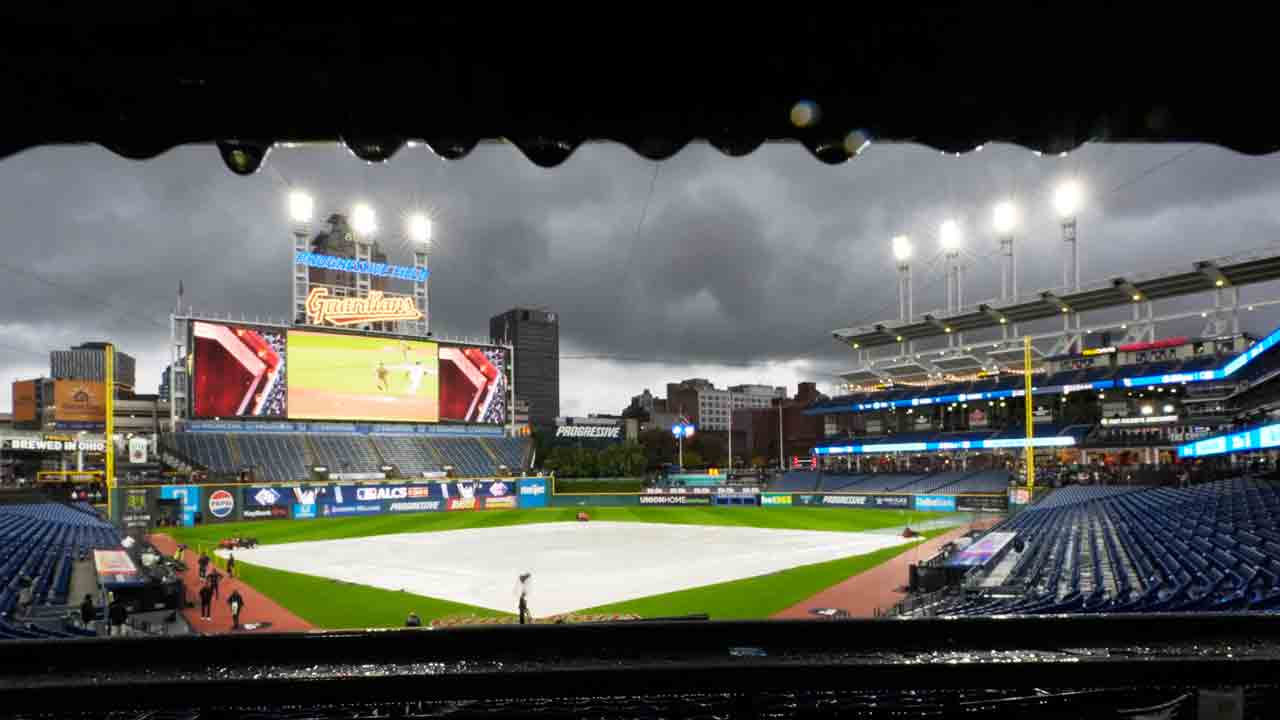
Cold Rain, Warmer Stakes: Weather Delay Tightens ALCS Demands on Guardians and Rays
Sabrowski unfazed as Progressive Field deluge halts Game 4
CLEVELAND – North of the border, generally, and in central Alberta, certainly, baseball season tends to start late and finish early due to the weather, so while growing up in Edmonton, Erik Sabrowski has played in all types of miserable conditions.
“Some snow a few times,” the Cleveland Guardians left-hander said Friday afternoon, before relentless rain washed out Game 4 of the American League Championship Series at Progressive Field. “Early April, you’re just excited to even be outside playing ball, didn’t really affect you too much. Or late October kind of thing, you’re just, again, excited to even still be outside.”
Given the circumstances – the Guardians leading the Tampa Bay Rays 2-1 in the best-of-seven – the thought of grinding through a soggy field and winds so chilling that they prompted a freeze warning was no big concern for someone who grew up playing in Edmonton’s shoulder-season cold.
“At least it’s not snowing,” Sabrowski said with a shrug.
Relentless rain forces MLB’s hand
The weather, though, did not cooperate with postseason scheduling. The inclement rain did not let up – it ebbed around 8 p.m. ET and the tarp was removed while the grounds crew worked to squeegee away pools of water on the warning track, but the downpour never fully stopped.
Shortly after 9 p.m. ET, with conditions still deteriorating and no clear window in sight, a postponement was announced.
Under the league’s postseason operations framework, game-time decisions on player safety and playability sit with the office of the Commissioner of Major League Baseball and the clubs involved, with precedence given to field conditions, visibility and competitive integrity. The back-and-forth in Cleveland reflected that protocol in real time.
The decision followed hours of discussions between officials from both clubs and MLB, with conversations about what to do beginning Thursday after Game 3 ended. By Friday morning, there was enough optimism about a break in the weather to push aggressively toward playing, and both sides held off as long as possible before conceding to the forecast.
Ultimately, “the rain didn’t change,” said Rays manager Kevin Cash. “It never cleared out the way they were hoping. It started to get later in the hour, and MLB and I think both clubs did everything they could to try to get it in. Made the most sense, like, at this point and this hour, with no guarantee that there wasn’t another band (of rain) coming.”
Compressed schedule raises strategic pressure
With Game 4 washed away, the series now accelerates into a demanding stretch for both pitching staffs.
- Game 4: Saturday, 8 p.m. ET, in Cleveland
- Game 5: Sunday, 5 p.m. ET, in Cleveland
- Games 6 and 7 (if necessary): Monday and Tuesday, back in Tampa
The starters will remain Nick Martinez for the Rays and Shawn Armstrong for the Guardians, maintaining the original matchup but compressing the rest and recovery windows around them. In a championship series where rotation depth and bullpen management are already central to success, the shift from a more spaced-out calendar to potentially four games in four days adds another layer of complexity.
For both dugouts, that raises questions about how aggressively to lean on high-leverage relievers, how many pitches to ask from starters on short turnarounds and how to protect arms that have already carried a full regular-season workload. With the Guardians holding a 2-1 edge in the series, the new timeline also sharpens the risk-reward balance on every pitching decision: one miscalculation could swing momentum before the matchup returns to Tampa.
Managers brace for a four-day grind
Guardians manager Stephen Vogt framed the upcoming run as a test that mirrors the physical and mental grind of the regular season, even if the stakes are now far higher.
“Let’s go, it’s regular season, we play four in a row all the time,” Vogt said. “Obviously it’s not ideal for either team. I think we both wanted to play today. It just wasn’t in the cards.”
That attitude underscores a key competitive theme: while October baseball is typically micromanaged around rest days and travel, both rosters now face a sequence more familiar from mid-summer series – but with no room for rotation experiments or low-leverage innings.
From a league operations perspective, the adjusted schedule preserves the structure of the best-of-seven format, keeps off days aligned with travel and minimizes the risk of pushing the series too far into the calendar. It is a reminder of how postseason planning must remain flexible within the broader framework laid out each year by MLB’s postseason manual, while still safeguarding competitive balance.
Weather as an equalizer in a tight series
The Rays, trailing 2-1, must now prepare to play on consecutive days in hostile conditions before any possibility of returning home. The Guardians, meanwhile, lose the opportunity to press their advantage with a more rested bullpen, but gain the benefit of maintaining their preferred starters for Game 4.
Weather delays at this stage of the year often act as an equalizer: the team with the lead must hold concentration through disruption; the team chasing the series is offered a reset, at the cost of a tougher calendar. In Cleveland, both realities arrive at once.
For Sabrowski, whose formative baseball years in Edmonton involved early-April chill and late-October dusk, the cold and rain are simply part of the sport’s outer edges. For the Guardians and Rays, the elements now sit alongside tactics and execution as another factor likely to shape how this AL Championship Series is remembered.
Keep reading
