
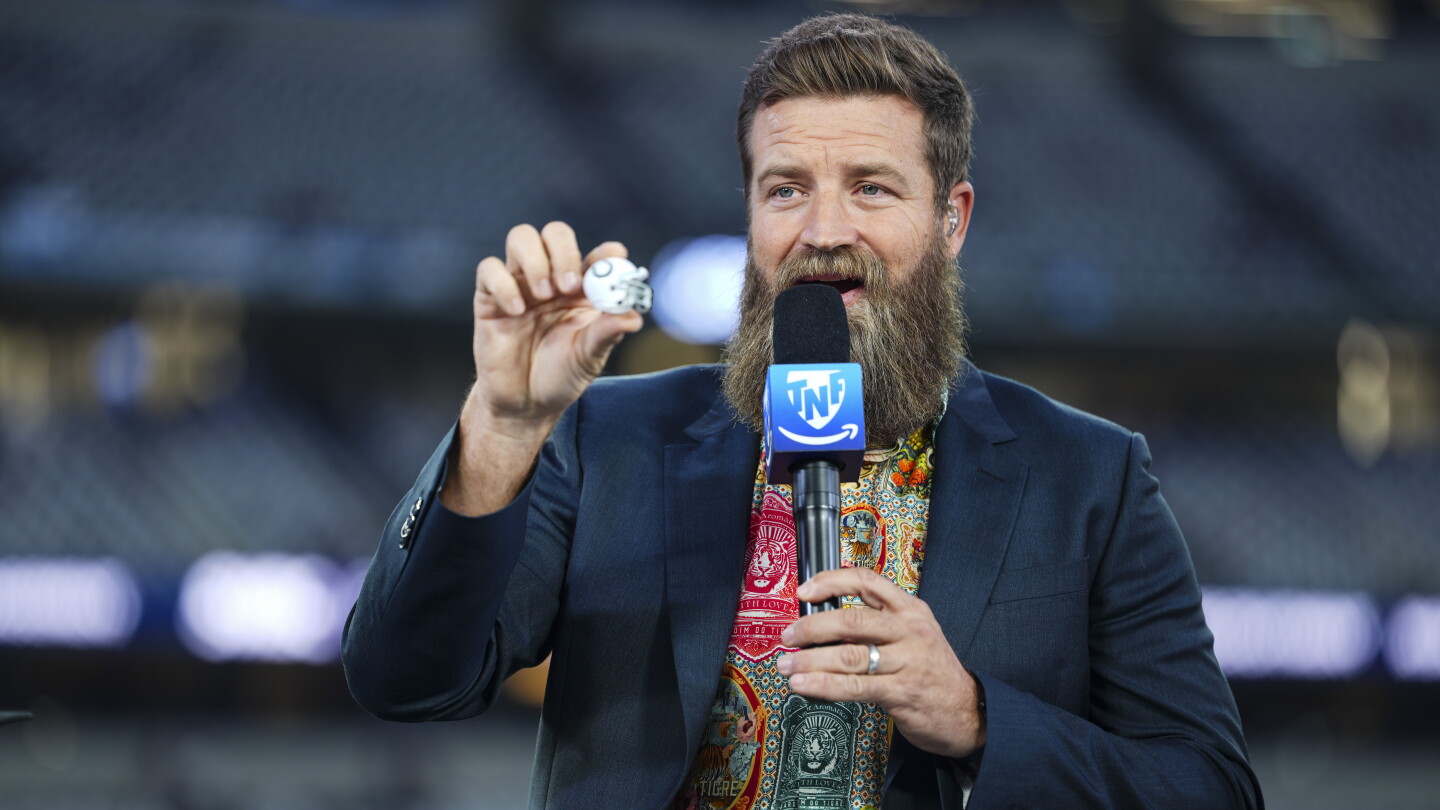
Aqib Talib hits back at Ryan Fitzpatrick after scathing on-air critique of Bo Nix
Four years ago, Aqib Talib and Ryan Fitzpatrick were scheduled to become colleagues on Prime Video’s coverage of Thursday Night Football. If Talib hadn’t stepped aside from the job after his brother shot and killed a man at a youth football game, the most recent postgame show could have unfolded very differently.
Instead, Talib watched from the outside as Fitzpatrick delivered one of the sharpest on-air takedowns of a current quarterback in recent memory. After the Denver Broncos’ 17-14 overtime win against the Seattle Seahawks on Thursday night, Fitzpatrick went all in on Broncos quarterback Bo Nix, calling the rookie’s showing “almost disrespectful to the quarterback position” and later adding: “That right there is garbage. That effort is garbage.”
From on-field struggle to on-air crossfire
Fitzpatrick’s comments came in immediate reaction to a low-scoring overtime game in which Denver still escaped with a win. In the modern NFL, prime-time broadcasts are built as much around postgame opinion as on-field analysis, and former players are encouraged to be forthright about what they see from quarterbacks, who operate under intense weekly scrutiny.
Yet Fitzpatrick’s language went beyond routine criticism of decision-making or execution. His description of Nix’s performance as “garbage” and “almost disrespectful” struck many viewers as unusually personal. The tone raised the question of whether the veteran analyst was simply reacting in the moment or channeling broader frustrations around the Broncos’ offensive approach.
That edge is what drew Talib, a former Broncos cornerback and Super Bowl winner, into the discussion from his own media platform.
Talib unloads on Fitzpatrick’s playing career
On the Gridiron podcast, Talib responded with a blistering rebuttal aimed directly at Fitzpatrick rather than at his assessment of Nix.
“You are disrespectful to the quarterback position because you suck,” Talib said. “Period.”
From there, Talib turned Fitzpatrick’s own history under center into his central argument.
“We’re talking about a guy who played for nine different teams in 17 years,” Talib continued. “Ain’t nobody want his ass. We’re talking about a guy who only played for a team for more than two years once. That’s Buffalo. And his record as a starter in Buffalo was 19-35. That’s fucking suck. A guy who played 17 years, 147 starts, and never sniffed a playoff game. He never touched the playoffs ever. That’s disrespectful to the quarterback position.
“You suck. You suck, bro. We’re talking about a guy who got 169 interceptions, more interceptions than he has starts. How can a quarterback of his caliber talk about what is disrespectful to the quarterback position? I know Amazon is begging for you to be more entertaining, and you’ve just got to just blabber out some bullshit. Nobody’s worried about what Fitzpatrick said. Nobody was worried about playing against you. You suck.”
In tone and language, Talib’s comments mirrored the same level of directness Fitzpatrick had used on air about Nix, but redirected the focus onto the former quarterback’s credentials as a national analyst.
How this clash fits into the modern NFL media landscape
The exchange illustrates how thin the line has become between forthright analysis and personal attack in NFL broadcasting. Networks increasingly lean on former players to deliver unvarnished assessments that cut through the noise of a long regular season, particularly in the high-visibility Thursday night window overseen within the league’s centralized broadcast framework.
Fitzpatrick, whose career spanned multiple franchises and systems, has been valued on air for his willingness to dissect quarterback play without softening his conclusions. Talib’s rebuttal, however, highlights the risk that when criticism is framed as an affront to the “quarterback position” itself, it can provoke equally forceful counterattacks from other ex-players who feel a responsibility to protect current athletes from what they see as performative harshness.
For a rookie quarterback such as Nix, the impact is twofold. First, such public critiques can shape early perceptions among fans and decision-makers far beyond Denver. Second, they can influence how a coaching staff manages his development, game plans and risk tolerance in future nationally televised games, where the spotlight and postgame reaction are magnified.
Implications for players-turned-analysts
Talib’s comments also underscore a growing tension within the fraternity of former players now working in front of cameras and microphones. Many of them are operating under the same league-wide broadcast umbrella, yet they are also building individual media brands that sometimes thrive on sharp contrasts and disagreement.
When one prominent former player publicly questions whether another has the standing to critique current professionals, it touches on wider debates in sports media about:
- how far ex-players should go in questioning effort and respect for the game, as opposed to scheme or execution
- whether a player’s own résumé – wins, losses, interceptions, team changes – should limit or shape the force of their on-air opinions
- how commercial pressure for more “entertaining” content influences the tone of analysis on major prime-time platforms
In this case, Talib explicitly framed Fitzpatrick’s remarks as a product of entertainment demands, suggesting that the quarterback’s critique was driven less by film study and more by a need to deliver viral soundbites.
Bo Nix caught in the middle
Lost in the back-and-forth between Talib and Fitzpatrick is the fact that Denver won the game, and that Nix’s development is a long-term project rather than a one-night referendum. For a young quarterback, being discussed in such absolute terms – “garbage,” “disrespectful” – so early in a career can become part of the national narrative faster than any incremental improvement on the field.
How the Broncos respond, both privately with their quarterback and publicly in future media availabilities, will influence whether this becomes a brief flashpoint or an enduring talking point around Nix’s trajectory. In a league where prime-time outings can sway confidence, contract decisions and coaching evaluations, the language used on postgame sets has real consequences beyond the studio.
A debate that is unlikely to end quickly
For now, Talib’s broadside stands as one of the most pointed player-on-player media critiques of the season, matching the intensity of Fitzpatrick’s original comments about Nix. Whether Fitzpatrick chooses to respond further, recalibrate his on-air tone, or simply move on will help determine if this remains a short-lived feud or a reference point in ongoing discussions about standards, respect and responsibility in high-profile NFL broadcasting.
In a tightly contested league where every prime-time snap is dissected, this episode is a reminder that the fiercest clashes are not always between the lines, but between former players now shaping the conversation from the studio and the podcast mic.
Keep reading
