
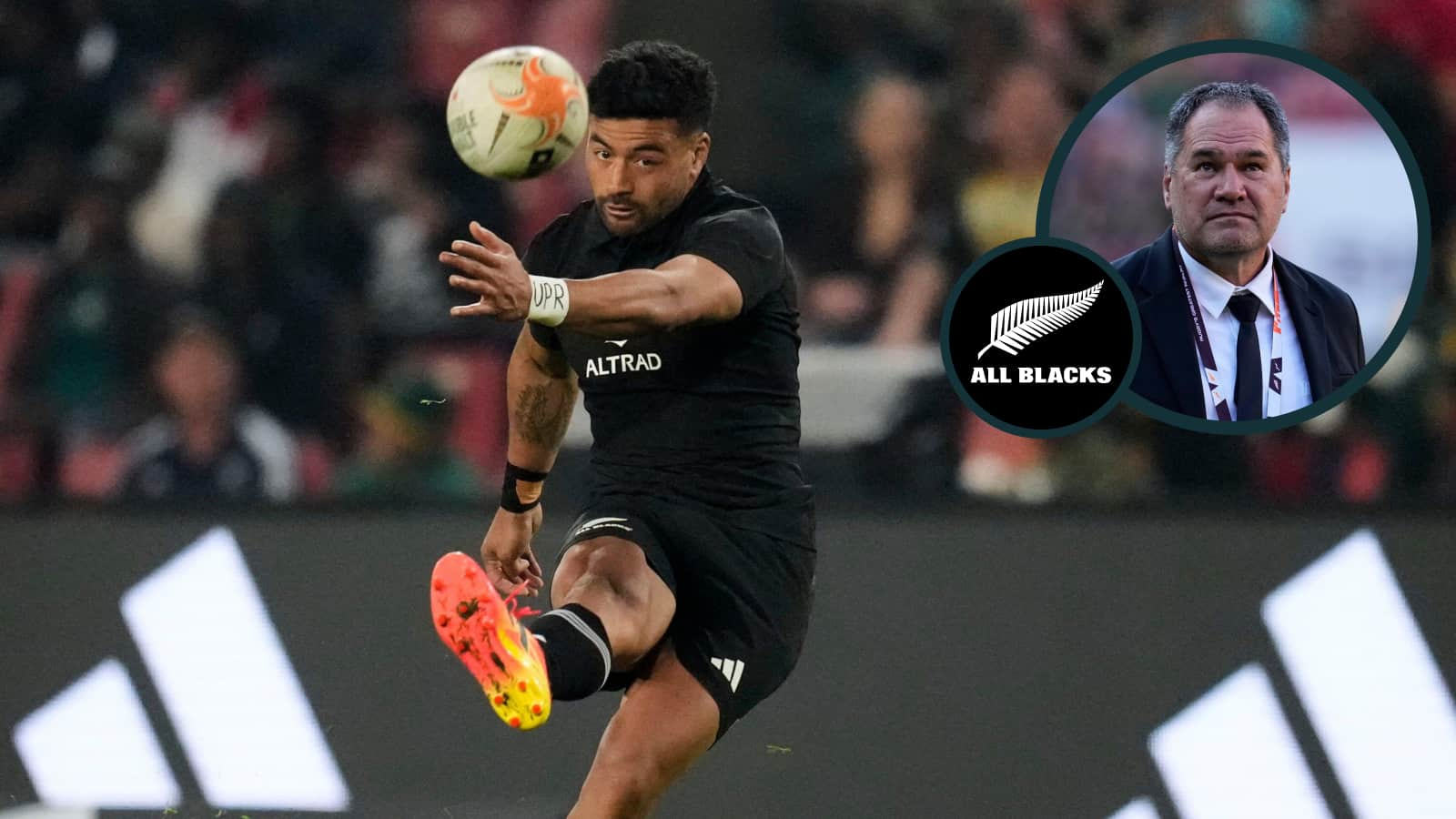
Richie Mo’unga injury leaves All Blacks weighing risk ahead of Nations Championship
All Blacks head coach Dave Rennie has revealed that Richie Mo’unga could miss the upcoming Nations Championship due to the calf issue he sustained last week, forcing New Zealand to reassess both selection and strategy at fly-half.
The playmaker was pencilled in for the opening Bledisloe Cup clash in Auckland but was ruled out after suffering the injury in training. The decision removed one of New Zealand’s most experienced game managers on the eve of a key trans-Tasman Test and has now placed his involvement in the northern tour under serious doubt.
Rennie has brought Mo’unga into camp so the medical staff can manage his rehabilitation closely, and the head coach stresses the fly-half is “progressing well”. Even so, Rennie concedes that Mo’unga may not recover in time to feature in the Nations Championship fixtures against Scotland, Wales and England.
Risk calculation around a six-to-eight-week injury
Rennie has characterised Mo’unga’s calf problem as “potentially a six to eight weeker”, noting that even an optimistic recovery does not guarantee his availability at the start of the tour.
“We brought him (Mo’unga) over, just so our medics can control the rehab. He’s progressing well but that injury is potentially a six to eight weeker,” Rennie told reporters.
“If we got him back in five, which is possible – he’s progressing pretty well – even that would mean he misses the first couple of games on tour.
“We’ve got to weigh up where he’s at and whether we can afford to maybe take him when he can’t play for the first two or three.”
For a touring squad operating under the selection and replacement regulations set by World Rugby, carrying a senior fly-half who is not available for the opening Tests is a significant commitment. Those early matches often shape momentum for the rest of the campaign and influence how much rotation a coach can afford later in the schedule.
McKenzie handed the 10 jersey in Sydney
In Mo’unga’s absence, Damian McKenzie once again starts at 10 in Sydney on Saturday and could retain that role for the end-of-year encounters if he convinces the coaching staff he can steer the side through a full Test window as first-choice playmaker.
McKenzie’s selection underlines the All Blacks’ immediate preference for continuity in decision-making at half-back. With Mo’unga sidelined and the Nations Championship approaching, every Test outing at fly-half becomes a live audition for how New Zealand will manage their attacking shape and territorial game in Europe.
Rennie has acknowledged the limited body of recent work McKenzie has at 10 at this level, pointing out that “Damian’s only had one hit at 10”. The plan, for now, is to keep the spine of the backline stable, rather than introduce further volatility in selection while Mo’unga is unavailable.
Impact of losing both Mo’unga and Ruben Love
The selection puzzle has been complicated by the likelihood that the All Blacks will also be without Ruben Love for the Nations Championship. With both Love and Mo’unga out of contention, New Zealand loses two options who offer contrasting strengths: Mo’unga’s control and experience, and Love’s running threat and versatility.
That shortage of proven fly-halves has immediate knock-on effects for the tour:
- The balance of the backline may tilt towards players who can cover multiple positions, particularly full-back and inside centre, to protect against in-game injuries at 10.
- The coaching staff may be more reluctant to rest McKenzie, potentially increasing his workload across a demanding schedule that already includes Bledisloe commitments and travel.
- Attacking structures built around Mo’unga’s distribution will need to be adapted to suit McKenzie’s different strengths as a playmaker.
Why Josh Jacomb waits despite squad involvement
Given the shortage at fly-half, Rennie was asked directly why Josh Jacomb was not included in the matchday 23.
Jacomb has been part of the wider squad for the past couple of months, featuring against South African franchises during Rugby’s Greatest Rivalry tour, but he has yet to make his Test debut.
“We want consistency. We’re not sure whether Richie’s going to make it back in time for the end-of-year tour and Damian’s only had one hit at 10,” Rennie said.
“We think the majority of the guys out there will get another run. We considered it. He’s likely to tour at the end of the year and get his opportunity.”
Rennie’s comments underline a clear short-term priority: stabilise selection in the immediate Tests, then expand opportunities once the squad reaches the northern hemisphere. For emerging players like Jacomb, that means patience now in exchange for a likely chance to step into a Test match environment later in the season, when travel is settled and combinations are more established.
Fly-half depth still strong despite absences
Even shorn of Love and Mo’unga, Rennie insists the All Blacks still have enough fly-half cover within their current group to complete the Nations Championship without necessarily drafting in another specialist 10.
“I’m not sure if we will take another 10, we would still have three within the group, but it is an option. It may end up being someone who gives us a bit more versatility and covers a few more spots for us,” he said.
That approach reflects a broader trend in modern Test rugby, where squads are built around players capable of covering multiple positions across the backline, particularly in the compressed windows of international competition. With a squad of 34 and “a couple extra” places available for the tour, Rennie has scope either to double down on specialist fly-half depth or lean towards utility backs who can ease pressure across several roles.
Selection meetings focused on availability and balance
Rennie outlined the internal process now under way as the All Blacks refine their touring party for the Nations Championship.
“We do get to take a couple extra on top of the 34 we have here. We had a meeting this morning working through the best-case scenario and trying to get clarity on the guys who are here and who of that group might be available.
“It will become clear. Once we get beyond this weekend and get an idea of hopefully no one injured, we will get an understanding of who’s available and then what that make-up looks like.”
The timing of those decisions matters. The Nations Championship fixtures against Scotland, Wales and England will be played under the global Test window framework, with limited preparation time once the squad arrives in Europe. Finalising the touring group early helps manage player workloads, ensures alignment on game plans and reduces disruption if injuries occur later in the Bledisloe series.
Strategic implications for the Nations Championship
The potential absence of Mo’unga for the full Nations Championship has implications that go beyond one position on the team sheet.
Against Scotland, Wales and England, New Zealand will be confronting teams operating within the structure of the Six Nations and accustomed to high-intensity, set-piece-driven rugby in European conditions. The All Blacks’ choice at fly-half will shape how they manage field position, adapt to local conditions and control tempo over a series of tightly scheduled Tests.
Relying heavily on McKenzie would place creative responsibility on a player whose strengths include attacking flair and broken-field running. Balancing that with the need for territorial discipline and risk management on a northern tour will be a central theme of the coming weeks, especially with Mo’unga’s experience potentially unavailable for part or all of the campaign.
For Rennie and his staff, the next Bledisloe Test in Sydney doubles as both a must-win fixture in its own right and a live examination of whether the current fly-half plan can sustain the pressures of a full international window without Mo’unga at the helm.
