
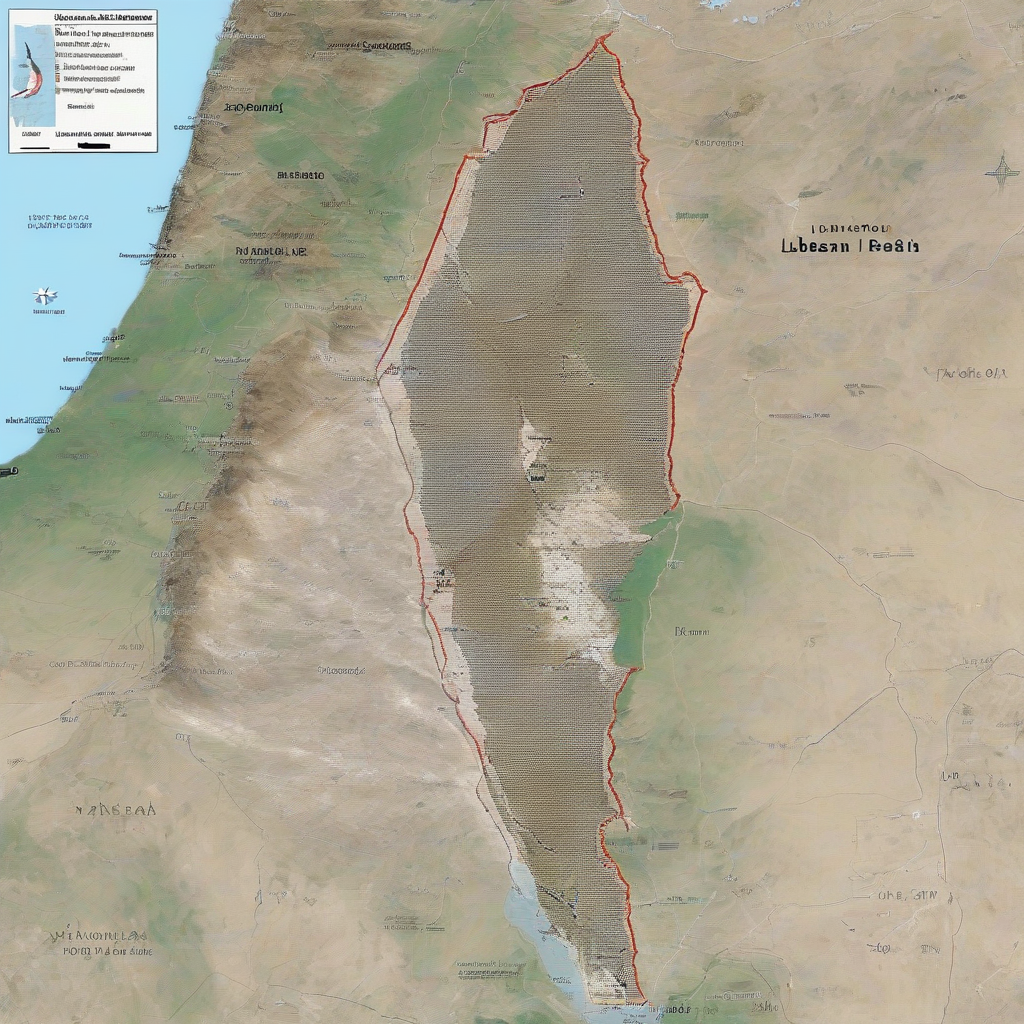
JERUSALEM – Israel published a map on June 18, 2026, detailing an expanded military control zone in southern Lebanon, signaling a refusal to withdraw troops despite a recently signed US-Iran pact intended to end regional hostilities and protect Lebanese sovereignty.
The move marks a significant escalation in diplomatic tensions between Prime Minister Benjamin Netanyahu and US President Donald Trump, as Israel asserts its right to maintain “buffer zones” to prevent Hezbollah rocket fire from reaching northern Israeli towns.
The new map, released by the military on Thursday, shows Israeli forces operating several kilometers deeper into Lebanese territory than previously acknowledged, including areas near the Hezbollah stronghold of Nabatieh, located north of the Litani River.
While Israeli troops had been operating in these expanded sectors for several weeks, the official demarcation in dark red on the June 18 map formalizes the presence. An Israeli military official stated that the military “will continue to remove threats (to) soldiers and the civilians of the State of Israel that are identified beyond the security zone,” indicating that strikes deeper into Lebanon remain a viable operational option.
Tensions Over the US-Iran Pact
The expansion of the control zone directly challenges an interim pact signed on June 17, 2026, between the United States and Iran. The agreement calls for an end to fighting on all fronts and requires all parties to ensure “the territorial integrity and sovereignty of Lebanon,” echoing long-standing language in UN Security Council Resolution 1701, which ended the 2006 Israel-Hezbollah war and mandates respect for Lebanon’s borders.
Israeli officials have expressed anger over the new pact, arguing it fails to sufficiently address concerns regarding Iran’s nuclear program and restricts what they describe as necessary military operations in Lebanon to contain Hezbollah, which is designated as a terrorist organization by the United States and several European governments.
Prime Minister Benjamin Netanyahu stated that while Israel appreciates its relationship with the US, the security of northern Israeli towns must be prioritized.
“This requires maintaining the security strip in southern Lebanon, it requires that we not leave there as long as Israel’s security needs require it,” Netanyahu said, framing the security zone as a defensive measure rather than a territorial claim.
The disagreement has strained the relationship between Netanyahu and President Trump. Trump has criticized the scale of Israeli military actions in Lebanon, specifically questioning the necessity of bombing entire apartment buildings to target Hezbollah militants and warning that disproportionate strikes could undermine broader US diplomatic efforts with Tehran and Arab capitals.
Despite this public friction, there is currently no indication that the US administration will withhold military aid or slow arms shipments to force a change in Israeli tactics. Congressional leaders from both parties have so far signaled continued support for Israel’s security assistance, even as some lawmakers call for tighter oversight of how US-supplied weapons are used.
Hezbollah Resistance and Military Reality
On the ground, Hezbollah has continued to challenge Israeli positions in the south, deploying explosive drones this week that have caused Israeli casualties and underscoring the group’s ongoing ability to operate close to the border.
In a televised address on June 17, 2026, Hezbollah chief Naim Qassem rejected the establishment of any Israeli security zones on Lebanese soil.
“No yellow zones, no red zones, and no green zones. Israel must leave, and it will leave,” Qassem said, portraying the new map as an occupation that violates Lebanese sovereignty and the authority of the Beirut government.
The conflict has resulted in a severe displacement crisis and the destruction of numerous villages since Israel invaded southern Lebanon in March 2026 in response to Hezbollah rocket fire. Lebanese municipal authorities and international agencies report that tens of thousands of civilians have been pushed northward, straining already fragile public services and governance in areas far from the front line.
Strategic Use of Buffer Zones
Israel’s current security policy relies heavily on the creation of “buffer zones”-territories seized in Lebanon, Gaza, and Syria to create a physical barrier between the state and its adversaries. Supporters inside Israel argue that such zones reduce immediate threats to civilians; critics, including some former security officials, warn that open-ended control without a political framework risks entrenching conflict and drawing international censure.
Danny Citrinowicz, a retired Israeli military intelligence officer and senior researcher at the Institute for National Security Studies, described the timing of the map’s release as a deliberate signal.
“By demarcating its zone of control, Israel is saying: ‘We’re going to stay here, this is our place, we’re not going to withdraw from here,’” Citrinowicz said, noting that formal maps can later serve as bargaining chips in ceasefire talks or border negotiations.
Jonathan Rynhold, a senior researcher at Bar-Ilan University, suggested the US-Iran pact may provide some “wiggle room” because Hezbollah is a non-state actor. Rynhold argued that the pact implies Hezbollah should not possess weapons, as such capabilities constitute a threat to the sovereignty of the Lebanese government, potentially allowing Israel and the US to claim they are enforcing Beirut’s own responsibilities under Resolution 1701 rather than undermining them.
The map’s publication also places new pressure on Lebanese state institutions, which have long struggled to assert control in the south. Officials in Beirut face the dual challenge of responding to domestic anger over Israeli operations while managing the political dominance of Hezbollah within the country’s fragmented power-sharing system.
Diplomatic Outlook
The publication of the map occurs just before a round of US-mediated talks between Israel and Lebanon, scheduled for next week in Washington and expected to run in parallel to follow-up discussions on the US-Iran pact. American officials say the talks will test whether the new map becomes a temporary military fact or a starting point for phased withdrawal and security guarantees along the border.
The primary points of contention for the upcoming negotiations include:
- Israel’s Demands: The complete disarmament of Hezbollah or, at minimum, the removal of its medium- and long-range rockets from areas south of the Litani River, alongside verifiable monitoring arrangements.
- Lebanon’s Demands: The full withdrawal of Israeli troops from southern Lebanese territory, accompanied by guarantees that any security arrangements respect Lebanese sovereignty and are implemented through state institutions rather than direct deals with armed factions.
Anonymous Israeli officials have indicated that the possibility of withdrawal remains open if these talks progress toward a resolution on Hezbollah’s disarmament. Diplomats caution, however, that the gap between maximalist demands and what either side can deliver at home is wide-and that any durable arrangement will ultimately have to be anchored in existing international frameworks as well as in a new, more detailed security understanding between Jerusalem and Beirut.
Keep reading
