
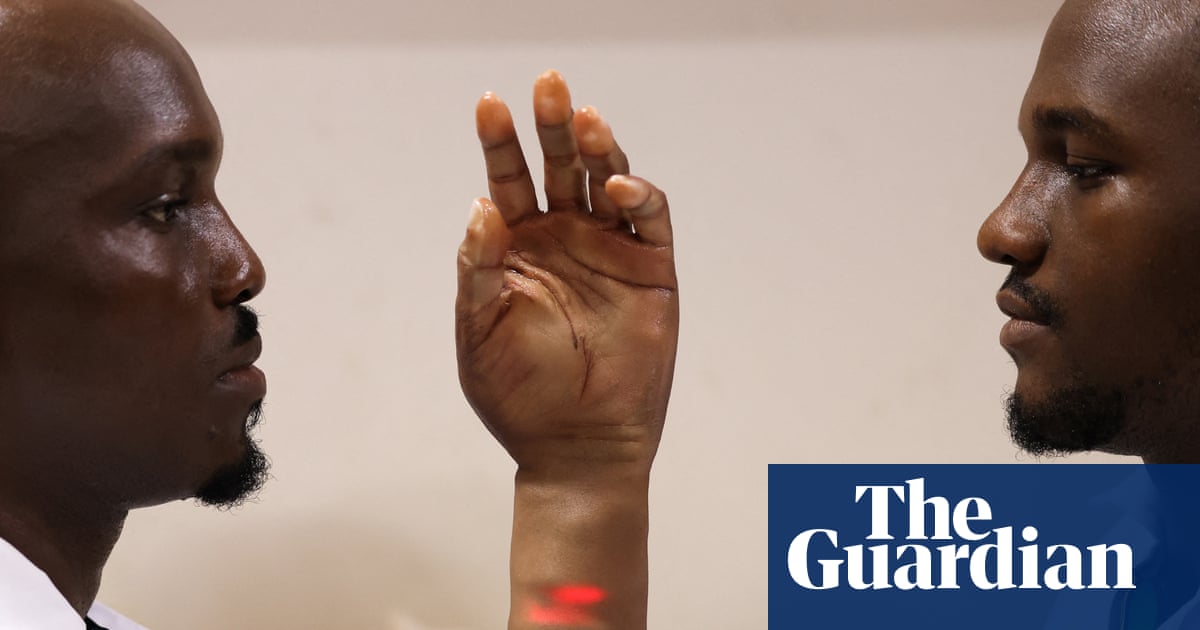
In Uyo, Nigeria, a family project born of injury and improvisation is exposing a structural gap in global health systems: the right to assistive technology that fits people’s bodies, budgets and daily lives. After losing fingers in a fireworks accident, Ubokobong Amanam found that what was on offer neither matched his skin nor his needs. “At first, it was deeply disappointing to realise there were no hyper-realistic or even realistic African-style prosthetics,” he says. “That discovery made me feel worse and intensified my depression.”
Working with his brother John, a former special-effects artist, he helped build a prosthetic hand that looked like his own and set in motion a local enterprise now developing lifelike and bionic devices for amputees across West and Central Africa. “The first thing I discovered is that prosthetics aren’t really made for people like us,” he says.
Designing for bodies that have been overlooked
Across much of the world, assistive products are scarce, unaffordable, or poorly matched to users’ bodies and environments. In Nigeria, estimates suggest as many as 2 million people may need a prosthetic limb, yet imported options are commonly priced far beyond average incomes. This mirrors the global picture, where most people who could benefit from assistive devices still cannot obtain them and where assistive technology is only slowly being integrated into universal health coverage debates.
- Need and access: Nine out of 10 people who require assistive devices such as prosthetics, wheelchairs or hearing aids do not have access to them (Global Report on Assistive Technology, 2022).
- Local reality: Imported prosthetic limbs in Nigeria typically cost $2,000-$3,000; locally developed bionic options remain cheaper than many western models but still out of reach for most households.
- Fit-for-purpose gap: Devices designed for temperate climates and lighter-duty work often fail in heat, humidity, farming, or uneven terrain, raising long-run costs of repairs and replacements.
For users, realistic appearance is not cosmetic indulgence but a matter of dignity, stigma reduction and social participation. As one customer, Emediong Bassey, put it: “It feels like my real leg,” Bassey says. “It’s comfortable and matches my skin tone. Most people don’t even realise it’s not my real leg because it so closely resembles my other leg in colour and shape.” For clinicians and policymakers, that realism speaks directly to adherence: a device that people are proud to wear is a device they are more likely to use.
From special effects to regulated medical product
The Amanam brothers’ company, Immortal Cosmetic Art, now fabricates silicone prosthetics that mirror wrinkles, veins, nails and fingerprints and is developing bionic devices using electromyography to translate residual muscle signals into movement. Each bionic limb sells for about $7,000-less than many high-end international products-while the team has also supplied free devices to more than 10 clients as part of early access efforts and informal compassionate-use schemes.
- Manufacturing approach: Custom silicone molding for lifelike aesthetics; iterative fitting and finishing for comfort and function.
- Mechatronics pathway: EMG-based control architecture designed to be serviceable locally to reduce downtime and shipping dependency for repairs.
- Scale to date: More than 5,000 products produced for clients in Nigeria, Ghana, Côte d’Ivoire and members of the African diaspora.
As the business shifts from workshop innovation to formal medical device production, it must navigate emerging national and regional rules on safety, quality and clinical oversight. That transition-from special effects to regulated health technology-is where individual ingenuity collides with the realities of procurement rules, reimbursement decisions and device-approval processes.
Why coverage lags behind need
Access gaps persist not only because of technology, but because of how health systems are financed and organized. “Assistive technology has often been treated as an optional extra rather than a core part of health services,” Layton says. “But it is essential for access to education, employment and social inclusion.” In many countries, prosthetics sit at the edge of health budgets-classified as appliances rather than enablers of basic rights.
- Financing: Limited inclusion of assistive products in national health benefits packages; high out‑of‑pocket spending; inconsistent insurance coverage for advanced components.
- Procurement: Fragmented purchasing and donor-driven supply that undermines local service networks and long-term maintenance.
- Standards and safety: Variable adoption of quality management systems and device testing; limited post-market surveillance.
- Workforce: Shortages of prosthetists/orthotists and technicians; constrained training pipelines and retention.
- Lifecycle support: Sparse repair services, parts logistics and user training, raising total cost of ownership and abandonment risk.
- Data: Weak national registries and needs assessments impede planning and reimbursement policy.
“Where systems have failed, people tend to be more innovative and flexible in the technologies they develop”
Community-built solutions as public health infrastructure
Experts point to a shift from one‑size‑fits‑all imports to localized design and manufacture that reflect climate, occupations and cultural preferences. “Assistive technology is often designed far from the people who will use it, leading to solutions that are costly, culturally mismatched and hard to maintain,” he says. Locally led engineering can invert that logic. “When technology is developed within communities, it reflects real needs. It becomes more accessible and sustainable.”
For governments under pressure to stretch limited health budgets, such community‑based manufacturing hubs can function as extensions of the public health system-if they are integrated into referral pathways, quality assurance schemes and coverage decisions rather than left to operate at the margins. “This is not by playing catchup. It is a chance for African innovators to redefine what inclusive technology means.”
Access and affordability snapshot
| Context | Need/Access | Typical Cost | Coverage and Constraints |
|---|---|---|---|
| Global | Nine out of 10 people who need assistive devices cannot access them (2022 report on assistive technology). | Varies widely | Devices often excluded or partially covered in health benefit packages; maintenance rarely financed. |
| Nigeria | Data are scarce; unofficial estimates suggest up to 2 million people may need prosthetic limbs. | $2,000-$3,000 for many imported limbs; ~ $7,000 for locally developed bionic models | High out‑of‑pocket burden; imported parts and servicing raise lifecycle costs. |
| United States | Demand influenced by trauma, vascular disease and cancer survivorship. | Advanced bionic limbs can reach tens of thousands of dollars | Coverage varies by insurer; cost-sharing and prior authorization can delay access. |
| India | Large unmet need met partially by low‑cost innovations. | Ultralow‑cost options such as the $45 Jaipur Foot | Affordability trades off with realism and advanced function for some users. |
Policy tools that move markets, not just moments
The policy levers are increasingly clear. Countries that treat assistive technology as part of their obligations under disability and health legislation-rather than as charity-are beginning to rewire how markets behave.
- Include a defined set of assistive products in national health benefit packages, with reimbursement for fitting, training and repairs.
- Pool procurement across public payers and humanitarian programs to stabilize demand and enable local manufacturing contracts.
- Remove tariffs and VAT on critical components and materials while conditioning incentives on compliance with quality systems.
- Fund workforce training and accreditation for prosthetists/orthotists and technicians; recognize new mid‑level roles for maintenance.
- Build community‑level service networks for follow-up, socket refitting and part replacement to reduce abandonment.
- Establish national datasets on need, access and device performance to inform pricing and coverage decisions.
- Support equitable access pathways for rural users, including travel vouchers and decentralized fitting clinics.
Quality, safety and compliance-what good looks like
Behind every hyper-realistic limb is a regulatory story. In many jurisdictions, prosthetics and bionic devices are now classed as medical devices subject to risk-based oversight under regimes such as the European Union Medical Device Regulation, with parallel frameworks emerging in Africa and elsewhere.
| Domain | Frameworks and Practices in Use | Why It Matters for Users |
|---|---|---|
| Priority setting | WHO’s Priority Assistive Products List for essential products within Universal Health Coverage | Focuses public budgets on devices with the greatest population impact. |
| Quality management | ISO 13485 for medical‑device quality systems; documented traceability for custom‑made devices | Reduces variability in fit and function; supports recalls and corrective actions. |
| Mechanical performance | ISO 10328 structural testing for lower‑limb prostheses; durability checks aligned to user weight and activity | Prevents catastrophic failure under local work and terrain conditions. |
| Electrical safety | IEC 60601 series for powered/bionic components and electromagnetic compatibility | Protects users and bystanders; limits interference with other devices. |
| Post‑market vigilance | Incident reporting, corrective actions, field safety notices, and periodic safety updates | Closes the loop between clinics, manufacturers and regulators for continuous improvement. |
Innovation flowing from constrained settings
For some researchers, the direction of travel is changing. “Traditionally, advances have flowed from high-income to low-income countries,” she says. “Now the trend is reversing, as innovations emerge from countries that must think creatively under constraints.” The momentum is not only technical. “Where systems have failed, people tend to be more innovative and flexible in the technologies they develop.”
The Amanam brothers’ work underscores a broader premise: when near‑patient manufacturing and service ecosystems are built into health policy, locally tailored prosthetics become part of the public infrastructure that enables work, schooling and community life. “The effects could reach the global prosthetics industry. If this technology can be produced more cheaply without sacrificing quality or functionality, its market could extend beyond Africa to the world.”
For now, realism and function delivered close to home are doing more than restoring grip and gait. They are challenging a global market that too often excludes the people it is meant to serve-and showing what changes when design begins with the user.
Worth a look
