
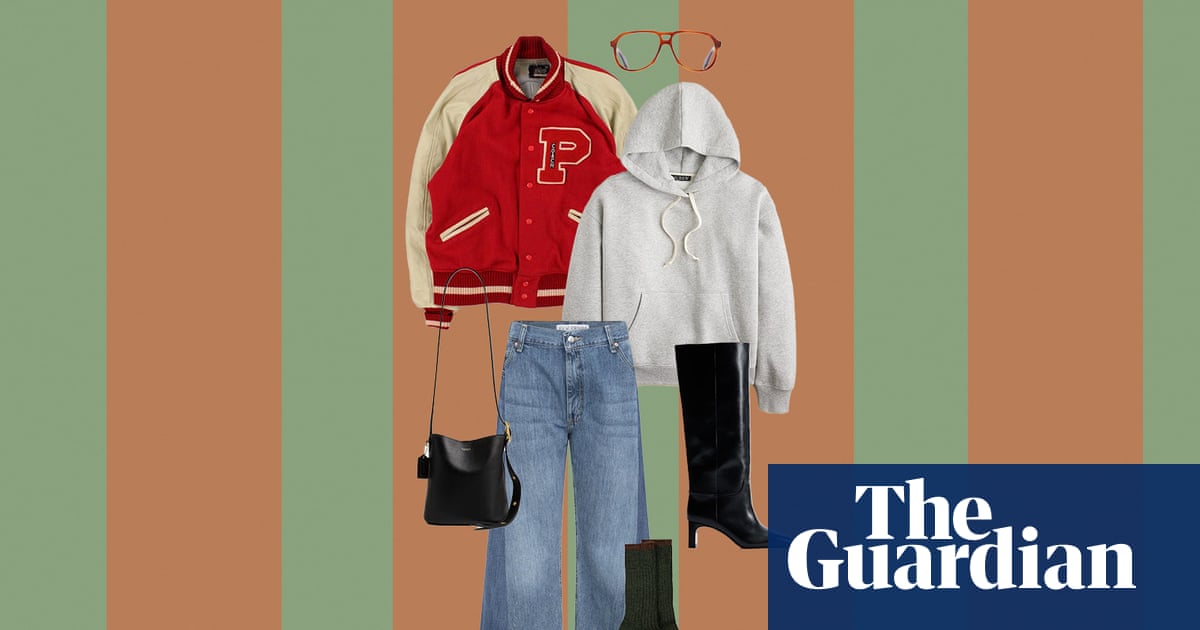
Feb. 6, 2026 – A newly published fashion gallery positioned the hoodie as a workable, public-facing wardrobe component rather than a garment reserved for “travelling or working from home,” presenting three styled outfits built around hooded tops and itemized with brand names and prices.
The feature’s format is explicitly commercial: each look is presented as a PR-credited composite image, with a publisher disclosure that the page contains affiliate links tied to commissions on sales generated through those links. In other words, it sits at the junction of styling advice and direct-response retail.
“We will earn a commission if you buy something through an affiliate link.”
For the entertainment business, that pairing of styling guidance and affiliate commerce sits in a familiar overlap zone: consumer fashion, media publishing, and the wider “screen-to-street” pipeline in which on-screen wardrobes, press-tour appearances, and music merchandising influence everyday buying decisions. While the gallery is not tied to a specific film, series, or tour, it reflects a continuing industrial reality-casualwear has become a default visual language in contemporary culture output, and media companies increasingly treat product curation as a monetizable editorial layer alongside coverage.
Three hoodie-centered outfits, priced and packaged as PR composites
The gallery presents three outfits, each anchored by a hoodie and styled with outerwear, footwear, and accessories. The items and prices are listed in pounds sterling, and the images are credited as PR composites, underscoring that these are constructed, shoppable looks rather than documentary street style.
| Look | Items listed (brand – price) | Listed-price total (added from the itemized prices) |
|---|---|---|
| Bomber + tailored separates |
Bomber jacket (Alpha Industries – £200); Hoodie (J Crew – £110); Glasses (Cutler and Gross – £395); Cami top (River Island – £26); Trousers (M&S – £46); Socks (Finisterre – £22); Plimsolls (Novesta, from Toast – £59) |
£858.00 |
| Long coat + knit hoodie + skirt |
Coat (Poetry – £289); Polo neck (Uniqlo – £19.90); Earrings (Mejuri – £128); Knit hoodie (Jigsaw – £145); Skirt (Zara – £49.99); Boots (H&M – £54.99); Bag (Charles & Keith – £79) |
£765.88 |
| Varsity jacket + zip hoodie + denim |
Varsity jacket (Rokit – £195); Shirt (Gap – £40); Hoodie (H&M – £24.99); Jeans (ELV Denim – £375); Boots (Massimo Dutti – £189); Bag (Coach, from Liberty – £325); Necklace (Rove London – £125) |
£1,273.99 |
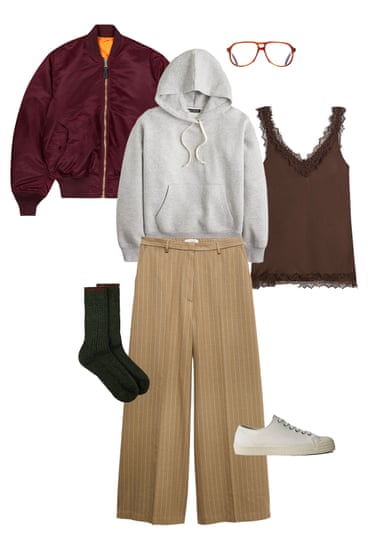
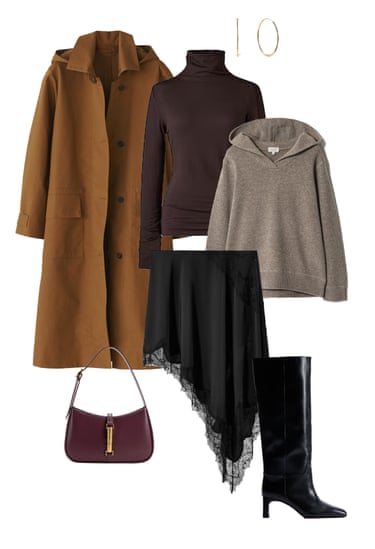
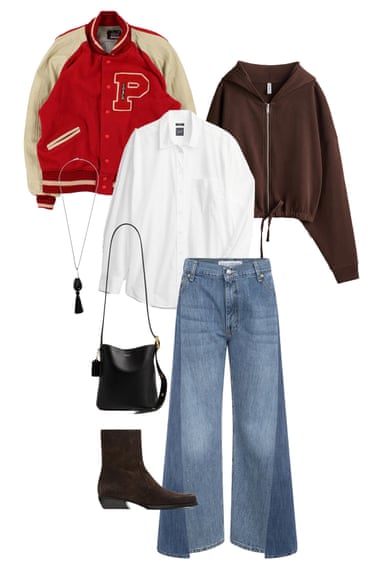
Across the three looks, the pricing spans mass retail and premium accessories. The single most expensive item listed is a £395 pair of glasses (Cutler and Gross), while the lowest-priced item is a £19.90 polo neck (Uniqlo). The spread is part of the editorial point: the hoodie is treated as a baseline garment that can be made “presentable” through framing pieces-coats, jackets, footwear, and accessories-rather than through replacing the hoodie with a formally coded alternative. For readers, the table also functions as a transparent price signal, making the total cost of each styled suggestion immediately legible.
What the styling formula signals about casualwear’s role in culture-facing business
Although the gallery is a consumer fashion item, its underlying logic mirrors how casualwear is handled in entertainment-facing contexts: a garment associated with comfort is repositioned for public visibility through adjacent signals of structure and intent.
In the featured outfits, that structure is supplied by outerwear (a bomber jacket, a long coat, a varsity jacket) and by deliberate contrasts in texture and silhouette (pinstripe trousers, a lace-trim skirt, flared denim). Accessories-eyewear, jewelry, and bags-do the work of “finishing” the look in the way wardrobe departments often use small, readable details to define status, taste, or character without changing the core casual base.
The composites also reveal a second, business-facing layer: a single outfit combines multiple brands at different price points, effectively turning one hoodie-centric concept into a basket of purchasable items. That is consistent with how commerce teams build conversion pathways-encouraging multi-item purchases rather than single-product transactions-and with the broader affiliate marketing model increasingly adopted across fashion publishing and creator platforms.
Affiliate commerce and disclosure as an institutional publishing practice
The publisher’s disclosure that it “will earn a commission” on purchases through affiliate links is not incidental; it is the governance mechanism that frames the page’s commercial relationship with retailers. In media business terms, it places the gallery inside performance marketing infrastructure: product selection becomes monetized not only through audience reach and brand advertising, but through trackable downstream sales. In markets such as the United States and United Kingdom, this kind of affiliate disclosure has also become a regulatory expectation under advertising and consumer-protection rules overseen by bodies including the Federal Trade Commission.
For entertainment companies and talent-adjacent businesses-especially music touring operations and franchise merchandising divisions-the same underlying mechanics are now routine across digital storefronts: curated “drops,” limited runs, and bundling strategies frequently lean on familiar casualwear forms (including hoodies) because sizing is standardized, demand is broad, and the product remains legible on-camera and in social distribution. Affiliate-ready editorial, such as the hoodie gallery, effectively sits upstream of those storefronts, priming audiences with styled use cases before they encounter official merch.
Here, the gallery’s contribution is not a new product launch but a clear demonstration of how a commonplace garment can be repositioned as an all-day item through styling-and then translated into a monetizable set of links, with the commercial terms disclosed upfront. For publishers, this kind of treatment also functions as a live case study in how far fashion coverage can lean into commerce while maintaining explicit labelling for readers.
The hoodie styling gallery is dated Feb. 6, 2026 (01.00 EST), presented as PR-credited composite images, and includes an affiliate-link commission disclosure on the page. Its structure and transparency place it firmly inside the current generation of fashion-affiliate formats used by media outlets and creator platforms alike, in which everyday garments are styled, priced, and linked as a single, trackable consumer journey from screen to checkout.
Keep reading
- Interactive Storytelling and Immersive Audio: How Next-Gen Gaming Engines Are Transforming Contemporary Television Production
- Independent Cinema’s New Distribution Paradigms: How Direct-to-Consumer Micro-Premiers Are Shifting Box Office Dynamics
- Australia investigating Flydubai co-pilot's links to country (globallypulse.com)
- Cocoa Prices Crashed. Why Is Halloween Candy Still So Expensive? (daybreakwire.com)
