
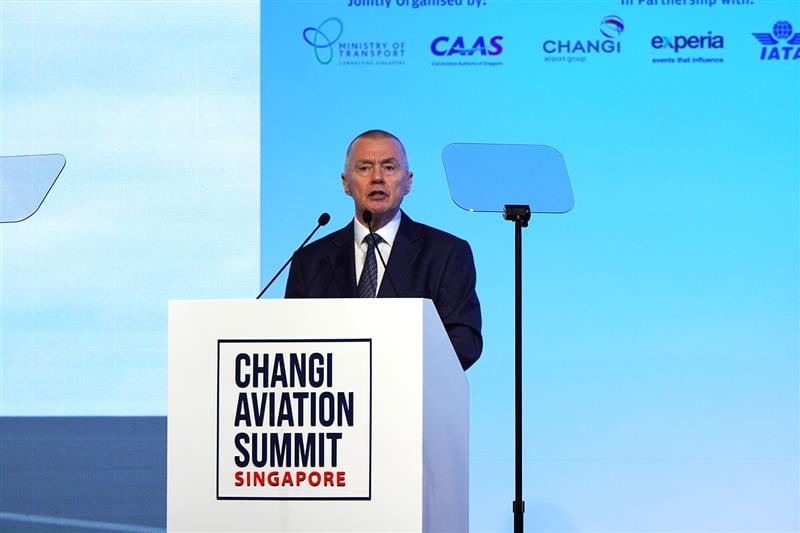
SINGAPORE –
The global airline industry recorded modest recovery gains in 2025 but continues to operate on thin margins and faces mounting compliance and supply-chain costs that will reshape carrier capital plans and fuel purchase strategies, GlobalHeadlinez reporting from the Changi Aviation Summit.
The International Air Transport Association (IATA) said passenger traffic rose 5.3% in 2025, with international revenue passenger kilometers up 7.1% and domestic traffic up 2.5%. Cargo volumes grew 3.4% overall, driven by divergent performance across major trade lanes: Asia-North America fell 0.8%, while Europe-Asia expanded 10.3%. The Asia‑Pacific region led global passenger growth at 7.8% and cargo growth at 8.4%. For 2026, IATA forecasts passenger traffic to rise 4.9% and cargo by 2.4%, with Asia‑Pacific expected to contribute about 7.3% of passenger growth and 6% cargo growth. The association’s full commission is recorded in its report issued in 2025.
Net profitability remains limited. IATA’s figures show industry net profit for 2025 was forecast to be just under USD 40 billion (a net margin of 3.9%), with a projected increase to USD 41 billion in 2026 while operating margin stays near 6.9%. Net profit per passenger in both 2025 and 2026 is projected at USD 7.9. By region, Asia‑Pacific’s operating margin is estimated at just under 5% and net margin at 2.3%, with average profit per passenger at about USD 3 in that region-well below the global mean. The association contrasted these results with 2015, when the industry delivered an operating margin of 8.3% and a net margin of 5.0%, underscoring how far profitability has retreated even as traffic has recovered.
Key metrics and near-term outlook
| Metric | 2025 (IATA) | 2026 forecast (IATA) |
|---|---|---|
| Passenger traffic growth | +5.3% | +4.9% |
| International RPK growth | +7.1% | – |
| Cargo growth | +3.4% | +2.4% |
| Industry net profit (USD) | ~40 billion | 41 billion |
| Net margin | 3.9% | 3.9% |
| Net profit per passenger | USD 7.9 | USD 7.9 |
These figures underline a recurring structural challenge: robust demand growth in passengers and freight is being eroded by cost volatility and constrained pricing power. Passenger volumes are rebounding toward pre‑pandemic patterns, but profitability remains highly sensitive to fuel, maintenance and compliance expenditures that management teams cannot easily pass through to ticket prices.
Supply‑chain disruption, fleet age and operating costs
IATA attributed more than USD 11 billion in additional industry costs since the post‑COVID recovery to supply‑chain disruption, with roughly two‑thirds of that amount arising from higher fuel and maintenance expenses. The association said the average global fleet is about two years older than the long‑term average as carriers deferred or delayed deliveries of new aircraft, increasing fuel burn and maintenance outlays and complicating fleet‑renewal timelines that had been set before the pandemic.
That combination-an older in‑service fleet and higher per‑flight maintenance-has direct budgetary consequences for airline balance sheets and cash‑flow planning. Carriers facing delivery backlogs have limited near‑term options other than heavier maintenance cycles, extended leases, or short‑term wet‑lease arrangements to maintain route capacity, all of which raise operating costs and can weaken balance‑sheet flexibility. For boards and finance committees, these dynamics narrow the room to fund new aircraft orders, digital upgrades and decarbonisation projects simultaneously.
The summit remarks did not name specific manufacturers or airlines but placed the phenomenon in the context of industry‑wide delivery delays and the uneven recovery of supply chains since the pandemic. For aviation regulators and competition authorities, the squeeze on available lift and the reliance on leased capacity also sharpen questions about market concentration in aircraft manufacturing and maintenance and the resilience of critical aerospace supply chains.
Decarbonisation costs and sustainable aviation fuel
Decarbonisation remains a central operational and regulatory focus. The speaker at the Changi Aviation Summit reiterated support for the International Civil Aviation Organization’s long‑term goal of achieving net zero by 2050 and called for continued government backing for the Carbon Offsetting and Reduction Scheme for International Aviation (CORSIA), the global market‑based mechanism agreed by states under ICAO. The scheme, set out in the ICAO CORSIA framework, is designed to address CO2 emissions from international aviation through monitoring, reporting and verification, offsetting requirements and, over time, the use of lower‑carbon fuels.
“I think it’s incumbent on all of us to continue to support CORSIA as the single market-based carbon offsetting mechanism to address CO2 from international aviation.”
Using current prices for eligible offset units under CORSIA, the association estimates additional industry costs of about USD 60 billion through 2035 to meet obligations under the mechanism. Those outlays will sit alongside national and regional climate policies-from fuel mandates to airport‑level environmental charges-that are beginning to feed into airline cost bases and, ultimately, fare and freight‑rate decisions.
Concurrently, sustainable aviation fuel (SAF) production underperformed earlier expectations: IATA reported SAF output of 1.9 million tonnes in 2025, equal to just 0.6% of total jet fuel consumption and constituting a downward revision from prior estimates. The address linked mandates and price dynamics to the shortfall, noting that SAF prices exceed fossil jet by more than two times on average and can be up to four times higher in markets with binding mandates-factors that have discouraged voluntary uptake and dampened planned production.
Those figures have practical implications for airline procurement strategies and capital allocation. Where SAF mandates exist or are strengthened, carriers will need to secure higher‑cost fuel supplies or purchase compliance credits, both of which will squeeze operating margins unless offset by subsidies, tax incentives, or coordinated policy measures that reduce the price delta with conventional jet fuel. The balance of responsibility between airlines, fuel suppliers and governments-via long‑term offtake contracts, production incentives and clear timelines-will be central to whether SAF volumes can scale without undermining the industry’s already thin profitability.
Trade lanes, regional performance and strategic implications
The diverging cargo performance across the major lanes signals shifting trade patterns. A contraction in Asia-North America volumes alongside a double‑digit expansion on Europe-Asia routes suggests reorientation in supply‑chain routing and customer demand, including manufacturers’ efforts to diversify production bases and inventory hubs. For airlines and freight integrators, that implies reallocation of freighter capacity and network adjustments that may include frequency changes, capacity rebalancing and cargo pricing reforms to reflect new centres of demand.
Regionally, Asia‑Pacific’s stronger passenger and cargo growth-coupled with substantially lower profit per passenger-points to intense competition and capacity expansion in markets where yields remain under pressure. Carriers in the region will face the twin task of expanding network reach while managing lower unit economics and elevated compliance costs related to decarbonisation. Policymakers in key aviation markets will have to weigh slot policy, airport‑expansion decisions and consumer‑protection rules against the financial resilience of home‑market carriers and their ability to invest in cleaner fleets.
The summit address contained no new regulatory decisions; it reiterated the industry’s preference for a single, internationally coordinated market‑based mechanism rather than a patchwork of regional schemes, and underscored the financing opportunity CORSIA presents to mobilise funds for mitigation. For governments, the message was that stable, predictable global rules are now a prerequisite for airlines to commit to multi‑billion‑dollar fleet and fuel investments that will run through the 2030s and beyond.
The IATA‑commissioned assessment of post‑COVID supply‑chain costs and the SAF production shortfall together set the operational and fiscal parameters carriers will need to factor into network planning, fuel hedging and fleet renewal timelines. Taken as a package, the data frame the next several years as a period in which governance decisions-on climate, competition and industrial policy-will be as important to the sector’s trajectory as passenger demand.
Industry figures presented at the summit:
- 2025 passenger growth: 5.3%; international RPKs: +7.1%; domestic: +2.5%.
- 2025 cargo growth: 3.4%; Asia-North America cargo: −0.8%; Europe-Asia cargo: +10.3%.
- 2025 SAF output: 1.9 million tonnes (0.6% of jet fuel consumption).
- Estimated additional industry cost from supply‑chain disruption since recovery: >USD 11 billion.
- Estimated industry CORSIA compliance cost through 2035: ~USD 60 billion.
The association’s data leave carriers and policymakers with immediate choices on capacity deployment, fleet renewal timing, SAF procurement pathways and the structure of market‑based compliance. IATA’s forecasts project passenger traffic growth of 4.9% in 2026 and an industry net profit of USD 41 billion, SAF supply at 1.9 million tonnes in 2025 (0.6% of jet fuel), and an estimated USD 60 billion in CORSIA costs through 2035 as the confirmed near‑term financial and regulatory baseline against which airline strategies-and public‑policy responses-will now be tested.
Worth a look
