
Carlton’s bold new identity survives Geelong scare as ARC debate reignites
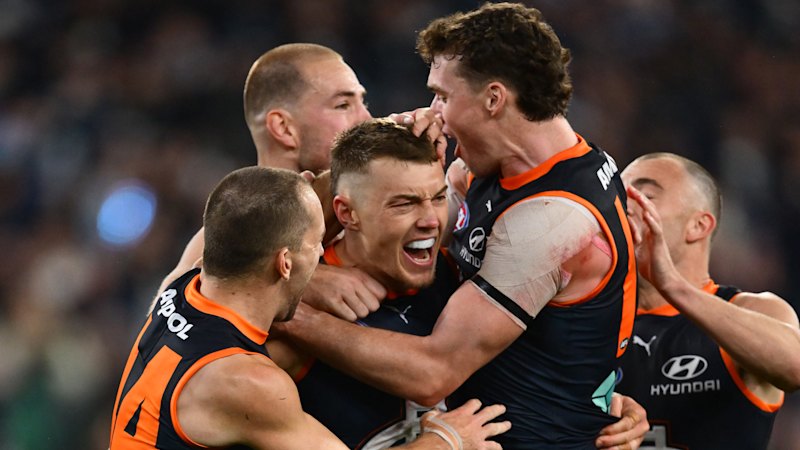
Carlton’s metamorphosis under caretaker coach Josh Fraser has gone to another level, with the Blues holding off premiership hopefuls Geelong in a Friday night thriller at the MCG.
What began as another ominous night against one of the competition’s heavyweights quickly became the latest piece of evidence that Carlton’s season – and perhaps their future – is being reshaped before the eyes of the football world.
ARC policy change meets its first major flashpoint
The decision of goal umpire (and former Richmond, Port Adelaide and Melbourne star) David Rodan not to go to a score review for what should have been Ollie Dempsey’s game-opener will be a major talking point for the weekend.
Last month, after more than 30 seconds of play were scrubbed from a game following an incident involving St Kilda star Rowan Marshall in which he was deemed to have taken a mark before the ball crossed the behind line, the AFL changed the rules around ARC reviews.
AFL football operations boss Greg Swann – citing the delay to the game (nearly a minute all-up) – announced that the ARC would no longer overrule a goal umpire’s decision, unless the goal umpire had called for a review.
In practice, that means the goal line technology in the ARC bunker can only be used when the on-field official is uncertain. In a competition decided by tight margins and percentage over a 23-round home-and-away campaign, that recalibration of authority back to the goal umpire will shape not only results, but potentially finals seedings.
Rodan’s call in this match instantly becomes one of the first high-profile stress tests of that framework, and will feed into ongoing discussion about how the AFL balances game flow, accuracy and the centralisation of officiating decisions.
Fraser’s Carlton leans into risk – and gets rewarded
After conceding four of the first five goals and appearing in danger of being overwhelmed by Geelong’s relentless early pressure, the Blues responded with a brand of football that has become increasingly recognisable under Fraser: daring ball movement, aggressive rebound from half-back, and a willingness to take the game on through the corridor.
The result was a stirring victory that would have been difficult to imagine only a month ago.
Carlton looked a completely different team after quarter-time.
Where the Blues had often appeared stagnant and predictable under pressure earlier in the year, Fraser’s side repeatedly sliced through Geelong’s defensive set-up with speed and confidence.
For a club that has spent recent seasons wrestling with expectation and scrutiny, backing in an attacking identity against a hardened contender is not simply a tactical shift; it is a statement about where this playing group now believes it sits in the premiership conversation.
Hayward’s revival and Smith’s rise reshape the midfield mix
The transformation was perhaps best embodied by Will Hayward, whose career has been revitalised since arriving at Ikon Park.
Hayward was electric throughout, providing energy, class and composure whenever the game threatened to swing Geelong’s way. His work rate up the ground and ability to impact in transition continually stretched the Cats and helped Carlton maintain scoreboard pressure.
But the emergence of Jagga Smith is becoming one of the stories of the season.
The young midfielder produced another performance that suggested he is rapidly becoming far more than just a promising prospect.
Smith dominated periods of the contest around stoppage, repeatedly bursting from congestion and driving Carlton forward. His poise with ball in hand belied his age, while his willingness to take territory and attack the corridor reflected the confidence currently surging through the Blues.
Alongside the established stars in Carlton’s midfield, Smith looked every bit at home on the biggest stage.
For a list that has long leaned on senior leaders, the combination of Hayward’s rejuvenation and Smith’s rapid development gives Carlton a far more varied midfield profile – with clear implications for how they can rotate through the centre square later in the season and into any finals campaign.
Geelong’s threats keep the contest on edge
The Cats refused to disappear.
Premiership contenders do not win four straight games and entrench themselves near the top of the ladder without possessing genuine resilience, and Chris Scott’s side repeatedly threatened to steal the match.
Jeremy Cameron did not enjoy his most prolific evening, but his presence loomed over the contest from start to finish. He kicked four, but it could’ve easily been seven.
Every time the ball entered Geelong’s forward 50 there was a sense Cameron could change the game with a single moment.
Even on a relatively quiet night by his lofty standards, Carlton’s defenders could never afford to relax.
The same applied to Bailey Smith.
With his trademark headband, flowing blond hair and trademark running power, Smith at times cut Carlton apart.
Whenever Geelong appeared trapped in congestion, Smith seemed capable of creating something from nothing.
His ability to carry the ball through traffic repeatedly generated dangerous forward-half opportunities and threatened to drag the Cats back into the contest.
For long stretches he looked like the player most likely to determine the result.
That Geelong still found ways to threaten, despite Cameron’s inaccuracy and Carlton’s territorial dominance after quarter-time, underlines why this performance will be read around the league as more than a one-off result. Beating a side with that level of firepower is a meaningful reference point for any club with ambitions in September.
Defence as launchpad for Carlton’s new game
Yet Carlton continually found the answers.
The Blues’ half-back line was outstanding.
Time and time again they repelled Geelong attacks before launching their own waves of offence, turning defence into attack with a boldness that has become increasingly synonymous with Fraser’s tenure.
The shift has been remarkable.
Only weeks ago Carlton looked a side weighed down by expectation and uncertainty.
Now they are playing with freedom.
Players are taking risks.
Young talent is flourishing.
And perhaps most significantly, the Blues are beginning to look like a team enjoying their football again.
In a competition as tightly compressed as the AFL, where a single win can dramatically alter the complexion of a season, this kind of performance does more than bank four points. It hardens belief in a coaching voice, accelerates the growth of emerging players such as Jagga Smith, and signals to opponents that Carlton’s resurgence is built on structure and conviction rather than short-term emotion.
Keep reading
