
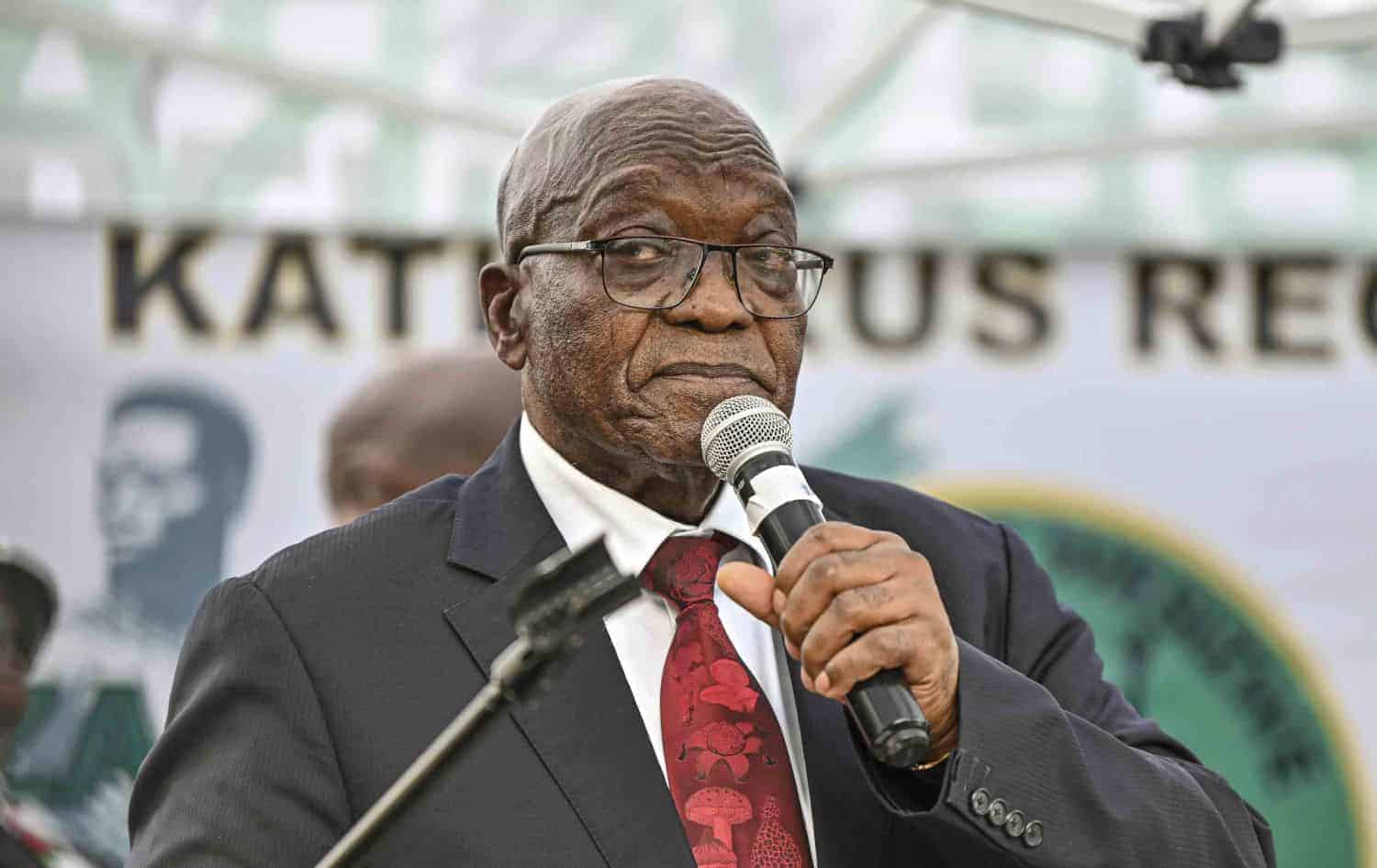
POLOKWANE – Former South African president Jacob Zuma, now leader of the uMkhonto weSizwe (MK) party, is expected to visit the family home of Economic Freedom Fighters (EFF) leader Julius Malema in Seshego, Polokwane, on Friday, March 20, 2026, to pay his respects following the death this week of Malema’s aunt, Mme Martha Motlanalo Malema. He will be accompanied by MK party officials, members of the party’s presidential task team and an MK member of parliament, according to the party.
The EFF described Mme Martha as a pillar of family and community life in Limpopo, noting her decade-long activism inside the movement. “She was characterised by a deep sense of love not only for her family, but also for those in her community. Her love for her community is best expressed by her undying commitment to the EFF, of which she had been a staunch member in good standing since its formation in 2013. She played an important role in the growth and strength of the organisation in Ward 13, Seshego, a ward that is today led by an EFF councillor,” the party said.
The condolence visit brings two of South Africa’s most prominent-and often adversarial-political figures into a rare moment of shared mourning. Malema’s EFF, founded in 2013, remains a national opposition force, while Zuma’s MK party, which surged into Parliament after the 2024 general election, has redrawn the country’s political map and is now a central fixture of opposition politics in the National Assembly. The encounter will unfold within the constitutional framework of a multi‑party democracy that allows former and current political leaders to occupy competing roles in Parliament while still observing common social and cultural rituals of respect.
Community roots in Seshego
Mme Martha’s political engagement was closely tied to Seshego’s Ward 13-Malema’s home base-where the EFF consolidated support in recent municipal contests. The ward remains under EFF representation after a 2025 by‑election, underscoring the movement’s entrenched grassroots machinery in and around Polokwane and the role of local councillors in mediating basic service delivery, protest, and party organisation at street level.
Her activism in Ward 13 also reflects how national political brands are anchored in specific communities: Seshego has long served as a proving ground for Malema’s influence inside Limpopo, and EFF structures there have frequently been used to test mobilisation strategies later deployed in provincial and national campaigns. In that sense, Zuma’s decision to travel to Malema’s home turf, rather than receiving the EFF leader in a neutral venue, is symbolically significant for both parties’ rank‑and‑file supporters.
National tributes for Nicholas “Fink” Haysom
South Africa is also marking the passing of Nicholas Roland Leybourne “Fink” Haysom, 73, the anti-apartheid lawyer who served as chief legal and constitutional adviser to President Nelson Mandela and later became one of the United Nations’ most seasoned envoys. He died this week in New York. In a statement, President Cyril Ramaphosa said he was “saddened” by Haysom’s death and praised his role in advancing peace and constitutionalism at home and abroad, noting that Haysom helped translate the promises of South Africa’s democratic settlement into the daily work of governance and public administration.
“Today we mourn a distinguished diplomat and a pioneer of our democratic administration whose commitment to justice and peace made our country, our continent, and the world a better place.
“As we commemorate Human Rights Month, we pay tribute for Fink for his dedication to human rights and the dignity of all people in all the parts of the world where his guidance was deeply respected and sought-after,” Ramaphosa said.
UN Secretary‑General António Guterres hailed Haysom as a tireless peacemaker whose legacy would endure “in the peace processes he advanced [and] the institutions he strengthened,” reflecting the diplomat’s decades of service in some of the world’s most fragile arenas, from post‑conflict constitution‑making to complex power‑sharing negotiations.
A career that bridged South Africa’s transition and UN crisis diplomacy
Haysom’s public life spanned South Africa’s democratic transition and multiple UN crisis postings, linking the country’s own constitutional journey to broader debates about international norms and state-building. As chief legal and constitutional adviser in President Nelson Mandela’s office from 1994 to 1999, he was closely involved in implementing the 1996 Constitution, the supreme law that underpins South Africa’s system of checks and balances, the separation of powers and a justiciable Bill of Rights, and that continues to frame disputes over executive power and coalition governance.
- Chief legal and constitutional adviser in Mandela’s office (1994-1999), contributing to the implementation of South Africa’s post‑apartheid constitutional order and advising on the legal architecture of transitional institutions.
- Head of the Office of Constitutional Support within the UN Assistance Mission for Iraq (UNAMI) (2005-2007), followed by senior political responsibilities at UN headquarters, where he helped navigate tensions between domestic political actors and international standards.
- Deputy Special Representative (2012-2014) and then Special Representative of the Secretary‑General for Afghanistan, leading UNAMA (2014-2016) during a fraught period of electoral transition and insurgent violence.
- Special Representative for Somalia and head of UNSOM (2018-2019), working amid persistent insecurity and institutional fragility.
- Special Representative for South Sudan and head of UNMISS from 2021 until his death, regularly briefing the UN Security Council on the country’s halting implementation of a peace agreement and the risks of backsliding ahead of planned elections.
Haysom’s path-from human‑rights law in South Africa to negotiated settlements in Burundi and Sudan, and sensitive constitutional work in Iraq and Afghanistan-made him a sought‑after mediator in conflicts where constitutional design, elections and reconciliation intersect. His career embodied a distinctly South African export: using lessons from the country’s negotiated transition to support fragile states wrestling with questions of inclusion, amnesty, federalism and security‑sector reform.
Cross‑currents of grief and politics
Zuma’s condolence call at the Malema family home unfolds against a polarized political backdrop. The MK party vaulted into national prominence in 2024, winning 58 seats and becoming a principal opposition force in a hung Parliament-while the EFF maintained a significant national footprint. Both operate within a proportional representation system that has fragmentised the National Assembly and forced the governing African National Congress into coalition talks at national and provincial level.
In that context, the optics of leading rivals observing a traditional condolence visit are likely to resonate beyond Polokwane. The moment underscores how South Africa’s political culture, shaped by liberation movements and codified within its constitutional democracy, still recognises personal bereavement as a space where hostility is briefly set aside. It also highlights the complex web of relationships among opposition leaders who may clash over policy, corruption allegations and coalition alignments, yet remain bound by shared histories in the anti‑apartheid struggle and, increasingly, by the institutional pressures of governing in a fragmented legislature.
Status: Zuma’s visit to the Malema home is scheduled for Friday, March 20, 2026; formal funeral details for Mme Martha Motlanalo Malema have not been announced. The United Nations and the South African Presidency have confirmed Haysom’s death and issued tributes, while South Africa’s constitutional and diplomatic institutions continue to absorb the loss of one of the legal architects of the post‑1994 order and a key figure in global peace diplomacy.
