
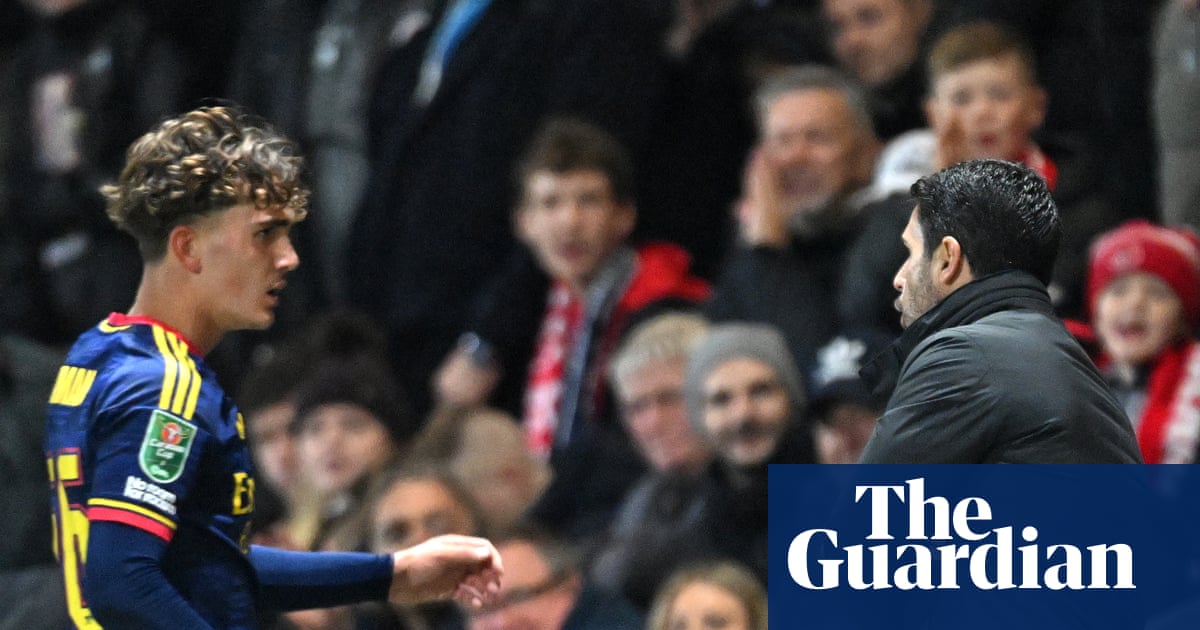
Max Dowman’s red card exposes fault line in Arsenal’s youth revolution
Mikel Arteta’s body language arrived a split second before the referee’s card. As Max Dowman trudged towards the touchline after becoming the youngest player sent off in a League Cup match at 16 years and 300 days, the Arsenal manager’s reaction framed the story as much as any replay.
Arms folded tightly across his chest like a parent catching a teenager sneaking in after midnight, Arteta leaned over the technical area and directed a few terse words at the forward before he disappeared down the tunnel. The exact phrasing remains unconfirmed, despite the efforts of amateur lip-readers on social media, but “Get in the changing room. Now,” has emerged as the most likely interpretation of the brief exchange.
The flashpoint in Fleetwood
There is little doubt Arteta had formed a clear view of the incident that ended Dowman’s night and, ultimately, Arsenal’s League Cup run. The dismissal followed Dowman’s reaction to an overaggressive sliding tackle from Fleetwood’s Harrison Neal during the fourth-round tie, which Arsenal went on to lose on penalties to a League Two side 84 places below them in the English football pyramid.
Arteta has said Arsenal intend to appeal the decision and indicated in a television interview after the match that he wanted to review the footage before “assessing the situation”. Yet, in his post-match press conference, there was no attempt to shield Dowman from blame. When asked directly about the touchline confrontation, Arteta made clear this was an issue of discipline and preparation as much as interpretation.
“It was something that we discussed before the game,” he said. “We knew when we prepared the context of the match, we were very clear on the things to expect, the things that emotionally we have to dominate.”
Whether Dowman’s response merited a straight red card remains contentious. The teenager’s reaction involved him lifting his right knee towards Neal with minimal visible force. Referee Michael Salisbury could have opted for a more conciliatory route – booking both players and defusing the situation – particularly when set against other recent incidents, such as Cole Palmer’s yellow card for barging Tottenham’s Matheus Fernandes off the ball in a more obviously forceful clash.
But history rarely smiles on gestures of petulance. From Wayne Rooney’s tangle with Ricardo Carvalho to David Beckham’s flick at Diego Simeone at World Cups gone by, any movement perceived as retaliatory tends to be met harshly by officials. Dowman, like those before him, was judged to have crossed that line.
A teenager learning the professional game
This is not the first time Dowman has been drawn into disciplinary controversy in his short career. Only last month he was sent off while playing for England Under-19s against the USA after a poorly timed tackle in a behind-closed-doors match. Witnesses at that game viewed the decision as harsh and highlighted a series of physical challenges Dowman had already absorbed before the red card.
The pattern is one Arteta has publicly acknowledged. Last year he revealed Dowman was fouled nine times in the first half of an England Under‑19s game against Spain, urging the youngster to look at how Bukayo Saka had learned to absorb persistent fouling without losing emotional control. It was a warning that as Dowman’s profile grew, so too would the provocation.
Max Dowman is the centre of attention for Fleetwood’s players after the teenager’s reaction to a tackle from Harrison Neal. Photograph: Ryan Browne/Shutterstock
Arteta has been consistent on that theme. “It’s going to happen, he’s going to have to learn when to release the ball and when to attract his starting position,” he said earlier in the season. “Very similar to Bukayo in the beginning as well. Those players are going to attract players, contact, attention and they have to be very smart about when you want that contact and when you don’t want it, and what you have to do to avoid it.”
Asked more generally about Dowman’s temperament, Arteta has spoken of a player who rarely indulges in theatrics. “He just gets up … very rare! Sometimes I get surprised emotionally how cool he can be. I think it’s about repetition. He’s so used to it that now he knows to let the referee deal with it and my teammates probably to defend me, and I will carry on playing.”
The events at Fleetwood cut directly against that established image and will now shape how referees, opponents and even some teammates view Dowman in the short term.
Officiating thresholds and disciplinary risk
The red card also throws a spotlight on how referees interpret retaliation under the Laws of the Game overseen by the International Football Association Board. Violent conduct does not require excessive force; it hinges on intent and the act being deemed aggressive or brutal, even when minimal contact is made.
In practical terms, that means gestures that may appear minor in isolation can still be punished severely if officials conclude they are retaliatory. Comparisons with other incidents – like Palmer’s booking against Tottenham – are inevitable, but disciplinary frameworks are built around what the referee sees in real time and how they interpret a player’s intent. Once an act is categorised as violent conduct, a straight red becomes the mandated outcome and carries an automatic suspension unless successfully appealed under the competition’s regulations.
For Arsenal, this exposes a risk that extends beyond one cup tie. A young forward already flagged in officials’ minds for previous dismissals may find marginal 50-50 calls drifting against him. For a teenager still calibrating his decision-making at elite speed, that is a delicate balance to manage.
Immediate consequences for Arsenal’s season
If Arsenal’s appeal against the decision is unsuccessful, Dowman faces a three‑match domestic suspension. That would rule him out of a trip to Liverpool and home games against Hull and Newcastle – a demanding run at any stage of the English season, let alone one shaped by injuries and squad rotation.
The timing is particularly awkward for Arteta. A thigh injury to Bukayo Saka, expected to keep the winger out for several weeks, had opened the door for Dowman to feature more regularly in the Premier League. Noni Madueke, another attacking option, did not travel to Fleetwood because of an ankle issue, further depleting resources in wide areas and heightening the strategic value of Dowman’s availability.
Arsenal are therefore confronted with a layered problem:
- Short-term: reduced attacking depth for key domestic fixtures if the suspension stands.
- Medium-term: a need to recalibrate Dowman’s integration plan without rushing him or overcorrecting his playing style.
- Long-term: ensuring one high-profile incident does not fix his reputation with referees as a player prone to retaliation.
From record-breaker to first major setback
That these questions surround a player still technically a school-age teenager underlines how quickly Dowman has been accelerated through elite football. He became the first 15-year-old to appear in the Champions League last season, a landmark that instantly propelled him into the global spotlight. In March he then broke the Premier League’s youngest goalscorer record with a goal against Everton, underlining why Arsenal regard him as one of the standout prospects from their Hale End academy in recent years.
Dowman has trained with the first team since he was 14, a sign of both his talent and the club’s confidence that he could cope with that environment. Yet Arsenal have been cautious about his competitive exposure, keen to avoid the physical and psychological overload that can accompany rapid promotion. Even after he scored twice against Ipswich in the previous Carabao Cup round, Arteta resisted the temptation to dramatically increase his league minutes.
This red card at Fleetwood therefore represents the first major on‑field setback of his senior career. For a club that has invested significant care in managing his transition, it marks a new phase: the point where development stops being a smooth upward curve and begins to include the reality of criticism, opposition targeting and public scrutiny at a global scale.
Arteta’s touchline rebuke and the wider message
When the immediate shock of a cup exit to lower‑league opposition fades, Arteta may review not only Dowman’s reaction but his own. His public admonishment of a 16‑year‑old, in full view of cameras, has already drawn criticism. Former Arsenal midfielder Paul Merson, among others, has questioned whether the manager would handle that moment differently given another chance.
Arteta’s frustration is understandable on several levels. Arsenal’s exit from a domestic cup removes a pathway for controlled minutes for fringe and emerging players, precisely the environment in which Dowman has been eased into senior football. It also denies Arsenal an additional competition in which to share the load on a squad already managing injuries.
Yet the incident has also sent a loud message – to Dowman, to the dressing room and to opponents. Internally, it reinforces Arteta’s insistence that emotional control is non-negotiable, regardless of age. Externally, it may encourage rivals, especially physical defensive units, to test Dowman’s composure further, knowing one misjudged reaction could result in another numerical advantage.
A pivotal test of development, not destiny
For all the noise around Fleetwood, this moment does not define Dowman’s career. Elite football is crowded with examples of prodigiously talented players who endured early disciplinary controversies before maturing into leaders and consistent performers. The challenge now is how club and player respond.
From a development standpoint, this episode forces several adjustments:
- Coaching staff must refine how they prepare Dowman for targeted physical attention, both in training scenarios and match-specific briefings.
- The player must recalibrate his instinctive responses in flashpoints, learning when to disengage rather than retaliate, however mildly.
- Arsenal’s hierarchy must balance protection with accountability, avoiding both public scapegoating and the perception that standards are being relaxed for a young star.
In practical terms, Dowman now moves from being simply a record-breaking curiosity – the 15‑year‑old Champions League debutant, the youngest Premier League goalscorer – to a case study in whether a modern superclub can successfully manage a teenager through the realities of senior football: hostile atmospheres, physical targeting, split‑second disciplinary jeopardy and unrelenting scrutiny.
How Arsenal handle this period, and how Dowman responds to the extra attention on and off the pitch, will help determine whether Fleetwood is remembered as a footnote in a long career or the night that forced a generational talent, and his club, to grow up faster than planned.
Keep reading
- Marco Borriello on Juventus: Leadership Void and the Limits of Managerial Change
- Mohamed Salah to Have Street Named After Him in Trabzon’s Yomra Municipality
- Arsenal Target Paris Brunner, per VoetbalNieuws.be and TEAMtalk (archysport.com)
- Women's Rugby League World Cup: England crush debutants Wales in Perth (globallypulse.com)
