

Caldentey’s late penalty caps dramatic night for English clubs in Women’s Champions League
Mariona Caldentey’s second-half stoppage-time penalty secured Arsenal a dramatic 1-0 win over Danish side HB Koge to open their Champions League campaign at Meadow Park, on a night when Manchester City also showed resilience to take a point away to Bayern Munich.
The group-stage fixtures sit under the jurisdiction of UEFA, with both English sides using their opening matches to underline squad depth and mental toughness in a competition where fine margins often shape qualification prospects and future seeding.
Arsenal’s rotated side leaves it late against HB Koge
There were wholesale changes for Gunners boss Renee Slegers, who inserted eight different faces into her starting line-up from Sunday’s 1-1 Women’s Super League draw with Manchester United. That level of rotation in the opening European fixture underlined Arsenal’s intent to manage workloads across domestic and continental campaigns while still trusting the broader squad to take responsibility.
Chloe Kelly had the ball in the back of the net in the first half, but the England forward’s would-be opener was disallowed following a VAR check. Greek referee Eleni Antoniu was called to the monitor after Kelly beat Alberte Vingum in the 12th minute, but it was chalked off after it was determined Stina Blackstenius had been offside in the build-up. The decision highlighted the growing influence of video review in elite women’s competitions and the need for forwards to play on the edge of defensive lines without overstepping.
Arsenal, who had lacked end product throughout, were gifted an opportunity when Selina Cerci was brought down and substitute Caldentey secured all three points with a bottom-corner finish. In a tight group format, turning a frustrating performance into maximum points at home is often the difference between advancing and falling into a chase for second place.
Arsenal pressure eventually tells
Maanum drew another save in the 25th minute, with the game rarely venturing outside the visitors’ half until Macy Schultz’s deflected effort drifted towards the crossbar. That spell underlined Arsenal’s territorial dominance but also their difficulty in converting it into clear chances.
There was a cross-shot from Maanum, who could not connect with a team-mate, before a Kyra Cooney-Cross effort also drifted wide. Blackstenius was replaced by Alessia Russo after the break and there were a couple of Arsenal chances in quick succession in what started as a more end-to-end opening to the second half, including a Smilla Holmberg free-kick punched away by Vingum.
The clinical finish, though, still evaded Arsenal, who wasted a handful of set-pieces and watched as Maanum directed an effort over the bar. Holmberg prevented danger with an alert clearance after Emelia Oskarsdottir’s cross fell loose, then came within a couple of inches as her corner caught the crossbar directly.
Then, in the third of four minutes of stoppage time, Yukina Sakabe sent Cerci tumbling. Antoniou pointed to the spot, and Caldentey buried the ball past Vingum. For a side with ambitions of going deep in Europe, demonstrating the capacity to win late from the bench-through Cerci’s run and Caldentey’s composure-reinforces the internal competition that Slegers is trying to foster.
Match facts – Arsenal vs HB Koge
- Result: Arsenal 1-0 HB Koge
- Scorer: Mariona Caldentey (penalty, stoppage time)
- Key incidents: Kelly goal ruled out by VAR for offside in build-up; late penalty won by Selina Cerci, converted by Caldentey
- Referee: Eleni Antoniu (Greece)
Slegers highlights mentality and squad contribution
Arsenal Women boss Renee Slegers told the club’s official website:
“[I’m pleased with] the three points and the mentality, resilience that we’ve been building to get late goals that are important for us. Again, a lot of dominance, but we don’t get the goal.
“But like I said, the mentality and that’s something we’re going to bring into the season, that we can do things this way as well. And then we continue to work on football.
“I think there’s all new teams starting today compared to last weekend. We have five players coming in, making their impact. I think Selina [Cerci] creates the penalty. Mariona [Caldentey] scores the penalty, two players coming on. And that’s what we’re about.
“That’s how we want to do things together as a squad and everyone having their impact. So from that perspective, I’m really happy and really proud.”
The head coach’s emphasis on resilience and impact from substitutes reflects a broader trend in elite women’s club football, where deeper benches and congested calendars make rotation a strategic necessity rather than a luxury.
Manchester City show recovery powers in Munich
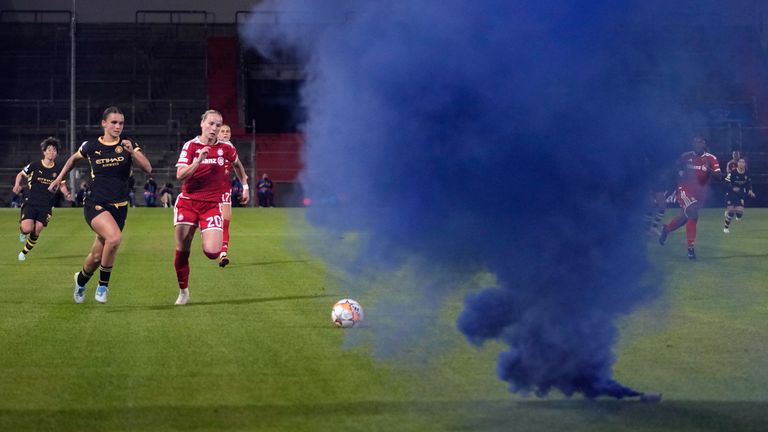
A flare was on the pitch during Man City’s first goal
Manchester City’s eventful return to the Women’s Champions League saw them come from 2-0 down to draw 2-2 away to Bayern Munich and become the first English side to avoid defeat to the Germans in Europe. Against a club with consistent recent pedigree in this competition, taking a point on the road has potential implications for how the group shapes up, particularly if head-to-head results and goal difference come into play later in the campaign.
City’s Germany international Carlotta Wamser was left completely unmarked in the penalty area to score her first City goal in the 86th minute after prolific striker Khadija “Bunny” Shaw had earlier missed a penalty to equalise. The contrasting fortunes in front of goal for two different forwards underlined both the pressure on leading strikers and the value of having multiple scoring options in a side built to compete across competitions overseen by national leagues and UEFA.
The visitors were worthy of a point based on their second-half performance, having been completely dominated before the interval before nicking a goal on the stroke of half-time.
Flare controversy and Bayern control in first half
Bayern were 2-0 up inside the first half-hour and had chances to put the result beyond doubt, but with seconds ticking down to the interval Kerstin Casparij’s break down the right led to Beth Mead eventually tapping in.
However, the hosts were unhappy that play had been allowed to continue, with a flare thrown onto the pitch as the attack developed. Casparij had crossed the ball before reaching the thick blue cloud, though, and the goal was allowed to stand. The incident highlighted the match officials’ discretion to continue play when they judge that immediate safety is not compromised, a judgement that can carry weighty consequences in European ties.
It was the stroke of luck City needed, and they benefited again when Ena Mahmutovic appeared caught between two minds as she raced out to close down Aoba Fujino. The goalkeeper initially appeared content to let the ball run out of play, only to inexplicably stick out a leg and bring down the City winger.
Shaw, who had been due to be substituted, could not capitalise and was immediately replaced. Wamser, however, ensured the miss did not prove costly.
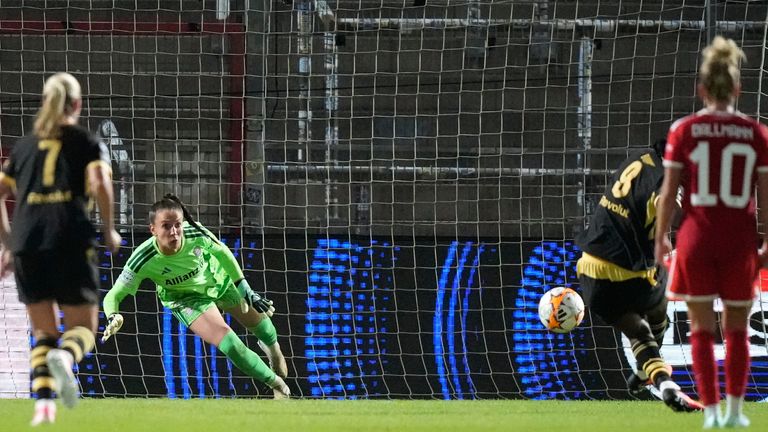
Bayern goalkeeper Ena Mahmutovic saved Bunny Shaw’s penalty
Bayern’s early dominance and City’s escape
City were fortunate to have only a two-goal deficit to overturn, with Klara Buhl and Pernille Harder both going close before Giulia Gwinn’s chipped effort across Ayaka Yamashita opened the scoring in the 11th minute.
Linda Dallmann had been allowed to drive unchallenged from the halfway line before finding Gwinn, who calmly lifted the ball over Yamashita and into the far corner. Buhl then volleyed straight at Yamashita, while Jovana Damjanović blazed over as Bayern cut through City’s midfield once again.
Lauren Hemp almost conjured a goal out of nothing when her deflected cross clipped the top of the crossbar, but it proved only a brief respite. Harder soon whipped a cross into the box, with Casparij making a complete mess of her attempted clearance and inadvertently diverting the ball into her own net.
Coffey praises depth and mentality
Man City Women midfielder Sam Coffey told the club’s official website:
“Beth’s goal changed momentum going into half-time. We connected better and were more front-footed in the second half. So it was huge to take that into half-time and continue to turn the game around.
“We wanted to win the game, so we’re disappointed we didn’t do that, but to come away from a really tough place with a draw is something we should be proud of.”
On the subs: “It’s one of the best parts of our team of how deep we are. We have so many gamechangers and whoever comes into the game is going to have an impact on it.
“That’s what the best teams in the world need and want, and I think we have that to the nth degree.”
Coffey’s assessment underlines how much value leading clubs now place on depth and tactical flexibility at this level. In a competition where knockout places are ultimately determined by the regulations set out for tiebreakers and head-to-head records, taking something from a difficult away assignment against Bayern may carry significance later in the campaign.
Key moments – Bayern Munich vs Manchester City
- Result: Bayern Munich 2-2 Manchester City
- Bayern 2-0 up inside half an hour, including an own goal by Kerstin Casparij
- City goals: Beth Mead on the stroke of half-time; Carlotta Wamser late on
- Major incidents: Flare on pitch during City’s first goal; Khadija “Bunny” Shaw penalty saved; late equaliser from Wamser
Taken together, Arsenal’s late win and City’s comeback draw illustrate how English clubs are navigating an increasingly competitive European landscape under the structures of the modern Women’s Champions League. Both sides showed that resilience, depth and decision-making in key moments are as decisive as technical quality in a tournament where progress is tightly governed by group-stage margins and knockout seeding.
Worth a look
