
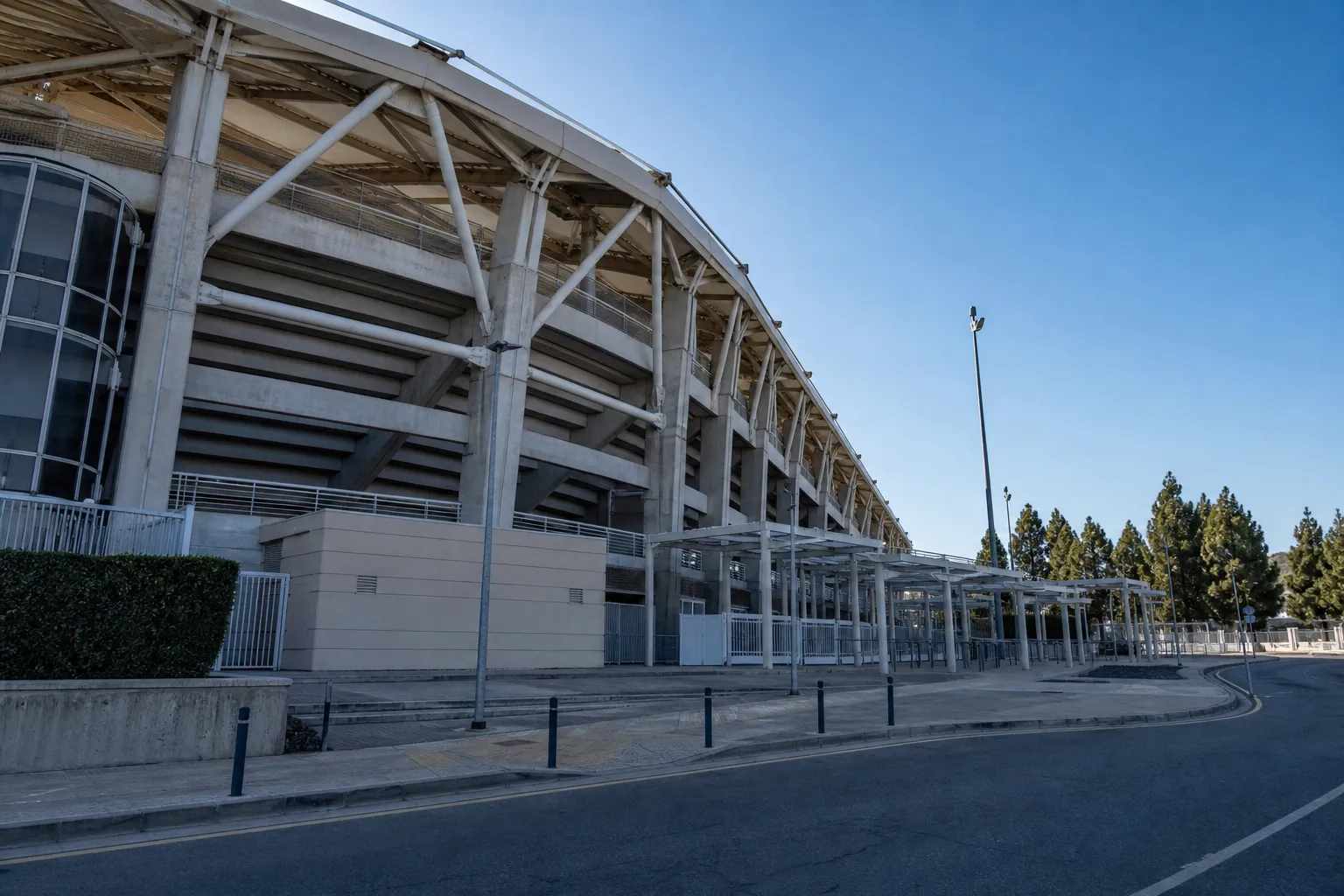
Cyprus’ GSP Stadium Targets Modernisation Amid Financial Pressures from Club Debts
The management of GSP Stadium in Nicosia is preparing a wide-ranging modernisation drive that aims to upgrade the arena’s infrastructure, overhaul its athletics division and diversify the venue’s revenues away from an over-reliance on football club income.
The priorities have been set out by GSP’s new general manager, Giorgos Yapanas, who has outlined a plan built around improving safety and comfort for supporters, strengthening the stadium’s sporting identity and reinforcing its financial resilience.
Infrastructure upgrades tied to safety and fan experience
Yapanas has identified the primary task as maintaining and upgrading GSP’s facilities so that they remain safe, functional and modern for both athletes and fans. The leadership wants the venue to operate as a well-maintained, welcoming sports centre rather than simply a matchday stadium.
Beyond the core playing and training areas, stadium management is targeting a complete reorganisation of food and beverage services. The plan calls for:
- a higher-quality menu inside the stadium,
- faster service at concession points, and
- more comfortable conditions for supporters during breaks in play.
These types of upgrades have become standard expectations in top-tier football and athletics venues across Europe. For clubs and national teams using GSP, improved catering, circulation and basic amenities are increasingly important in retaining season-ticket holders, attracting families and meeting the requirements of modern event operations.
Athletics division repositioned around talent development
Special attention will be given to reorganising the stadium’s athletics division. The plan envisages an academy and a stronger pipeline for developing new athletes, which are intended to form the foundation of this area.
For Cyprus, the move has sporting significance beyond a single venue. A more coherent athletics structure at GSP can support long-term athlete development, provide a reliable competition venue and align with the framework overseen by bodies such as the World Athletics. A stable home base with modern facilities is often a prerequisite for hosting higher-level meets and for preparing athletes for international championships.
By reinforcing athletics alongside football, GSP is also seeking to maintain its relevance as a multi-sport hub rather than being defined solely by its anchor football tenants.
Commercial strategy aims to reduce reliance on football income
On the business side, the stadium is planning broader commercial development, including:
- strategic sponsorships built around the venue and its events,
- hosting non-football events across the complex,
- upgrading food services as a recurring revenue line, and
- more active use of other facilities within the GSP site.
The stated goal is to gradually reduce GSP’s dependence on revenue from football teams and to build a more stable, diversified funding model. For a stadium that has traditionally relied heavily on matchday income from its main football tenants, this kind of shift is central to financial planning.
In the broader European context, multi-use programming-concerts, community events, corporate functions and athletics competitions-has become a key tool for stadium operators seeking to smooth seasonal peaks and troughs in revenue tied to league calendars and cup runs.
Risk from potential club departure
Yapanas has described the possible departure of one of Nicosia’s two major teams from GSP as a serious challenge to the stadium’s financial viability. The administration has examined how such a scenario could affect the association’s financial performance and day-to-day operations.
This risk underlines how central top-flight football remains to GSP’s current business model. Losing a major tenant would impact:
- matchday revenue from ticket-linked services,
- corporate and hospitality utilisation, and
- the broader visibility that comes with regular high-profile fixtures.
The push to expand non-football use and sponsorships is therefore not just about growth; it is also a hedge against structural changes in where leading clubs choose to play their home matches. For players and coaches, any relocation by a major team would mean a change in pitch conditions, travel routines and training logistics, but for GSP it would primarily be a revenue shock that the new strategy is trying to pre-empt.
Club debts and revenue collection mechanisms
The general manager has acknowledged that teams’ debts to GSP are a reality, adding that APOEL has substantial outstanding obligations to the stadium. In practice, GSP collects teams’ income from a range of in-stadium sources-such as advertising, executive boxes, food outlets and other commercial activities-and credits those sums against what the clubs owe.
This form of revenue assignment is a common mechanism used by venue operators to manage risk when working with clubs that have fluctuating cash flows. It gives GSP a degree of control over repayments but also reinforces how deeply stadium finances are intertwined with the performance and commercial health of its tenants.
Any sustained arrears from major clubs increase pressure on management to find new, more predictable income streams and to ensure that infrastructure upgrades can be funded without over-exposure to a small number of football clients.
Positioning GSP within Cyprus’ sports landscape
As the main stadium in the capital, GSP plays a central role in Cyprus’ sporting calendar, hosting domestic fixtures and a range of athletics and other events. The planned modernisation and reorganisation reflect wider trends in stadium management, where safety standards, fan expectations and multi-sport scheduling are converging.
If the new strategy succeeds, GSP will not only offer a better matchday experience but also provide a more resilient platform for club football, athletics and non-sport events. That combination is increasingly important for venues competing to host international qualifiers, club competitions and regional tournaments under the structures overseen by bodies such as the Cyprus Football Association and its continental counterparts.
