
NICOSIA —
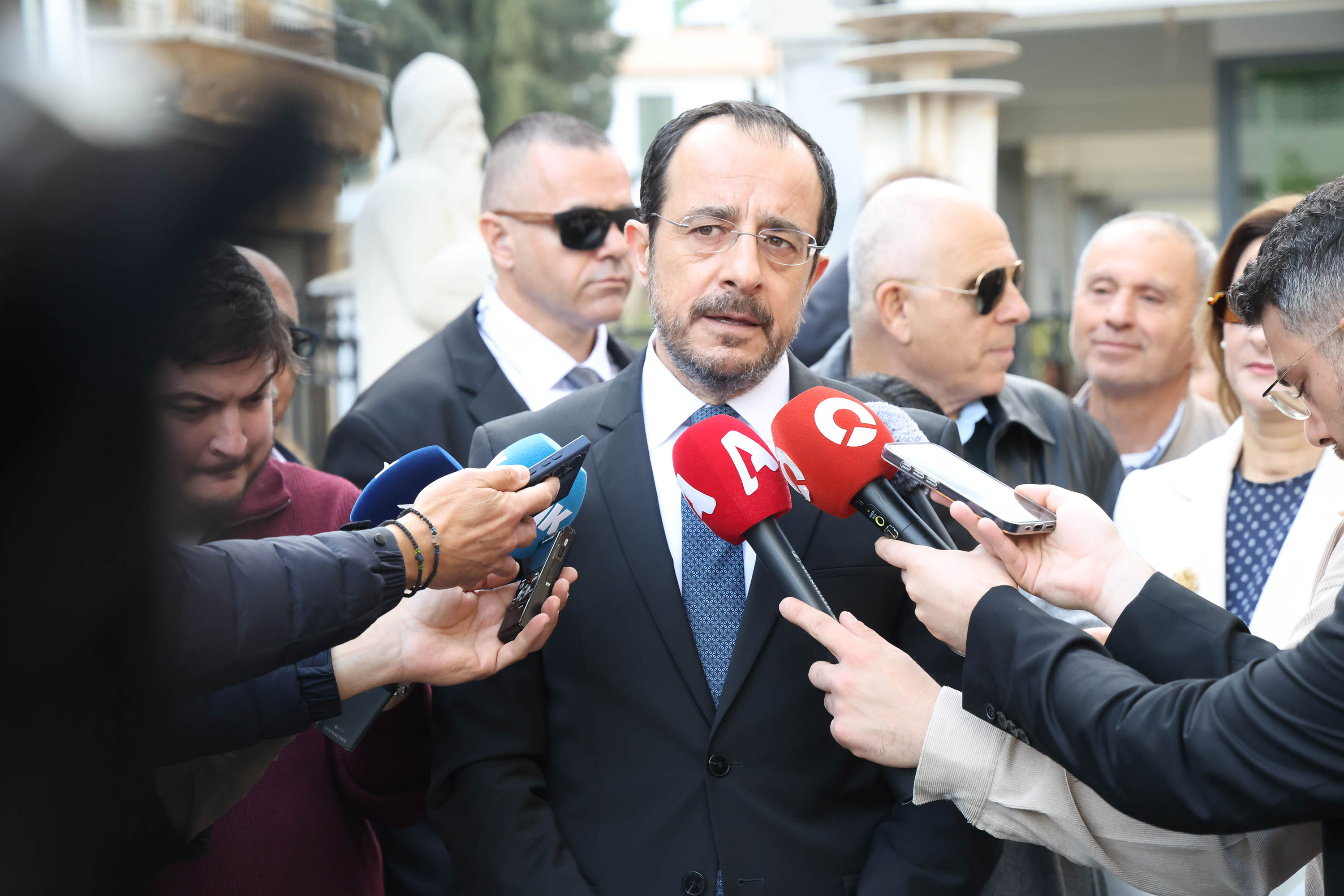
Cyprus President Nikos Christodoulides on Sunday dismissed as “ridiculous” objections that an expanded conference on the island’s division cannot be convened because of the country’s May parliamentary elections or because Nicosia currently holds the rotating Presidency of the Council of the European Union. He said he and the Greek Cypriot side are ready to participate “as early as next week” in a broadened meeting agreed with UN Secretary‑General António Guterres in New York.
Christodoulides told reporters after attending Saint Maron day celebrations in Nicosia: “I am ready next week to go to New York and announce the resumption of negotiations from where they left off in Crans‑Montana, with full respect for the negotiating acquis.”
“Let us prove in practice that we are ready. Let us move beyond mere statements.”
He added that neither the EU Council presidency nor domestic electoral timelines should impede diplomacy. “As regards the parliamentary elections, I am sorry, but it is an absurd argument. They do not in any way affect either the outcome or the process,” he said. “If some – I do not know who – are unable at this time to come to talks, let them come out publicly and say so. The Greek Cypriot side is ready.”
The remarks come amid signs the UN is reluctant to move to a high‑stakes international gathering without prior movement on the ground. UN Personal Envoy María Ángela Holguín has cautioned in recent days that without tangible progress on confidence‑building measures it would be “very difficult” to convene an enlarged “5+1” meeting bringing together the two Cypriot sides with the three guarantor powers, Turkey, Greece and the United Kingdom.
EU presidency, election calendar and the UN track
Cyprus assumed the rotating Presidency of the Council of the EU on January 1 for the January–June 2026 term, as part of the current trio with Poland and Denmark. Under the EU treaties, the presidency steers legislative work across policy files, brokers compromises among the 27 member states and chairs ministerial and technical meetings in Brussels and on the island, even as national leaders retain responsibility for foreign and security policy.
Separately, the Interior Ministry and parliamentary leaders have set the House of Representatives election for Sunday, May 24, 2026, with candidacies due May 6 and formal dissolution expected in late April, a timetable laid out to keep administrative preparations on track and avoid clashes with Orthodox Easter. Christodoulides’ insistence that talks can proceed in parallel is aimed at deflecting arguments that the caretaker period would constrain his mandate in the UN process.
Against that backdrop, Holguín — reappointed by Guterres in May 2025 to press for next steps — has continued shuttle diplomacy with President Christodoulides and Turkish Cypriot leader Tufan Erhürman. Her office has underscored that progress on practical measures is a prerequisite for any broader international conference, in line with the Security Council’s call in the latest renewal of the UN Peacekeeping Force in Cyprus mandate for both sides to create conditions conducive to a settlement.
What “from where they left off” means
Christodoulides’ reference point is the UN‑led 2017 Conference on Cyprus in Crans‑Montana, which paired talks on internal governance, territory and property with negotiations on security and guarantees — the so‑called Guterres Framework designed to package the most contentious trade‑offs, including political equality for Turkish Cypriots and the future of security guarantees and foreign troops. Formal negotiations have not resumed since that collapse, leaving the framework as the last agreed UN reference for a bizonal, bicommunal federation under a single international personality.
UNFICYP, the peacekeeping mission present since 1964, continues to police the buffer zone and support intercommunal initiatives under a mandate the Security Council has repeatedly extended, urging both sides to avoid unilateral steps that raise tensions. The mission operates within the legal and political parameters set by the Council’s resolutions on Cyprus and the island’s status in international law, which recognize only the Republic of Cyprus as a member state of the United Nations.
Crossing points and congestion at Ayios Dhometios
Asked about Turkish Cypriot leader Tufan Erhürman’s recent comments on crossings — and specifically the bottleneck at Nicosia’s Ayios Dhometios/Metehan checkpoint — Christodoulides said the Republic “had long been ready to proceed with the widening of the road,” attributing delays to works within the UN‑controlled buffer zone and recalling earlier objections from the Turkish Cypriot side under former leader Ersin Tatar.
EU‑funded expansion to add capacity at Ayios Dhometios was launched on December 4, 2025, with UNDP implementing the project inside the buffer zone to ease congestion at one of the island’s busiest crossings. The works — valued at roughly €435,000 — were scheduled to finish by end‑January 2026. The crossing‑point upgrades are among the practical measures diplomats say could demonstrate good faith ahead of any “5+1” conference by improving everyday conditions for Cypriots who live, work or study across the divide.
Erhürman, elected Turkish Cypriot leader in October 2025 on a platform favoring a federal settlement under UN parameters, has also urged opening at least one additional vehicle crossing in Nicosia to relieve pressure at Ayios Dhometios. Christodoulides’ comments signal that Nicosia wants the onus placed on the Turkish Cypriot side and Ankara to move on such confidence‑building steps if they wish to test his assertion that the Greek Cypriot side is ready “as early as next week.”
Gaza diplomacy and Cyprus’ maritime corridor
Christodoulides said Cyprus will participate as an observer in a United States‑invited Peace Council initiative relating to Gaza, calling the invitation “significant” because it enables the Republic’s direct presence at discussions focused on Gaza. He noted that “We are the EU member state closest to Gaza. We have more interest than any other state in seeing this plan implemented,” referencing Nicosia’s “Amalthea” maritime corridor concept launched after October 2023 to move humanitarian aid by sea under international supervision.
Since March 2024, the Amalthea corridor has served as a channel for sea‑borne relief, with partner states funding consignments verified under UN Security Council Resolution 2720’s aid‑facilitation mechanism. In 2025, for example, Cyprus and the United Arab Emirates reported shipments totaling about 1,200 tonnes via Ashdod under UN‑managed procedures, alongside NGO‑supported sailings coordinated through Cyprus. For Nicosia, the corridor has become both a humanitarian tool and a diplomatic asset, reinforcing its argument that a reunited Cyprus would be a more stable EU front‑line state in the Eastern Mediterranean.
Regional stakes and immediate next steps
The change in Turkish Cypriot leadership and Cyprus’ EU presidency have increased international attention on the UN track, but the sequencing remains clear: confidence‑building moves first, then an expanded diplomatic conference if sufficient common ground emerges. As of February 15, 2026, Holguín is continuing consultations with both leaders in Nicosia and has warned that, absent concrete progress, convening a broader meeting will be difficult; no date has been set.
For now, Christodoulides is using the visibility of the EU presidency and Cyprus’ role in Gaza‑related diplomacy to project readiness and shift pressure onto the other stakeholders in the decades‑long conflict. Whether the UN agrees that conditions are “ripe” for a return to the Crans‑Montana parameters will depend less on public statements and more on whether the sides can translate them into verifiable steps on the ground — from crossing‑point improvements to security and governance guarantees that fit within the framework of Cyprus’s obligations and rights as an EU member state.
Related reading
- Global Food Security Alliances: How Climate-Resilient Agricultural Corridors Are Stabilizing Wheat and Rice Supplies
- Cross-Border Renewable Energy Grids: North Sea and Mediterranean Subsea Cable Networks Enter Phase Two
- Spanish election: Pedro Sanchez calls snap election for 29 November after housing protests (globallypulse.com)
