
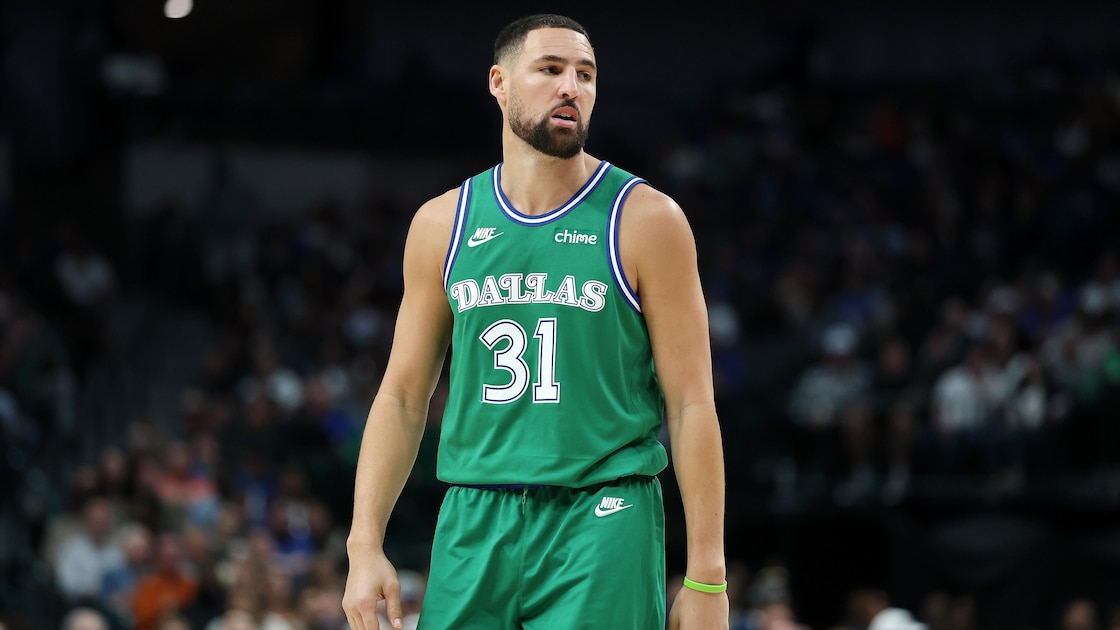
Mavericks Move On From Klay Thompson as Veteran Sharpshooter Eyes Heat Role
Buyout Ends Short-Lived Dallas Chapter
The Dallas Mavericks announced Friday they are buying out the final year of Klay Thompson’s contract, drawing a swift close to a high-profile but ultimately uneasy partnership.
The five-time All-Star was due to earn $17.5 million for the 2026-27 season, a figure that no longer aligned with his on-court impact in Dallas. The buyout makes the 36-year-old an immediate candidate to reshape his late career elsewhere while giving the Mavericks added financial and rotational flexibility as they continue to build around their established core.
Thompson is expected to join the Miami Heat after he clears waivers, ESPN’s Shams Charania reported. He will earn $13 million on a two-year deal, including a player option on the second season, per Charania. Any move to Miami would keep Thompson in the spotlight of the global NBA audience and place him back on a team with championship ambitions.
The transaction is part of the broader player-movement landscape overseen by the National Basketball Association, where the salary cap, luxury tax thresholds and contract structures increasingly push teams toward difficult decisions on aging stars whose production no longer matches past accolades.
From Guaranteed Starter to Rotational Question Mark
Dallas’ move is a clear sign of how far Thompson’s value has diminished around the league. Once one of the premier two-way guards in the NBA, he fell out of the Mavericks’ starting rotation midway through last season and struggled to consistently influence games on either end of the floor.
In 69 appearances, Thompson averaged 11.7 points and posted career lows in overall field-goal percentage (39.3) and three-point percentage (38.3). For a player whose reputation was built on elite efficiency and volume from beyond the arc, those numbers underlined a tangible decline that rival front offices and coaching staffs could not ignore.
Jason Kidd shifted Thompson to the bench after seven games, which made for a delicate internal situation considering Dallas promised him a starting spot when it made its pitch during the 2024 offseason.
Kidd indicated the switch was only a temporary tactical change, and Thompson returned to the first unit in a loss to the New York Knicks in mid-November. But over the course of the campaign he ultimately settled into a reserve role again, reflecting the coaching staff’s assessment that his best usage came in more controlled bursts rather than as a nightly, high-minute starter.
Warriors Exit Foreshadowed the Decline
The Golden State Warriors had already seen the trajectory turning. The franchise that Thompson helped lift to multiple NBA titles recognised, earlier than most, that his role would need to evolve sharply from cornerstone starter to situational contributor.
Head coach Steve Kerr and general manager Mike Dunleavy Jr. were pragmatic rather than sentimental with Thompson’s usage during the 2023-24 season and in the way they approached his subsequent free agency. Minutes were managed, late-game responsibilities were shared more evenly, and the organisation prepared supporters for the end of an era even as Thompson remained a central figure in the club’s identity.
Breaking up the “Splash Brothers” partnership with Stephen Curry was not a move anyone in the Bay Area embraced lightly. Yet the Warriors understood Thompson was on a downward trajectory. Missing two full seasons because of a torn ACL and a torn Achilles accelerated the inevitable decline that awaited any guard entering his mid-30s, especially one whose value had long been tied to mobility on the perimeter at both ends.
Dallas Gamble Never Turned Into a Renaissance
A change of scenery and a desire to prove Golden State wrong did not spark the on-court renaissance that Thompson and Dallas might have hoped for. In his first year with the Mavericks, he averaged 14 points per game, his lowest output since his rookie season, and his field-goal percentage (41.2) was a personal worst at the time.
The Mavs were not expecting to sign the peak version of Thompson. They appeared to envision him in a role reminiscent of Ray Allen during his late-career stretch with the Miami Heat and at the end of his Boston Celtics tenure – a veteran guard used primarily as a floor-spacer, secondary scorer and off-ball shooting threat. Allen remained a capable three-point specialist as his own career wound down, shooting 37.5 percent from beyond the arc in his final season.
In Dallas, that template never fully materialised. Thompson’s long-range prowess has started to waver, and as his three-point accuracy dipped, the other limitations in his current game became harder to mask. He is no longer the same level of defender he once was on the perimeter, and he cannot create off the dribble with the same explosiveness or variety that defined his prime years with Golden State.
Heat Fit: Low-Risk Bet on Experience and Spacing
Even with the visible decline, Thompson’s anticipated move to Miami has strategic appeal for both player and team.
For the Heat, who operate in a consistently competitive Eastern Conference and are structured around star talent and hard-edged role players, Thompson represents a relatively low-cost, low-risk addition. The financial framework of a two-year, $13 million agreement, with a player option on the second season, gives the franchise flexibility if his form stabilises at a solid rotation level or continues to wane.
The days of Thompson being a big difference-maker on a contender may be over, but his shooting gravity, institutional playoff experience and comfort in high-pressure environments still hold value for a Heat team that saw Giannis Antetokounmpo enter the fold this summer. In a postseason series, a veteran who understands spacing, timing and defensive schemes can still influence tactical matchups even in a more limited role.
For Thompson himself, the prospective move offers a chance to reframe the final chapter of his career on a team already built to feature other headline stars. Reduced usage and clearer expectations as a specialist could help him maximise what remains of his skill set without the strain of carrying starter-level responsibilities over an 82-game regular season.
What the Move Signals for Dallas and the Wider League
For Dallas, the buyout is about more than a single roster spot. It signals a willingness to make firm decisions on legacy names when performance no longer aligns with contract value – a dynamic that is becoming more pronounced across the NBA as franchises try to balance loyalty with the competitive and financial disciplines built into the league’s collective bargaining framework.
Freeing themselves from Thompson’s final year gives the Mavericks scope to reallocate minutes to younger perimeter options and to reconfigure lineups around players who can better complement their primary stars on both ends of the floor. It also underscores the competitive reality of the Western Conference: teams with playoff and title aspirations cannot afford prolonged experimentation with veterans whose production has dropped significantly.
More broadly, Thompson’s trajectory from franchise icon in Golden State to rotation piece in Dallas and now a projected role player in Miami illustrates how quickly roles can change for even the sport’s most decorated guards. In a league where spacing, defensive versatility and durability are prized, the margins for aging shooters are increasingly thin, and decisions such as this buyout are likely to become even more common as teams manage windows of contention with greater ruthlessness.
Within that landscape, Klay Thompson’s next act in Miami – if finalised as expected – will be watched closely, both for what it reveals about his remaining on-court impact and for what it says about how contending teams around the league choose to deploy veteran specialists in the modern NBA.
Worth a look
