
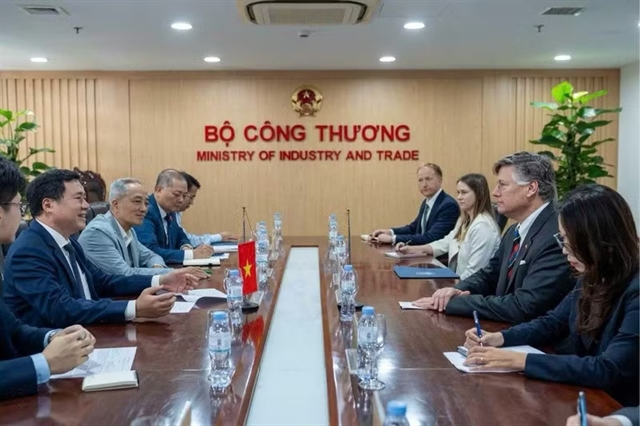
HANOI – Vietnam’s Deputy Minister of Industry and Trade Nguyễn Sinh Nhật Tân and US Deputy Secretary of State Christopher Landau have held a high-level working session to accelerate economic integration, focusing on the expansion of energy infrastructure and the removal of critical trade barriers.
The meeting comes as both nations seek to operationalize the Comprehensive Strategic Partnership established in late 2023, a diplomatic framework designed to deepen security and economic ties. The discussions centered on diversifying supply chains and transitioning Vietnam toward a more sustainable energy model, reflecting a broader US strategy of “friend-shoring” to reduce reliance on traditional manufacturing hubs in East Asia.
Energy Transition and Infrastructure
A primary pillar of the discussions involved the modernization of Vietnam’s energy sector. Deputy Secretary Landau emphasized the US desire to expand cooperation in the development of liquefied natural gas (LNG) infrastructure, as well as initiatives targeting environmental protection and the reduction of plastic waste.
This focus aligns with Vietnam’s Power Development Plan VIII (PDP8), which seeks to shift the country’s energy mix away from coal toward LNG and renewables to meet escalating industrial demand and support sustained export-led growth. PDP8, approved by the government in 2023, provides the core planning framework for generation capacity, grid expansion and private-sector participation in the power market.
Deputy Minister Tân noted that Vietnam is actively implementing its international commitments regarding green transition, emissions reduction, and sustainable development. These efforts are closely tied to the Just Energy Transition Partnership (JETP), a multi-billion dollar financing deal backed by the US and G7 nations to help Hanoi decarbonize its economy and meet its net‑zero pledge by mid-century. Officials said closer coordination on project pipelines under PDP8 and the JETP would be essential to translate headline commitments into bankable projects.
Trade Barriers and Market Status
The session highlighted a significant diplomatic priority for Hanoi: the formal recognition of Vietnam as a market economy.
The Vietnamese side proposed that the US promptly recognize Vietnam’s market economy status and remove the country from the D1 and D3 lists. These designations, used by the US Department of Commerce in trade enforcement, currently impact how officials calculate anti-dumping duties and restrict the export of certain high-tech products.
Under US law, market-economy status affects whether investigators can rely on a country’s own prices and costs, or must instead use “surrogate” data when determining whether goods are being dumped, a distinction that can materially change duty levels. The discussion therefore goes to the heart of how the two governments apply, and potentially recalibrate, the rules-based architecture of bilateral trade remedies.
Removing these restrictions would streamline the flow of semiconductors and advanced electronic components-critical inputs for Vietnam’s burgeoning tech manufacturing sector and its role in global supply chains. It would also complement Vietnam’s existing commitments under the World Trade Organization framework, including disciplines on subsidies, transparency and dispute settlement that already shape Hanoi’s trade policy choices.
Regarding the broader trade relationship, the following priorities were established:
- Import Expansion: Vietnam expressed readiness to increase imports of US agricultural products, energy, and high-tech equipment, positioning itself as a deeper market for US exporters while supporting domestic industrial upgrading.
- Investment Climate: Hanoi reaffirmed its commitment to improving the business environment for US firms to ensure stable, long-term operations, citing ongoing regulatory reforms and administrative simplification aimed at attracting high-quality foreign direct investment.
- Trade Frameworks: Both parties noted progress in negotiations for a fair and balanced reciprocal trade arrangement and agreed to accelerate work on outstanding provisions related to market access, standards and digital trade.
US officials signaled that any shift on market-economy status would need to be consistent with the criteria and procedures set out under the US Trade Act and related trade-remedy statutes, underscoring that political will in Washington must be matched with demonstrable regulatory and economic reforms in Hanoi.
Strategic Investment and Innovation
The US business community has significantly increased its footprint in Vietnam, particularly in the electronics and semiconductor sectors as companies diversify production away from a single-country model in East Asia. Deputy Minister Tân credited these investments with driving technological innovation, deepening Vietnam’s participation in regional value chains and boosting the country’s export capacity.
“Economic, trade and investment relations between the two countries have achieved substantial results, bringing benefits to businesses and people of both nations,” Tân said during the session.
Tân further stressed that the Vietnamese and US economies are “highly complementary and hold significant potential for further growth,” emphasizing a desire for a partnership that is balanced and mutually beneficial. He pointed to Vietnam’s young workforce and manufacturing base, alongside US capital, technology and standards-setting power, as core ingredients of the emerging economic architecture between the two countries.
The meeting concluded with a commitment to increase high-level exchanges and coordination across the spheres of trade and energy to further deepen the bilateral Comprehensive Strategic Partnership. Officials said that closer technical engagement between line ministries, trade agencies and energy regulators would be required to unlock large-scale infrastructure and advanced manufacturing projects.
The two nations are currently maintaining a coordinated schedule of diplomatic visits to resolve outstanding trade disputes and finalize the terms of high-tech export licenses, including items governed under US export-control authorities such as the Bureau of Industry and Security’s Export Administration Regulations. Both sides framed the Hanoi talks as a step toward making those regulatory processes more predictable for businesses while reinforcing long-term strategic alignment.
