
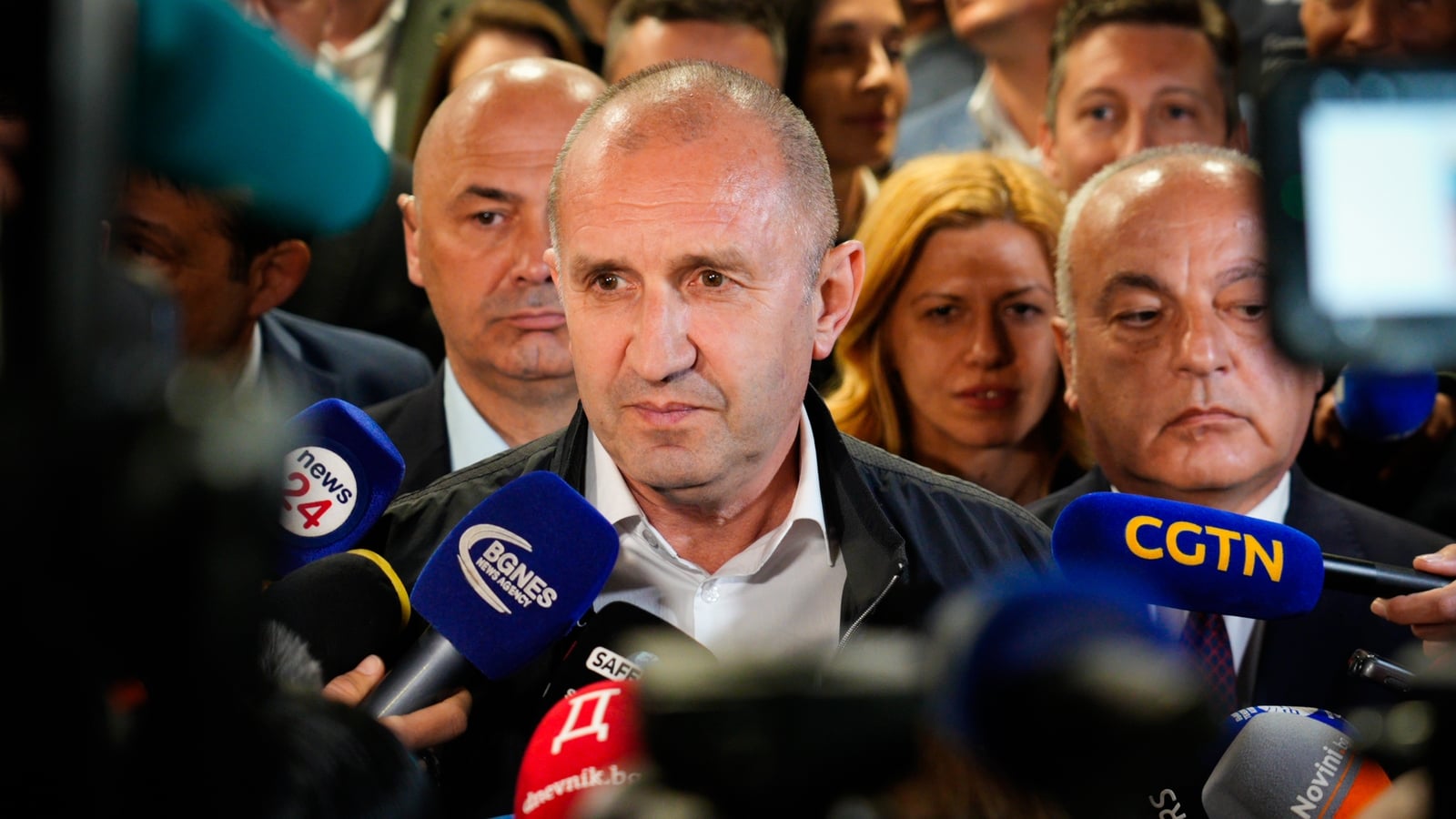
SOFIA – Rumen Radev and his Progressive Bulgaria coalition have secured an absolute majority in Bulgaria’s parliamentary elections, ending a grueling cycle of political volatility that saw the country undergo eight general elections in just five years.
The victory marks a decisive shift in the Balkan nation’s domestic trajectory and introduces a potentially disruptive element into the European Union’s unified front against Russian aggression. Coming just one week after the defeat of Viktor Orbán’s Fidesz party in Hungary, Radev’s ascent suggests that while some “illiberal” strongmen are faltering, the appetite for sovereignist, anti-establishment politics remains potent across Central and Eastern Europe.
The outcome places Bulgaria at a geopolitical crossroads. As a NATO and EU member, Sofia has traditionally balanced its strategic Western alliances with deep-seated cultural and historical ties to Moscow. Under Radev, that balance is likely to tilt, risking a repeat of the diplomatic frictions that have characterized Hungary’s relationship with Brussels and tested the EU’s ability to act in unison on sanctions, Ukraine and enlargement.
The Collapse of the Center-Right
Radev’s path to power was paved by the failure of the previous centre-right administration, which collapsed last December. The government fell following mass protests led by young Bulgarians who initially rallied against budget plans to increase taxes, but whose demands quickly evolved into a broader movement against systemic judicial corruption and perceived impunity for political elites.
Radev, who served as Bulgaria’s president from 2017 until his resignation last January to lead this campaign, successfully positioned himself as the antidote to what he termed the “oligarchic model.” He campaigned on a platform of dismantling the influence of a small circle of elites who allegedly control the country’s political machinery and media landscape, promising sweeping changes to the prosecutor’s office, party financing rules and public procurement.
His coalition’s appeal spanned a wide demographic, capturing the votes of the traditional left, disillusioned youth, and a general electorate exhausted by nearly half a decade of parliamentary instability and caretaker governments. By framing the election as a choice between “permanent crisis” and “institutional reset,” Radev turned frustration with gridlock into a mandate for structural reform.
The Moscow Alignment
The primary concern for EU leadership in Brussels is Radev’s ambiguous, and often sympathetic, stance toward the Kremlin. While Radev denies being a proxy for Russian interests, his policy positions frequently diverge from the EU consensus, particularly on sanctions and military support to Ukraine.
During a recent interview with broadcaster bTV, Radev explicitly opposed the shipment of Bulgarian military aid to Ukraine. He has further challenged the EU’s territorial integrity policies by suggesting that recognizing Crimea as part of Russia is a “realistic position,” putting him at odds with the bloc’s formal non-recognition line and its commitment to Ukraine’s sovereignty under the Treaty on European Union.
“I do not see what is pro-Russian about my position. My stance is entirely pro-Bulgarian,” he told bTV.
Despite this rhetoric, Radev has attempted to maintain a degree of diplomatic flexibility. He indicated that he would not block other EU member states from providing financial aid or weaponry to Kyiv, suggesting he may avoid the total veto power that Orbán frequently utilized to stall EU loans and joint borrowing packages.
However, the friction with Kyiv is already evident. In 2023, Radev stated that “Ukraine insists on carrying on with this war, but the whole of Europe is paying the bills,” a comment that drew a direct public rebuke from President Volodymyr Zelensky during a bilateral meeting. Most recently, Radev has criticized a 10-year defense pact signed between Sofia and Kyiv last month, signaling that defense and security cooperation with Ukraine will be subject to tighter political control under his government.
Economic Sovereignty and the Euro
Beyond foreign policy, Radev is challenging Bulgaria’s integration into the Eurozone, a process that has been a cornerstone of successive governments’ economic strategy. Having criticized the adoption of the euro in January, Radev argues that the single currency erodes Bulgaria’s fiscal independence, limits the tools available to respond to domestic shocks and serves as a catalyst for inflation in lower-income member states.
This eurosceptic lean extends to his view of the EU’s global role and economic governance rules. Following his victory, Radev told reporters: “A strong Bulgaria in a strong Europe needs critical thinking, needs pragmatism.” He added that “Europe has fallen victim to its own ambition to be a moral leader in a world without rules,” a swipe at what he portrays as Brussels’ tendency to prioritize values-driven policy over competitiveness and national interest.
Analysts suggest Radev may seek to form a “sovereignist” bloc within the EU Council, finding common ground with figures such as Slovak Prime Minister Robert Fico and Czech Prime Minister Andrei Babiš. Such a coalition could complicate negotiations on future fiscal rules, Ukraine financing and climate legislation, even if it falls short of a formal voting alliance.
Energy and Strategic Risk
The most immediate flashpoint for the new government will be energy security, where questions of sovereignty, sanctions policy and household prices intersect. Since 2024, Bulgaria has moved to reduce its dependence on Russian energy imports as part of the broader EU sanctions regime and efforts to diversify gas supplies via regional interconnectors and LNG.
Reuters reports that Radev has discussed resuming the free flow of Russian oil and gas into Europe. If Radev pushes to restore these imports, he would not only defy EU energy policy but could potentially create a loophole in the sanctions framework intended to starve the Russian war machine of revenue, while exposing Sofia to infringement procedures from the European Commission over single-market and sanctions compliance.
The Kremlin has already welcomed Radev’s victory, signaling a willingness to deepen bilateral ties and revive stalled energy projects. Any such pivot would be closely watched by other eastern member states who have invested heavily in reducing Russian leverage over their critical infrastructure.
The Progressive Bulgaria coalition is now in the process of forming a government, with Rumen Radev expected to assume a central role in determining the new administration’s cabinet and diplomatic priorities. His early decisions on the justice portfolio, finance ministry and energy regulator will offer the clearest first signals of whether his promised break with the “oligarchic model” translates into a new kind of leverage over Bulgaria’s place inside the EU.
Keep reading
