
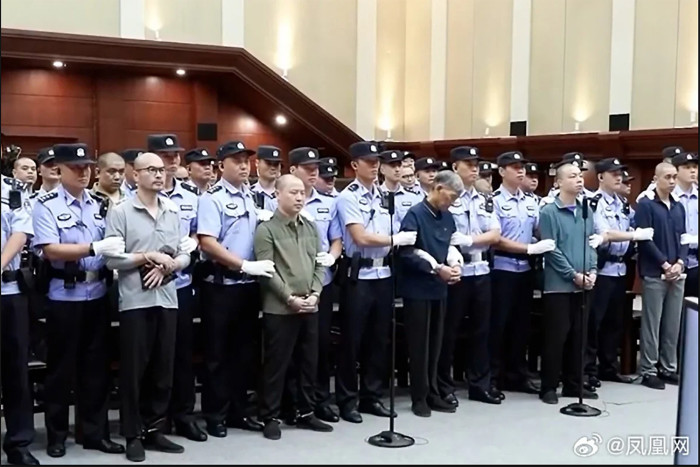
BEIJING – China has carried out a rare, rapid series of executions of convicted leaders of cross‑border crime syndicates tied to Myanmar’s Kokang region, underscoring Beijing’s willingness to assert jurisdiction and leverage regional clout to protect Chinese citizens abroad.
In two court actions less than a week apart, authorities announced the executions of 11 people on January 29 in Wenzhou and four more on February 2 in Shenzhen. Those put to death included members of the “Ming family” network and the Bai syndicate, whose operations spanned industrial‑scale telecom scams, illegal casinos, kidnappings and killings. A fifth defendant in the Bai case, the group’s leader Bai Suocheng, died of illness after conviction. Chinese courts said the crimes defrauded victims of more than 29 billion yuan (about US$4.2 billion) and led to multiple Chinese deaths and injuries.
Many of those condemned were Myanmar citizens operating from Kokang’s border enclaves, while the victims were overwhelmingly Chinese nationals. China obtained custody of several ringleaders after Myanmar authorities handed them over-a reflection of Beijing’s coercive diplomacy in Southeast Asia and of Chinese criminal law that extends to foreigners who target China or its citizens abroad.
The cases that led to the gallows
The January 29 executions in Wenzhou involved core members of the Ming syndicate. China’s Supreme People’s Court (SPC) said the group had, since 2015, established armed compounds across Kokang to run telecom fraud and gambling operations that resulted in the deaths of 14 Chinese citizens and injuries to many more. The court called the crimes “exceptionally heinous, with particularly serious circumstances and consequences.”
Four days later, the Shenzhen court announced it had carried out death sentences against four leading figures in the Bai family network-among them Bai Yingcang-following SPC approval. The SPC detailed a portfolio of crimes, from murder to trafficking roughly 11 tonnes of methamphetamine, and said fraud and gambling proceeds alone exceeded 29 billion yuan.
In a televised confession aired by state broadcaster CCTV, Bai expressed contrition for the scale of harm:
“I would like to represent my entire family, to apologise for the citizens of China and the Chinese government,” he said. “Because of our family’s actions, we have caused harm to tens of thousands of Chinese people. I am deeply sorry for what we have done.”
A day after the first executions, a court in Chongqing sentenced Xu Faqi-better known as Xu Laofa, another Kokang crime boss-to death with a two‑year reprieve for running fraud compounds and colluding in violence, an outcome that in China typically means commutation to life imprisonment if no new crimes are committed during the reprieve. The suspended death sentence underlined that not all senior figures are being executed, but most face the harshest penalties available.
Law without borders: how Beijing claims jurisdiction
Beijing’s legal basis for prosecuting foreigners for crimes committed abroad rests on Article 8 of the Criminal Law, which allows Chinese courts to try non‑nationals for serious offenses committed overseas against China or its citizens. In legal terms, China is invoking the “passive personality” principle-asserting jurisdiction because Chinese nationals were the primary victims, even though the conduct occurred outside its territory.
China has since layered on more targeted legislation. The Anti‑Telecom and Online Fraud Law of 2022 further codifies extraterritorial reach by applying to scams “committed overseas by citizens of the People’s Republic of China” and to overseas organizations or individuals who target victims in China, and by requiring banks, telecom operators and internet platforms to harden their systems against fraud. The full text of the law is available through China’s Ministry of Justice at en.moj.gov.cn.
China’s criminal procedure also requires the SPC to review and approve every death sentence-a safeguard reintroduced in 2007 that the court touts as improving uniformity and caution in capital cases. Both the Wenzhou and Shenzhen executions proceeded only after the relevant high courts dismissed appeals and the SPC signed off, underscoring that the campaign is being routed through formal judicial channels rather than handled as a purely security operation.
Kokang’s criminal economy and a war next door
Kokang, an ethnic‑Chinese enclave of northern Shan State, has long been a hub for illicit economies ranging from gambling to narcotics. The region’s instability deepened during Myanmar’s civil war: by late 2023 and early 2024, the Myanmar National Democratic Alliance Army and allied groups captured Laukkai and other strongholds near the China border, disrupting entrenched scam and casino complexes that had relied on weak central control and local militias for protection.
Those convulsions, combined with sustained Chinese pressure on Myanmar’s military government, set the stage for high‑profile arrests and transfers of Kokang figures to China. For Beijing, the operations have served a dual purpose: containing a lucrative criminal industry on its doorstep and signaling to domestic audiences that the state is willing to project power into lawless borderlands when Chinese lives and savings are at stake.
Regional pressure and cooperation
The wave of executions caps a multi‑year campaign in which Beijing pressed neighbors to shutter scam parks, repatriate Chinese nationals and surrender alleged ringleaders. During a 2023 visit to Myanmar, then‑foreign minister Qin Gang told officials: “Telecom and online fraud gangs have long been entrenched in Myanmar’s border regions, seriously harming the interests of Chinese citizens, and the Chinese public is deeply angered by this. The Chinese government attaches great importance to the issue and is determined to crack down on it with firm and forceful measures.” The message aligned China’s diplomatic engagement with a rising domestic law‑and‑order priority.
Chinese officials have described telecom fraud as a “global scourge,” and Beijing says joint actions with Thailand, Laos and Myanmar have dismantled thousands of scam dens and led to large‑scale repatriations. While details on individual operations are sparse, the pattern points to increasingly institutionalised cross‑border policing mechanisms in mainland Southeast Asia, often led or chaired by Chinese security agencies.
Analysts say the latest extraditions and executions also reflect China’s leverage over frontline states. Lin Minwang of Fudan University argued that handovers by Myanmar’s authorities were, in part, a function of power politics: “Put simply, why did Myanmar’s authorities ultimately hand these people over? They had little choice. If they hadn’t, China has various means to apply pressure,” he said. “Its military government is already under significant domestic and international strain and needs support to survive. China is one of its most important backers. What is more important is China’s firm determination to enforce the crackdown resolutely, and I think it comes as a big shock to some smaller surrounding countries.” He added: “However, this time it is very clear the push comes from the public security authorities, as domestic anger grows stronger.”
The dynamic extends beyond Myanmar. In early January, Cambodia revoked the Cambodian citizenship of tycoon Chen Zhi-indicted in the United States and accused by China of running forced‑labor scam compounds-and deported him to China at Beijing’s request, even as Western authorities moved to seize crypto assets linked to alleged fraud on a massive scale. The move underlined how governments that have benefited from murky investment flows are now recalibrating as China and Western law‑enforcement agencies place greater scrutiny on cyber‑scam hubs.
Wang Jiangyu, an international law professor at City University of Hong Kong, said the region is adjusting to China’s hard line: “The key members of the four big crime families in Myanmar were apprehended by China, undoubtedly demonstrating China’s influence in regional diplomacy and its power in those surrounding countries,” he said. “The local governments did not cooperate willingly – they acted under pressure.” On the broader message from recent cases, he added: “[Those cases show China’s] tremendous resolve, the deterrent power of its law, and a merciless approach to handle criminals harming China’s interests overseas.”
The human toll driving Beijing’s response
The execution cases catalogued killings and brutal coercion in compounds that held trafficked workers and targeted victims worldwide with romance‑investment and other online scams-an industry the United Nations and independent monitors have valued at tens of billions of dollars annually. Survivors have described being lured by fake job offers, then having their passports confiscated and being forced under threat of violence to defraud strangers online.
Public outrage inside China intensified amid reports of citizens lured by those schemes, then detained, beaten or worse. Social media has amplified stories of missing relatives and life savings wiped out in minutes, creating political pressure on Beijing to show that it can not only dismantle scam networks but also punish those deemed most responsible. The executions and high‑profile trials have been extensively covered by state media, underlining their role as both criminal justice and public messaging.
Capital punishment and Chinese procedure
China imposes the death penalty more than any other country, though exact figures are state secrets and executions are not systematically disclosed. Since 2007, the SPC’s mandatory review has been presented by authorities as a due‑process check that reduces errors and curbs local‑level abuses. In the Ming and Bai cases, the SPC said facts were clear, evidence sufficient and sentences appropriate after appeals were rejected.
The Kokang‑linked cases also show how Chinese courts use a spectrum of severe punishments to project deterrence without executing every defendant. While 15 people have been executed since January 29, Chongqing’s court gave Xu Laofa a suspended death sentence after finding his gang’s fraud proceeds topped 1.1 billion yuan. In practice, such suspended sentences are usually commuted to life imprisonment, allowing authorities to keep high‑value defendants alive as potential intelligence assets while still signalling that their crimes merit the ultimate sanction.
How Beijing makes the cross‑border cases stick
China’s legal toolkit for these prosecutions includes:
- Article 8 of the Criminal Law, which asserts jurisdiction over foreigners who commit serious crimes abroad against China or its citizens and provides the formal basis for trying Kokang‑based syndicate leaders in Chinese courts.
- The 2022 Anti‑Telecom and Online Fraud Law, which applies to overseas actors who target victims in China and mandates cross‑industry controls on phones, payments and networks, tightening compliance obligations on state‑owned and private firms alike.
- Regional security platforms built after the 2011 Mekong River massacre-in which 13 Chinese sailors were killed and drug lord Naw Kham was later captured and executed in China-which created joint river patrols, intelligence‑sharing arrangements and command centres that have since been repurposed against telecom‑fraud and online‑scam hubs.
Lin from Fudan framed Beijing’s posture as inward‑facing, despite the cross‑border theater: “I think this goes beyond conventional diplomatic framing. China as a major power is prioritising domestic interests. In this latest round of actions, the driving considerations appear to be primarily domestic, with diplomatic concerns likely taking a secondary place.” The choice to publicise confessions, legal justifications and SPC reviews appears calibrated above all for a home audience worried about personal security and financial stability.
As of February 8, 2026, China’s courts-following Supreme People’s Court review-have confirmed 15 executions tied to Kokang‑based syndicates since January 29; additional proceedings continue in related cases, and regional law‑enforcement cooperation remains active. For Beijing, the message is that its laws now follow Chinese citizens across borders-and that the full force of its criminal‑justice system will be deployed when they become prey to criminal industries overseas.
Keep reading
