
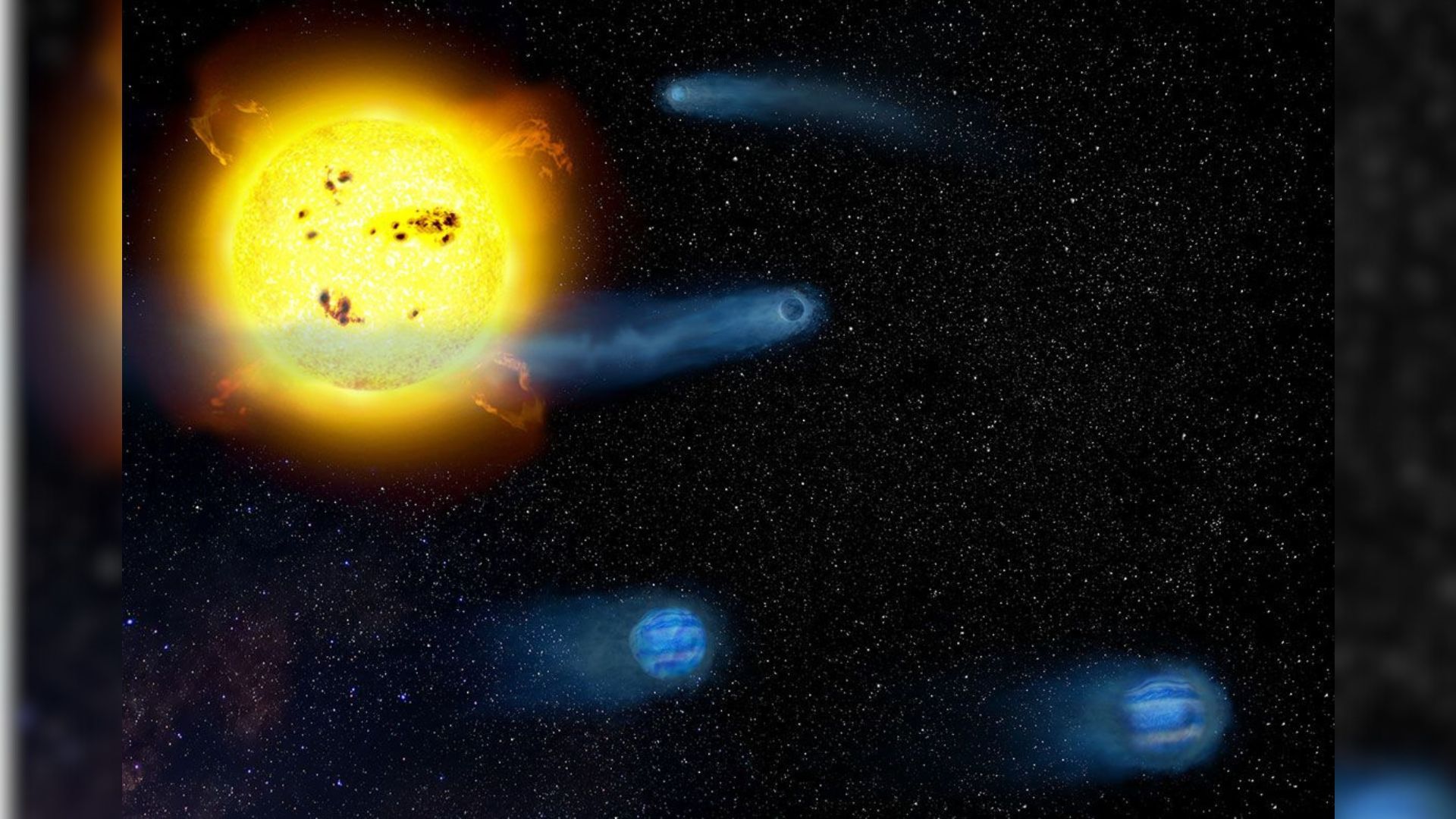
A young, evaporating planetary system is rewriting the origin story for super‑Earths
A nearby stellar nursery is giving exoplanet science something it has long lacked: a clear, early snapshot of how the most common types of planets become what they are. Some 350 light‑years away, the infant, sun‑like star V1298 Tau hosts four closely packed worlds that cross the star’s face from our viewpoint. By tracking subtle changes in the timing of those crossings, researchers have directly measured the planets’ masses, revealing extremely low densities and atmospheres that are being stripped by intense radiation. The picture that emerges is a step‑by‑step path for building super‑Earths and sub‑Neptunes from bloated, youthful planets, offering rare, observational evidence for a process that has so far existed mostly in models.
The work slots into a wider, publicly funded effort to map planetary populations beyond our solar system, guided in the United States by long‑range priorities set in the National Academies’ decadal survey process and implemented through agencies operating under the framework of the U.S. federal science and technology budgeting and oversight system. That governance scaffolding shapes which missions fly, which data become public, and how quickly discoveries like V1298 Tau move from raw light curves to policy‑relevant questions about long‑term investment in space infrastructure.
V1298 Tau at a glance
- Star: young, sun‑like; age roughly 23 million years, still rich in high‑energy radiation compared with our middle‑aged sun.
- Distance: about 350 light‑years, in the direction of the Taurus star‑forming region.
- Planet sizes: roughly 5-10 Earth radii (puffy, low‑density worlds that currently resemble scaled‑down Neptunes more than rocky planets).
- Orbital periods: 8.2, 12.4, 24.1 and 48.7 Earth days.
- Orbital architecture: four compact orbits well inside the distance of Mercury’s path around our sun, maximizing gravitational interactions and exposure to stellar radiation.
Masses from clocks, not colors
Instead of relying on starlight color shifts from massive spectrographs, the team used transit timing variations: when multiple planets tug on one another, each transit arrives a bit early or late. The pattern of those offsets encodes each planet’s mass and, together with the radius, its bulk density. The technique is computationally heavy and sensitive to data quality, but it excels in compact, multi‑planet systems like V1298 Tau, where the planets’ mutual gravity leaves a strong fingerprint in the timing.
- Photometry capture: high‑cadence light curves record every dip as each planet crosses the star, building up hundreds of precisely measured transits over several years.
- Detrending and vetting: stellar activity and instrumental systematics are modeled and removed without distorting transit shapes, so that timing shifts are planetary, not artefacts.
- Transit fits: precise mid‑transit times and durations are extracted across many events, yielding a schedule of early‑and‑late arrivals for each planet.
- Dynamical inversion: N‑body models search for combinations of masses and orbits that reproduce the observed schedule of early/late transits.
- Density and composition: combining masses and radii yields low densities consistent with extended, hydrogen‑rich envelopes rather than purely rocky worlds.
Open data pipelines and standardized formats help make this possible at scale, with community archives such as the NASA Exoplanet Archive enabling independent checks and reanalysis by teams that were not part of the original discovery.
Radiation is sculpting these planets in real time
The four worlds likely formed with Neptune‑like atmospheres, but their star’s X‑ray and extreme‑UV output is heating those envelopes, causing them to swell and escape. The inner pair should lose essentially all gas and contract into rocky super‑Earths; the outer pair, more shielded by distance, may either partially retain gas as mini‑Neptunes or eventually strip down as well. The observed configuration matches the “peas‑in‑a‑pod” pattern seen in many mature systems, where planets of similar size sit on regularly spaced, nearly circular orbits, hinting that V1298 Tau is an early snapshot of a very common planetary end state.
“The unusually large radii of the young planets led to the hypothesis that they have very low densities, but this had never been measured,” said Trevor David in a statement. “By weighing these planets for the first time, we have provided the first observational proof. They are indeed exceptionally puffy, which gives us a crucial, long-awaited benchmark for theories of planet evolution.”
“What’s so exciting is that we’re seeing a preview of what will become a very normal planetary system,” said Livingston. “The four planets we studied will likely contract into super‑Earths and sub‑Neptunes – the most common types of planets in our galaxy, but we’ve never had such a clear picture of them in their formative years.”
The data pipeline behind the breakthrough
The scientific result rests as much on infrastructure as on inspiration. Turning a noisy stellar light curve into a precise planetary census requires decisions about data access, software governance, and who gets to challenge the conclusions.
- Source photometry: space‑based light curves from survey missions minimize atmospheric noise and deliver long, continuous baselines that ground‑based telescopes cannot easily match.
- Activity modeling: young stars flare and spot; pipeline components explicitly model rotational modulation to protect transit timing from false signals.
- Timing precision: per‑transit mid‑time uncertainties are propagated end‑to‑end to avoid over‑confident mass inferences and to make error bars transparent to outside reviewers.
- Cross‑validation: independent fits with different priors and integrators ensure the masses are not artifacts of a single solver or a single group’s modeling choices.
- Reproducibility: machine‑readable outputs and archived light‑curve versions support third‑party audits and future improvements, an expectation increasingly embedded in public‑funding requirements for large data projects.
Infrastructure, risk, and governance considerations
Behind the scenes, V1298 Tau also illustrates the logistical and governance questions that come with data‑intensive astronomy: who funds the computing, who maintains the archives, and how the scientific community guards against subtle errors that could cascade into mission‑planning decisions worth billions of dollars.
- Compute demand: TTV dynamical fits require large ensembles of N‑body integrations; scheduling on shared research clusters must balance throughput with energy and cost constraints, and is increasingly subject to institutional sustainability targets.
- Data integrity: mis‑modeled stellar activity can mimic timing shifts. Safeguards include activity indicators, outlier‑robust likelihoods, independent photometric segments, and governance processes for flagging and correcting suspect datasets.
- Standards: community use of FITS time standards and consistent barycentric corrections reduces cross‑pipeline discrepancies that can bias mass estimates, aligning with broader pushes toward interoperable data standards in publicly funded research.
- Security: open archives need routine integrity checksums and provenance tracking so that reprocessed light curves remain traceable to raw data, a concern that now overlaps with broader cyber‑risk discussions in research infrastructure policy.
- Instrument road‑mapping: results strengthen the case for next‑generation ultraviolet monitoring and high‑stability photometers to directly track atmospheric escape and refine demographics. Those choices flow through national and international prioritization exercises that weigh exoplanet science against other strategic space investments.
Why this system shifts the model space for planet formation
The V1298 Tau measurements capture a formative stage when radiation, not just initial core mass, sets the final category of a planet. That single, concrete snapshot reduces ambiguity in models that attempt to explain why today’s galaxy teems with super‑Earths and sub‑Neptunes while our own solar system has none. It also gives theorists an anchor point for the so‑called “radius valley” – the observed gap between small, rocky planets and slightly larger, gas‑rich ones – by showing how atmospheric stripping can move a world from one side of that divide to the other.
A peer‑reviewed analysis published Jan. 7 details the measurements and the evolutionary trajectory, offering a benchmark dataset for future missions and models built to trace atmospheric loss and planetary contraction over time. For readers seeking the technical backbone behind the news, the study is accessible via Nature, which lays out the dynamical fits, mass estimates, and escape‑rate calculations in full.
Timeline
- 2019: Four transiting planets around V1298 Tau identified in K2 mission data, flagging the system as a high‑value laboratory for planetary evolution.
- Jan. 7, 2025: Masses derived from transit timing variations are reported, confirming extremely low densities and active atmospheric escape and elevating V1298 Tau into the small group of young systems with well‑measured bulk properties.
- Next ~100 million years: The inner two planets are expected to become rocky super‑Earths; the outer two trend toward mini‑Neptune or stripped outcomes, depending on how long they can resist photoevaporation, effectively compressing billions of years of planetary evolution into a forecast astronomers can now test against observation.
Keep reading
