
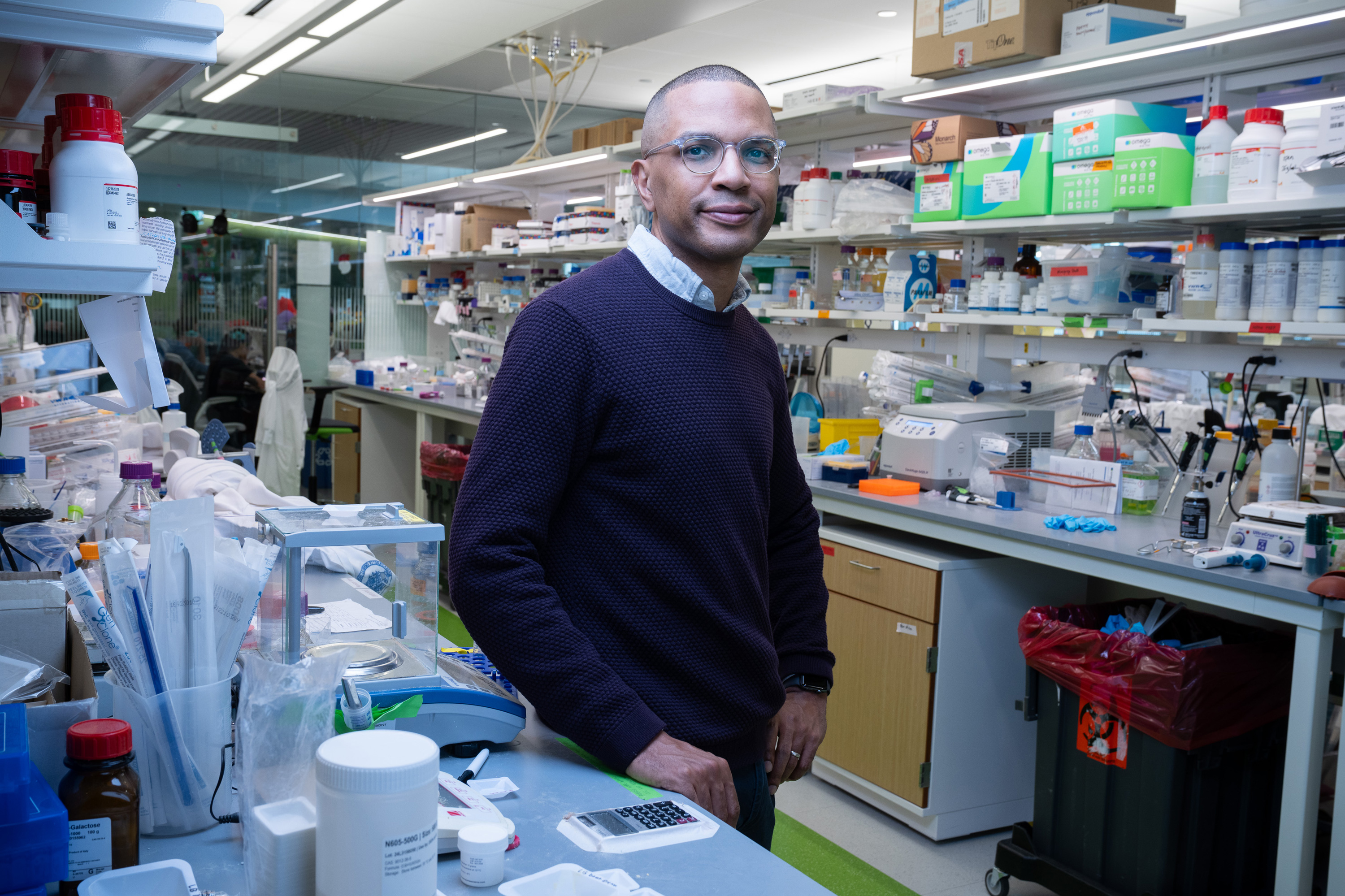
Ask Bryan Bryson why he built a lab around tuberculosis and he starts with first principles. “Here is a pathogen that has probably killed more people in human history than any other pathogen, so you want to learn how to kill it,” he says. “That has really been the core of our scientific mission since I started my lab. How does the immune system see this bacterium and how does the immune system kill the bacterium? If we can unlock that, then we can unlock new therapies and unlock new vaccines.”
Engineering the measurements that vaccines need
BCG, the century‑old vaccine used in many countries, offers inconsistent protection against adult pulmonary TB, leaving an unmet need for new options. Bryson’s team centers its work on a problem that often stalls vaccine discovery: measuring, with precision, which fragments of Mycobacterium tuberculosis (Mtb) human cells actually display to T cells during infection. “To me, making a better TB vaccine comes down to a question of measurement, and so we have really tried to tackle that problem head-on. The mission of my lab is to develop new measurement modalities and concepts that can help us accelerate a better TB vaccine,” he says.
The lab’s approach focuses on antigens that appear on the surface of infected cells. Of Mtb’s more than 4,000 proteins, only a small subset are consistently presented to immune cells. Bryson’s group has developed methods to identify these targets, finding that many belong to type VII secretion system substrates, including proteins exported through the ESX-1 pathway that are known to shape how infected human macrophages present antigens to CD8+ T cells. By combining mass spectrometry-based “immunopeptidomics” with functional assays, the lab is defining which of the roughly 100 type VII substrates reliably appear in the MHC class I repertoire in real human infections, and how that display shifts with genetic background.[1]
- Discovery to date: antigens displayed in about 50% of the population identified; ongoing work aims to complete coverage across diverse genetic backgrounds.
- Rationale: mapping real, in-human presentation increases the odds a vaccine will recruit the right T‑cell responses in the populations most affected by TB.
The public-health stakes of getting it right
Tuberculosis remains one of the world’s leading infectious killers, with global deaths still exceeding one million each year. Disease control hinges on faster diagnosis and effective treatment, but durable vaccine protection-especially for adolescents and adults-would shift the trajectory for health systems and economies, and reduce the long-term burden on national TB programs and social protection schemes.
| Population impacts | Health-system implications |
|---|---|
|
|
From antigen maps to a regulatory pathway
Identifying the right antigens is only the start. New TB vaccines must meet stringent standards before routine use. The path typically runs from preclinical evaluation through Phase 1-3 trials, national licensure, global policy recommendations, and finally procurement and introduction. For many low- and middle‑income countries, World Health Organization (WHO) policy and formal prequalification are key to unlocking international financing and uptake.
| Stage | Key objective | Evidence required | Common bottlenecks | System enablers |
|---|---|---|---|---|
| Antigen discovery | Identify targets presented on infected human cells | Reproducible immunologic presentation across diverse HLA types | Limited access to well-characterized human samples | Biobanks, standardized assays, data-sharing |
| Preclinical | Demonstrate immunogenicity and safety | Robust T‑cell responses; toxicology profiles | Animal models imperfectly reflect human TB | Consensus endpoints; translational biomarkers |
| Phase 1-2 | Safety, dosing, and immunogenicity in adults/adolescents | Adverse event monitoring; correlates of protection (if available) | Lack of validated correlates | Adaptive designs; immune-marker standardization |
| Phase 3 | Efficacy against disease | Incidence reduction in high-risk populations | Large, multi-year trials in high-burden settings | Networked trial sites; sustained funding |
| Licensure & policy | Regulatory approval and policy recommendations | Risk-benefit assessment; manufacturing quality | Manufacturing scale-up; affordability | Quality assurance; transparent pricing; volume guarantees |
What a next-generation TB vaccine must prove
- Protection against pulmonary disease in adolescents and adults, the main drivers of transmission.
- Durable immunity across diverse genetic backgrounds, reflected in antigen choices that capture global HLA diversity.
- Compatibility with BCG programs for infants, with clear guidance for co‑administration or revaccination strategies.
- Safety in populations with high rates of HIV and other comorbidities.
- Feasible cold-chain and dosing schedules that health systems can implement at scale.
Risk and vulnerability remain uneven
TB is an airborne disease that exploits social and biological vulnerabilities. Preventive strategies and eventual vaccination will have to meet those realities head-on, and policy-makers will need to align TB vaccine roll-outs with broader agendas on poverty reduction, housing, and worker protections.
- Higher risk of TB disease is associated with HIV infection, undernutrition, diabetes, tobacco exposure, and heavy alcohol use.
- Congregate settings-such as mines, prisons, and shelters-can amplify transmission without strong infection control.
- Rural and peri‑urban areas often face diagnostic delays that raise community exposure.
Designing for universality through diversity
Bryson’s lab is using population genetics to inform antigen selection. By analyzing blood samples from people with varied HLA backgrounds, the team is assembling a set of targets that could elicit protective responses in nearly everyone. The aim is to move from antigen panels that work well in narrow cohorts to a portfolio that generalizes across continents and aligns with the genetic diversity seen in high-burden settings.
“That postdoc really taught me how to think bravely about what you could do if you were not limited by the measurements you could make today,” Bryson says. “What are the problems we really need to solve? There are so many things you could think about with TB, but what’s the thing that’s going to change history?”
Manufacturing and delivery: the system test
A successful candidate would still face the realities of production and rollout. In many countries, national immunization programs will look for alignment with existing schedules, consistent supply, and clear clinical guidance. For global access, coordination with procurement and delivery partners typically begins once clinical efficacy is clear and policy bodies signal demand. Information for the public and health workers will be essential to build trust and counter misinformation surrounding TB and new vaccines.
| System capacity questions | Operational considerations |
|---|---|
|
|
Milestones on the road to first‑in‑human testing
- Finalize antigen set spanning type VII secretion substrates with broad HLA coverage.
- Formulate vaccine platform and complete preclinical safety and immunogenicity studies.
- Prepare manufacturing and quality controls suitable for early-phase trials.
- Initiate Phase 1 trials to establish safety profile and dose range.
The team’s planning horizon anticipates animal testing and translational steps leading to clinical trial readiness “in about six years.”
The human factor behind the science
Bryson credits family and mentorship for the lab’s ambitious posture. “My mom decided to raise all four of her children by herself, and she made it look so flawless,” he says. “She instilled a sense of ‘you can do what you want to do,’ and a sense of optimism. There are so many ways that you can say that something will fail, but why don’t we look to find the reasons to continue?” That optimism extends to the campus community as well. “The engineer ethos of MIT is that yes, this is possible, and what we’re trying to find is the way to make this possible,” he says. “I think engineering and infectious disease go really hand-in-hand, because engineers love a problem, and tuberculosis is a really hard problem.”
Outside the lab, the engineering mindset occasionally turns culinary. “Recently I did flavors of fall, so I did a cinnamon ice cream, I did a pear sorbet,” he says. “Toasted marshmallow was a huge hit, but that really destroyed my kitchen.”
Ending the TB epidemic will require coordinated action across science, regulation, financing, and delivery. As new candidates move through trials, the global community will need to translate immunologic insight into equitable access-so that any vaccine that works can reach the people who need it most. For basic facts on tuberculosis, readers can consult widely used public‑health resources from WHO and national health authorities.