
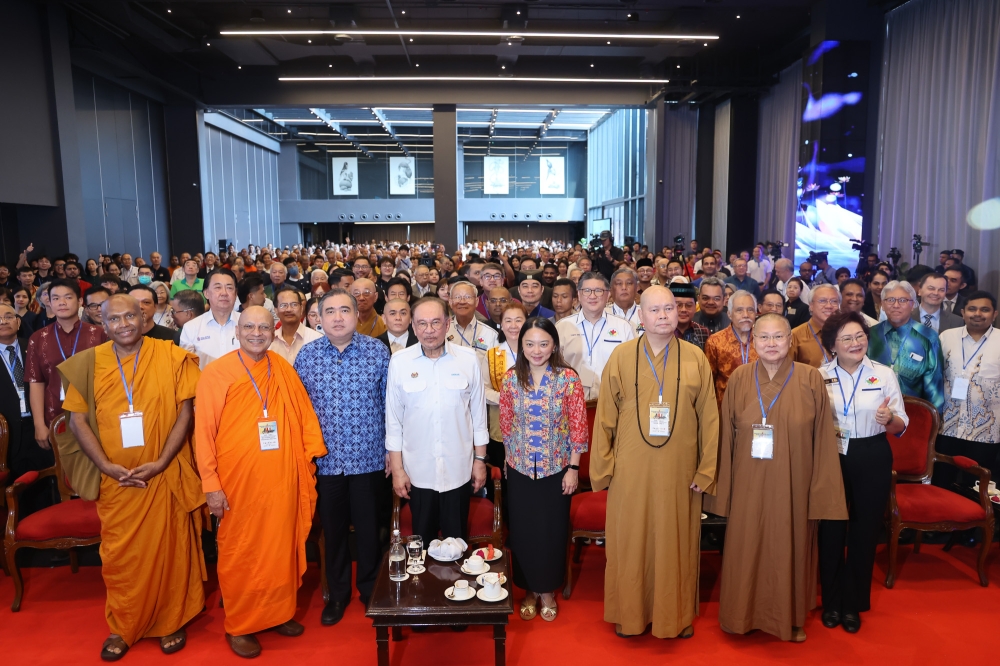
KUALA LUMPUR – Prime Minister Datuk Seri Anwar Ibrahim has called on the Malaysian public to unify under common moral values and decisively reject “hate politics,” warning that a small but vocal minority continues to fuel division within the country.
The appeal comes at a critical juncture for Malaysia, as the administration of the “Unity Government” struggles to maintain social cohesion amidst a rising tide of ethno-religious nationalism. Speaking at the Wesak Day national conference at Menara Ken in Taman Tun Dr Ismail (TTDI), Anwar framed the rejection of polarization not merely as a political necessity, but as a moral imperative.
This diplomatic outreach to the Buddhist community is a central pillar of Anwar’s “Malaysia Madani” framework, a policy vision designed to steer the nation toward a sustainable, caring, and respectful society. By bridging the gap between the Muslim majority and minority faith groups, the Prime Minister is attempting to neutralize the influence of hardline political factions that have gained traction by emphasizing racial and religious exclusivity.
A Synthesis of Moral Values
During his keynote address, Anwar urged Malaysians to reflect on core Buddhist tenets, arguing that these principles are universal and find parallel resonance within Islamic teachings. He specifically highlighted the values of sila (moral conduct), karuna (compassion), and panna (wisdom).
“These are not just values and principles. They are habits of the heart,” Anwar said.
The Prime Minister’s focus on “habits of the heart” suggests a strategy of cultural integration over mere legal tolerance. He acknowledged that despite state efforts to accelerate economic growth, education, and technological advancement, elements of hatred remain entrenched in the social fabric.
“The majority of Malaysians must have the principles (to reject hate politics). Only a minority portion of people are causing the fear-mongering,” Anwar said.
Framing the appeal in ethical rather than partisan terms allows Anwar to cast the rejection of hate politics as a shared civic duty, rather than a defence of his administration. It also places moral responsibility on the broader public, beyond party structures, to uphold the spirit of Malaysia’s multi-religious social contract.
State Sponsorship of Pluralism
The conference marked a significant shift in the government’s engagement with the Buddhist community. According to Transport Minister Anthony Loke, who attended the event alongside Minister in the Prime Minister’s Department (Federal Territories) Hannah Yeoh, the level of state involvement was unprecedented.
“This is the first time the government is co-organising the Wesak Day national conference and it is also the first one to be attended by the country’s prime minister,” Loke said in his welcoming remarks.
To institutionalize this support, the government has provided significant financial backing to ensure the reach of the celebration extends beyond the urban elite to grassroots communities. The funding structure includes:
- A total allocation of RM2.5 million approved by the Prime Minister for the organization of the national conference.
- Direct grants to approximately 1,000 Buddhist organizations to facilitate local celebrations and grassroots activities.
- A token of RM2,000 provided to each individual organization for their specific local initiatives.
Officials say the allocations are meant not only to underwrite a single festival but to normalize visible state support for minority faith communities as part of the broader Malaysia Madani agenda.
Loke expressed his hope that the national conference would become an annual fixture of the Malaysian calendar, signaling a permanent shift toward inclusive governance. If sustained, such engagement could embed Buddhist-Muslim dialogue more firmly in the country’s policy calendar, complementing interfaith initiatives already present at federal and state levels.
The Geopolitical and Internal Stakes
The Prime Minister’s emphasis on unity is an implicit response to the “Green Wave”-a term used by analysts to describe the surge of support for the conservative Perikatan Nasional (PN) coalition, particularly the Pan-Malaysian Islamic Party (PAS). These groups have frequently campaigned on platforms that prioritize the primacy of the Malay-Muslim identity, often creating friction with Malaysia’s significant Chinese and Indian minorities.
Malaysia’s constitutional framework, set out in the Federal Constitution, establishes Islam as the religion of the Federation while guaranteeing the right of other religions to be practiced in peace and harmony. However, the practical application of this pluralism has faced increasing pressure as identity politics becomes a primary tool for electoral mobilization.
By aligning Buddhist values with Islamic ethics, Anwar is attempting to build a cross-faith coalition of moderates capable of resisting the pull of religious extremism. This approach mirrors broader regional trends in Southeast Asia, where governments are increasingly forced to navigate the tension between democratic pluralism and conservative religious revivalism.
Domestically, the push sits within Anwar’s Malaysia Madani policy blueprint, which calls for “civil and compassionate” governance across ministries. The Malaysian government continues to coordinate with various religious councils and community leaders to implement the Madani guidelines across federal agencies, testing whether a values-based narrative can translate into lasting institutional practice.