
US Open 2026: Zverev’s New York Breakthrough Caps a Transformative Fortnight in Tennis
The 2026 US Open closed in New York with Alexander Zverev winning the men’s singles title and adding a significant new chapter to German tennis history, while Elena Rybakina claimed the women’s singles crown in a final that underlined her status at the top of the sport. Across singles and wheelchair events, the second week at Flushing Meadows delivered career-defining results and sharpened the contours of the men’s and women’s games heading into the final stretch of the season.
A fortnight defined by Zverev’s ascent
The defining storyline of the tournament’s second week was Zverev’s march to, and ultimate victory in, the men’s singles final. Seeded No. 1 and already a Grand Slam champion after his breakthrough at Roland-Garros earlier in the year, the German arrived in New York with both expectation and historical weight on his shoulders. He had previously come agonisingly close to a US Open title in the 2020 final, and his 2026 campaign was framed as a test of whether he could convert consistent deep runs into another major.
His opponent in the championship match, American Ben Shelton, brought a contrasting narrative: a powerful, aggressive game, a recent Masters 1000 title in Montreal and the momentum of a run that had elevated him into the core of the home nation’s hopes. Pre-final analysis highlighted Shelton as one of the form players of the North American summer swing, albeit still a step below the major-winning experience of Zverev.
Across four sets in the final, Zverev imposed his baseline control and serving precision to secure the title and end another American men’s home challenge, extending the drought that has persisted since Andy Roddick’s 2003 triumph. For German tennis, the win means Zverev now stands alongside Boris Becker as a multiple major champion and alongside Becker and Michael Stich in shaping the modern history of the country’s men’s game. His earlier Roland-Garros title had already made him the first German man in the Open era to win in Paris and the first German man to win any Slam since Becker’s 1996 Australian Open victory; New York confirms him as a central figure in the post-“Big Three” landscape.
Career and tour implications
- Grand Slam profile: Zverev’s 2026 season now includes titles at Roland-Garros and the US Open, plus a final at Wimbledon, establishing him as the only man to reach the second week at all four majors this year and reinforcing his credentials as an all-surface contender.
- German records: By reaching a second US Open final, he moved beyond Becker, Stich and Gottfried von Cramm in that specific New York milestone; by winning it, he joins Becker as the only German men’s singles champions in the Open era at multiple majors.
- Ranking and year-end stakes: With a major title in New York added to Paris and deep runs elsewhere, Zverev strengthens his case in the battle for the year-end No. 1 and for honours such as the official season-ending awards administered by the men’s tour.
- American men’s trajectory: Shelton’s run to the final, coupled with recent results from other US players on hard courts, suggests the host nation has a clear front-runner for future Slam success, but the loss underlines the gap that still exists at the last hurdle.
Rybakina’s US Open title cements a changing women’s order
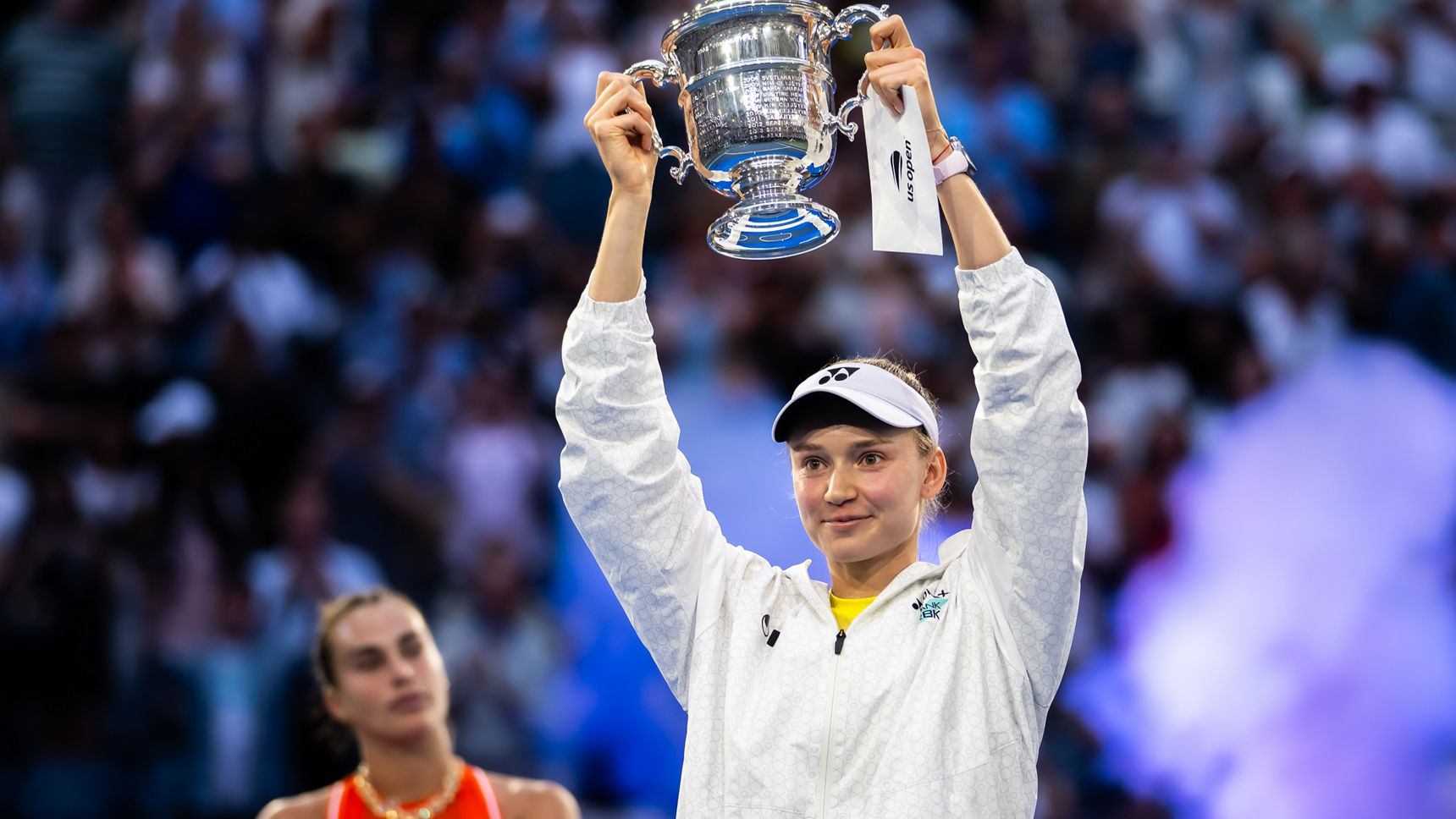
On the women’s side, Elena Rybakina’s victory over two-time defending champion Aryna Sabalenka in the final completed a sequence that has defined the top tier of the WTA in 2026. Rybakina, who had already beaten Sabalenka in the WTA Finals at the end of 2025 and in the 2026 Australian Open title match, extended that pattern in New York by winning in three sets to secure her first US Open trophy and further validate her status as the world No. 1.
The final pitted the top two seeds against each other, reviving a rivalry that has become one of the key matchups in women’s tennis over the past two seasons. Sabalenka entered the match with a streak of winning at least one major every year since 2023 and with the added objective of defending her US Open title; the defeat ended both the title defence and that annual Slam sequence.
Rybakina’s win also placed her within a historical context at Flushing Meadows: it was the first time since 2013, when Serena Williams defeated Victoria Azarenka, that the women’s final featured the No. 1 and No. 2 seeds and ended with the top seed lifting the trophy. For the women’s game, the result reinforces a structure at the summit in which a small group of players repeatedly meet in the latter stages of the biggest events on multiple surfaces.
How the women’s tournament reshapes the picture
- Leadership at No. 1: By adding the US Open to her Australian Open title this season, Rybakina backs up the ranking points that took her to No. 1 with tangible silverware in two different major environments.
- Sabalenka’s standard: Falling short of the title does not erase the scale of Sabalenka’s recent run, but it introduces new pressure into a rivalry in which Rybakina now holds decisive wins in high-profile finals.
- Hard-court hierarchy: With two of the season’s biggest hard-court trophies in her possession, Rybakina emerges from New York as the primary reference point for the next phase of the tour on this surface.
Wheelchair titles underline depth and longevity
The second week also completed a milestone edition of the US Open Wheelchair Championships, staged under the tournament’s broader umbrella at the USTA Billie Jean King National Tennis Center. In men’s wheelchair singles, Alfie Hewett defeated world No. 1 and defending champion Tokito Oda in straight sets, halting Oda’s bid for a calendar-year Grand Slam. The result is significant both competitively and symbolically: Hewett’s win rebalances a rivalry that had increasingly tilted toward the younger Japanese player and preserves the rarity of a single-player sweep of all four majors in a season.
In another draw, Niels Vink achieved precisely that feat, completing a calendar-year Grand Slam with victory in New York. In women’s wheelchair singles, Yui Kamiji added another major title in the year that wheelchair tennis marks its 50th anniversary, lifting the trophy in front of many of the sport’s pioneers. The confluence of historic performance and historic commemoration underscored how the US Open platform is being used to position wheelchair tennis more centrally within the global calendar.
Why the wheelchair results resonate
- Calendar-year achievement: Vink’s sweep of all four majors in a single year is one of the rarest accomplishments in any form of tennis and confirms his dominance in his division.
- Hewett vs. Oda: Hewett’s victory over the world No. 1 in New York ensures that the men’s wheelchair hierarchy remains competitively dynamic rather than linear.
- Legacy and governance: Kamiji’s title during the 50th-anniversary celebrations reinforces the institutional work done by the sport’s global regulator, the International Tennis Federation, to integrate wheelchair events fully into the Grand Slam structure.
Structuring a global season from Flushing Meadows
The US Open, organised annually in New York as one of the four Grand Slam events under the framework of the United States Tennis Association, traditionally acts as both culmination and turning point. The 2026 edition has been no different.
On the men’s side, Zverev’s dual-major season changes the arithmetic of the race to end the year as world No. 1, while Shelton’s run consolidates him as a long-term fixture in the late stages of hard-court majors. For national federations, these trajectories inform decisions on Davis Cup selections, Olympic preparation strategies and investment in surface-specific development programmes.
For the women, Rybakina’s victory and Sabalenka’s near-miss extend a period in which the same core of players contest the key matches at the sport’s biggest events. That stability at the top, in turn, shapes commercial planning, scheduling of marquee night sessions and broadcast narratives as the tours pivot toward the year-end championships and the early hard-court swings of 2027.
In wheelchair tennis, the combination of a calendar-year Grand Slam, an upset of the world No. 1 and an anniversary title is likely to be used by organisers and regulators as evidence that integrated scheduling at the majors is delivering both sporting and institutional returns. It strengthens the case for continued expansion of draws, prize money alignment and broadcast coverage in the seasons to come.
By the time the lights went down on this year’s night sessions in New York, the 2026 US Open had delivered more than a list of champions. It had clarified hierarchies, reset targets and offered a snapshot of where the sport is headed, from the top of the men’s and women’s games to the most decorated names in the wheelchair disciplines.
Related reading
- Arteta Criticizes VAR Decision After Arsenal Victory, Warns of Premier League Title Impact
- Montreal Canadiens Extend Martin St. Louis Through 2030 as Team Prepares for New NHL Season
- Ariake vs. Kumamoto Kogyo: Score, Results & Highlights | Autumn High School Baseball Kumamoto Tournament (archysport.com)
