
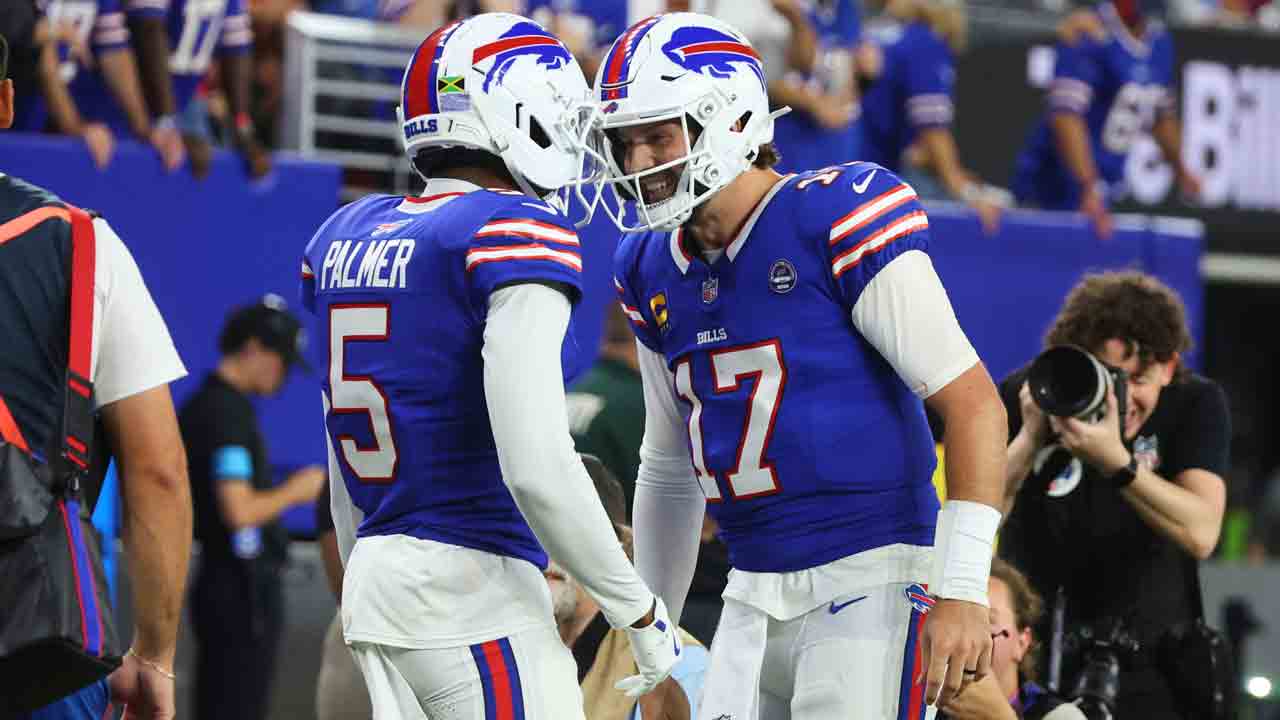
Allen Owns Bills’ New Era as Buffalo Outguns Injury-Hit Lions
Quarterback delivers five-touchdown statement in first regular-season game at $2.1 billion home
ORCHARD PARK, N.Y. – Forget the branding on the façade of the Buffalo Bills’ new stadium. On opening night, it belonged unmistakably to Josh Allen.
The quarterback put an immediate stamp on Highmark Stadium, throwing three touchdown passes and running for two more in a 41-31 victory over the Detroit Lions in the first regular-season game at the $2.1 billion facility.
In a setting that underlines the National Football League’s status as the dominant commercial force in North American team sport, Allen’s performance gave the Bills exactly what any franchise wants when it moves into a new building under the NFL’s modern stadium and game-operations framework: a marquee win led by its franchise player.
Emotional anthems, clinical football
Allen said the only time emotion threatened to overtake him came before a snap had been played, during the performances of the U.S. and Canadian national anthems.
“I caught myself taking it all in and understanding how cool what I get to do. My job is the coolest in the world,” Allen said. “It’s everything I ever wanted, to be the quarterback of an NFL franchise. I’m just very fortunate to have ended up in Buffalo.”
Once the game began, sentiment gave way to execution. After rewriting many of Buffalo’s scoring and passing records during his first eight seasons across the street at the old Highmark Stadium, the 30-year-old looked instantly at home in the new environment.
Allen opened the scoring with a 1-yard plunge 5:51 into the game, recording the first touchdown at the new stadium. His second rushing score, a 2-yard run, was the 83rd rushing touchdown of his career, tying him for 18th on the NFL all-time list with Hall of Famer Jim Taylor.
That ground production complemented a sixth career five-touchdown outing, coming one week after he accounted for four touchdowns in Buffalo’s season-opening 36-31 win at New Orleans. Early-season form of that consistency usually places a quarterback squarely in the conversation for individual accolades and keeps a team on pace in a tightly structured conference playoff race.
Brady’s aggression rewarded as Bills start fast
Head coach Joe Brady backed his quarterback and offence from the opening coin toss. Confident enough to take the ball first, rather than defer, he leaned into the atmosphere generated by a fan base experiencing its new home for the first time in a regular-season game.
“Anytime the ball’s in his hands, good things happen. And yeah, love that guy,” Brady said of Allen. “I wanted us to take the ball in this environment and set the tone. That was the start that we needed.”
The decision produced precisely that. Buffalo scored on each of its first four possessions:
- Josh Palmer’s 43-yard touchdown catch, created when Detroit’s coverage collapsed on DJ Moore in the flat and left Palmer uncovered deep.
- Dawson Knox’s 2-yard reception.
- Dalton Kincaid’s 16-yard touchdown grab.
- Allen’s early quarterback sneak to open the scoring.
By the time the Lions found any rhythm, the Bills’ offence had asserted itself and forced Detroit to chase the game for the remaining three quarters – a difficult proposition against a unit operating with this level of efficiency.
Stat line underlines Allen’s control
Allen completed 20 of 31 passes for 248 yards and three touchdowns, adding 69 yards rushing alongside his two scores on the ground.
James Cook provided balance on the ground, rushing for 134 yards and sealing the contest with a 1-yard touchdown run with 2:50 remaining. That late score came after Detroit’s final serious push had stalled and underlined Buffalo’s ability to manage the closing stages once in front.
Buffalo’s 41 points were the third-most by a team in its regular-season debut at a new stadium, trailing only Dallas, which scored 44 in its first game at Texas Stadium in 1971, and Miami, which scored 42 in its first outing at Joe Robbie Stadium in 1987. For an international audience, those figures place the Bills’ night within a small group of high-scoring launches in the league’s modern era of venue development.
Injury-hit Lions pay for slow start
Detroit travelled with ambitions of spoiling the occasion but were undone by a combination of early errors, an injury-depleted defence and a banged-up offensive line that struggled both to create running lanes for Jahmyr Gibbs and to protect quarterback Jared Goff.
“You play an opponent as potent as this, you don’t have the luxury of spitting and sputtering early,” head coach Dan Campbell said of falling behind 21-0 with 11:48 left in the second quarter. “We needed to play. It didn’t have to be spotless, but it certainly needed to be a lot cleaner than that.”
The Lions’ defence endured a difficult first half, allowing the Bills to score 27 points and gain 299 yards before the interval, and 446 yards overall. For a team with aspirations of being a consistent contender in the NFC, those numbers will fuel internal review sessions on tackling, coverage communication and early-game preparation.
Goff’s production not enough
Detroit’s offence eventually responded. After rallying to cut Buffalo’s lead to 34-24 on Sam LaPorta’s 1-yard touchdown catch four minutes into the fourth quarter, the Lions briefly threatened to turn the season’s first visit to Orchard Park into a genuine contest.
But, backed up at their own 10-yard line on the next drive, they went three-and-out. Goff had two passes tipped at the line by Deone Walker, and Gibbs was stopped for no gain. Forced to punt from deep in their own territory, the Lions handed Buffalo the field position that allowed Cook to finish the game off.
Goff’s individual numbers reflected the aggressive approach Detroit had to adopt while trailing. He finished 26 of 38 for 327 yards and four touchdowns, supported by Amon-Ra St. Brown’s nine catches for 142 yards and two scores. Gibbs added an 11-yard touchdown catch but was limited to 52 rushing yards as the ground game never fully established itself behind a compromised line. LaPorta’s 1-yard score completed a productive night for Detroit’s receiving options, even as the result slipped away.
“I think we knew what type of game it was going to be, and we dug ourselves in that hole,” Goff said. “Against a team like that with the offence they have, it was really tough to get back in it.”
Historic pairing, frustrating miscues
One of the few long-term markers for Detroit came from its young offensive core. St. Brown and Gibbs have now scored in the same game 22 times, moving into a tie for fourth place in matching the Cleveland receiver-running back combination of Paul Warfield and Leroy Kelly. That consistency underscores why Detroit is investing its system around them, even as this particular night highlighted broader structural concerns.
The Lions’ problems were visible from Buffalo’s second drive. Two defenders converged on DJ Moore in the flat, leaving Palmer free for his 43-yard touchdown reception. On the following series, a holding penalty on Rock Ya-Sin wiped out Skyler Gill-Howard’s interception of a tipped pass, denying Detroit a potential momentum-changing takeaway.
In the context of a league in which possession, field position and turnover margin are heavily emphasized, those moments represented costly lapses against a high-functioning opponent.
Injuries and depth tested on both sidelines
Both teams suffered injury setbacks that tested roster depth and will be monitored closely as the season progresses under the NFL’s strict game-day roster and injury-reporting rules.
- Lions: Defensive back Avonte Maddox injured his right foot during a three-player collision in the end zone in the second quarter and did not return.
- Bills: Starting defensive lineman Ed Oliver was ruled out after hurting his hip during pre-game warmups, leaving Buffalo with four healthy linemen. Wide receiver DJ Moore was ruled out after injuring his shoulder and head when Ya-Sin landed on him as he attempted to make a catch in the end zone.
For Buffalo, absorbing the loss of Oliver and Moore yet still generating sustained pressure and explosive plays adds to the sense that this roster has enough depth to withstand the attrition that shapes every NFL season. For Detroit, the Maddox injury further stretches a secondary already being asked to manage complex assignments against elite quarterbacks.
Stadium debut sits within wider NFL landscape
With a capacity and design tailored to contemporary broadcast, hospitality and fan-experience expectations, the Bills’ new home reflects a broader strategic trend across major North American sports, where venues are built as multi-purpose revenue engines as much as sporting arenas. Delivering a high-scoring win in the first regular-season game helps validate that investment to season-ticket holders, sponsors and local stakeholders alike.
Buffalo’s 41-point output on opening night also reinforces the franchise’s recent identity as one of the league’s most aggressive offences. In an AFC landscape where playoff places are determined within a structured seeding system and divisional balance is closely monitored by the league office, early-season momentum can heavily influence January positioning.
Next on the schedule
Both teams now turn quickly toward fixtures that will shape their early campaigns:
- Lions: Host the New York Jets on Sept. 27.
- Bills: Host New England on Sept. 27.
Both games, played under the same regular-season format that governs this opener, will further test whether Buffalo can convert its new home into a sustained competitive advantage and whether Detroit can translate its flashes of offensive efficiency into results against top-tier opposition.
Worth a look
