
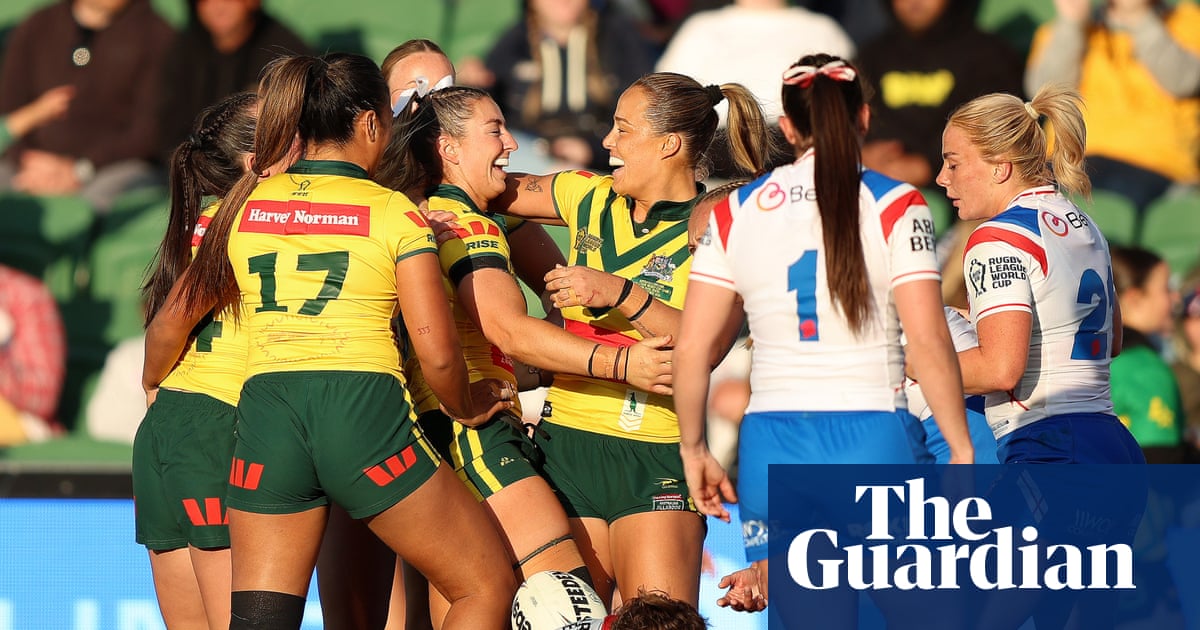
‘Worlds apart’: Jillaroos’ 78-0 demolition exposes England’s women’s rugby league gap
Australia’s Jillaroos have delivered a stark reminder of where power now resides in the women’s game, crushing England 78-0 in Perth and underlining a growing imbalance between the northern and southern hemispheres at this Rugby League World Cup.
The 15-tries-to-none rout not only confirmed the gulf in athleticism, skill and depth between the sides; it also reinforced the widening structural divide between a fully professional system in Australia and a developing pathway in England. After a 90-4 defeat in Las Vegas last year, this was further evidence that England’s women are slipping out of touch with the standard being set around the Pacific.
Brutal opening sets tone in Perth
England arrived having never beaten the Jillaroos in four previous meetings and needed a composed start to settle. Instead, they handed the initiative away almost immediately.
Offside from the kick-off, England conceded early field position and invited the hosts into their half. On Australia’s first serious foray, full-back Tamika Upton sliced through the defensive line on her opening carry, a run that set the rhythm for the afternoon.
Seconds later, back-rower Tiana Penitani-Gray – promoted into the starting lineup – drew in two defenders and shifted the ball to winger Jaime Chapman, who had a simple finish. England then compounded the damage when debutant half-back Jenna Foubister sent the subsequent kick-off out on the full, again placing her side under immediate pressure.
On the last tackle of the resulting set, five-eighth Jocelyn Kelleher, who had only made her own international bow for Australia the previous week, produced a precise attacking kick that arced over England winger Anna Davies. Chapman read it early, climbed above the defence and grounded for a spectacular second try that encapsulated the difference in timing and confidence between the teams.
Video reprieve the closest England came
Chapman’s afternoon began flawlessly, but a knock-on soon handed England rare attacking ball inside 20 metres. Davies thought she had dragged her side back into the contest, sneaking around the Australian edge defence to dive for the corner. The video referee intervened, however, spotting her knee brushing the sideline before the ball was grounded.
That narrow call was as close as England would come to scoring. From that moment, almost all of the meaningful play unfolded at the opposite end, with Australia dictating territory and tempo.
Upton, Kelleher and Australia’s spine dominate
Upton quickly assumed control of the contest. With repeated line breaks – including on kick returns – she surged past 100 running metres well before the 20-minute mark, constantly putting England on the retreat and allowing the Jillaroos to attack in good-ball sets.
On one standout play, England full-back Fran Goldthorp appeared to have Upton contained, only for the Australian to shrug clear and send Kelleher over for Australia’s third try. By then, the Jillaroos’ spine was dictating play at will.
Julia Robinson, shifted from the wing into the centres, crossed for the fourth try to extend the margin. Shortly afterwards, Robinson was forced from the field clutching her arm after contact from a tackle by Shaylee Bent, with the injury suspected to be a broken wrist. Her departure opened the door for another international debut as Sariah Paki, a premiership winner at club level and two-time Olympian in rugby sevens, entered the contest.
Power and polish expose structural divide
What followed underlined that this was more than a bad day at the office for England. The physical and technical disparity was evident across the park, reflecting the effect of longer professional seasons and elite pathways in Australia compared with a still-evolving domestic structure in England.
After forward Olivia Kernick was held just short, the ball was swept left in a cleanly rehearsed move. Half-back Tarryn Aiken engaged the line, with a hard, straight decoy run from Paki freezing the cover defence. Kelleher, running a powerful line outside, took the ball and drove over, the movement showcasing both the Jillaroos’ tactical cohesion and the fatigue already visible in English legs.
The contest was effectively finished before the interval but Australia showed little inclination to ease up. Captain Isabelle Kelly crossed to push the scoreline out to 30, then winger Abbi Church – recalled to the starting side – finished a flowing movement to make it 36-0 at half-time, the Jillaroos having scored more points than minutes played.
Match facts
- Fixture: Australia (Jillaroos) vs England, women’s Rugby League World Cup, Pool A
- Venue: HBF Park, Perth
- Score: Australia 78-0 England
- Tries: Australia 15, England 0
- Notable scorers: Multiple tries to Jaime Chapman and Jocelyn Kelleher; debut tries for Makenzie Weale
- Key statistics (Australia advantage): roughly double the possession, triple the run metres, 13 line breaks to none
Second-half procession and moments of flair
The pattern barely changed after the restart. Aiken, Kernick and replacement Quincy Dodd all crossed early in the second half as Australia surged past the 50-point mark, consistently slicing through despite England attempting to tighten the middle.
By the final quarter, the statistical dominance was emphatic: Australia had enjoyed roughly twice the possession, amassed three times the run metres and racked up 13 line breaks to England’s none, with more than 20 minutes still on the clock. The long-standing rivalry between the nations had, on this evidence, tilted decisively one way.
Yet there remained flashes of entertainment. One of the standout passages saw Kelleher chip over the defensive line, regather her own kick and link with Upton, who drew the defence before sending Church over. It was a sweeping sequence that underlined the Jillaroos’ confidence to play expansively even with the result long sealed.
On debut, forward Makenzie Weale added her own try off the bench, a small personal milestone amid the avalanche of points. Penitani-Gray, Kelly and Bent then crossed for further late four-pointers to complete the 78-0 scoreline.
The England fans who had packed into HBF Park after watching their men’s side dispatch France 82-0 earlier in the day were left with a brutal contrast between the two national programmes.
World Cup stakes and what the scoreline reveals
The tournament sits under the umbrella of the sport’s global governing body, the International Rugby League, and results at this level carry consequences that extend beyond immediate World Cup qualification scenarios.
For Australia, such a heavy win strengthens an already formidable reputation and reinforces selection depth heading into the knockout phase. The Jillaroos will face Wales in Sydney next Sunday, a fixture that, on current evidence, shapes as another near-formality. The real scrutiny will arrive in the semi-finals, where a likely encounter with Fiji awaits; the Fijians pushed the Kiwi Ferns in the opening round and then brushed aside Papua New Guinea 40-4 in Port Moresby, suggesting a more physically testing assignment ahead.
For England, the defeat is more than a bad result – it raises questions about pathways, investment and competition quality at domestic level. The national side now head into a decisive third pool match against Samoa, who thrashed Wales 76-0 on Friday. England must win that game to stay on track for the semi-finals, where they would probably meet New Zealand.
That task looks significantly more daunting set against Samoa’s recent performance, having restricted the Jillaroos to 40 points last week. With that benchmark now in mind, England’s 78-0 loss suggests not just a tactical shortfall but a wider challenge in matching the intensity and speed produced routinely in the southern hemisphere.
Pressure point for England’s programme
World Cup campaigns often shape national federation decisions on central contracts, coaching structures and investment in domestic leagues. While no such decisions have been announced around this team, a result of this magnitude inevitably intensifies the examination of England’s women’s programme at policy level.
In practical terms, the immediate priority is short turnaround recovery and mental reset before facing Samoa. The group permutations are simple: England require victory on Friday to progress to the semi-finals; defeat would leave them heading home early from a tournament in which the men’s side are thriving.
Beyond this week, the margin in Perth will be cited as evidence that, for now, the women’s rugby league universe orbits firmly around Australia and its Pacific neighbours. Bridging that divide will demand more than a single tactical rethink; it will require sustained structural work from England’s rugby league authorities to ensure that nights like this do not become a recurring feature of the international calendar.
Related reading
- Cox Plate 2026: Jockey Insights, Race Analysis, and Future Prospects at Flemington
- Will Lankshear’s Brace Propels Middlesbrough to Championship Summit with 5-1 Victory Over Bolton
- Canada 31-22 England: Canada beats England in Ottawa (archyde.com)
- Women's Rugby League World Cup: England crush debutants Wales in Perth (globallypulse.com)
