
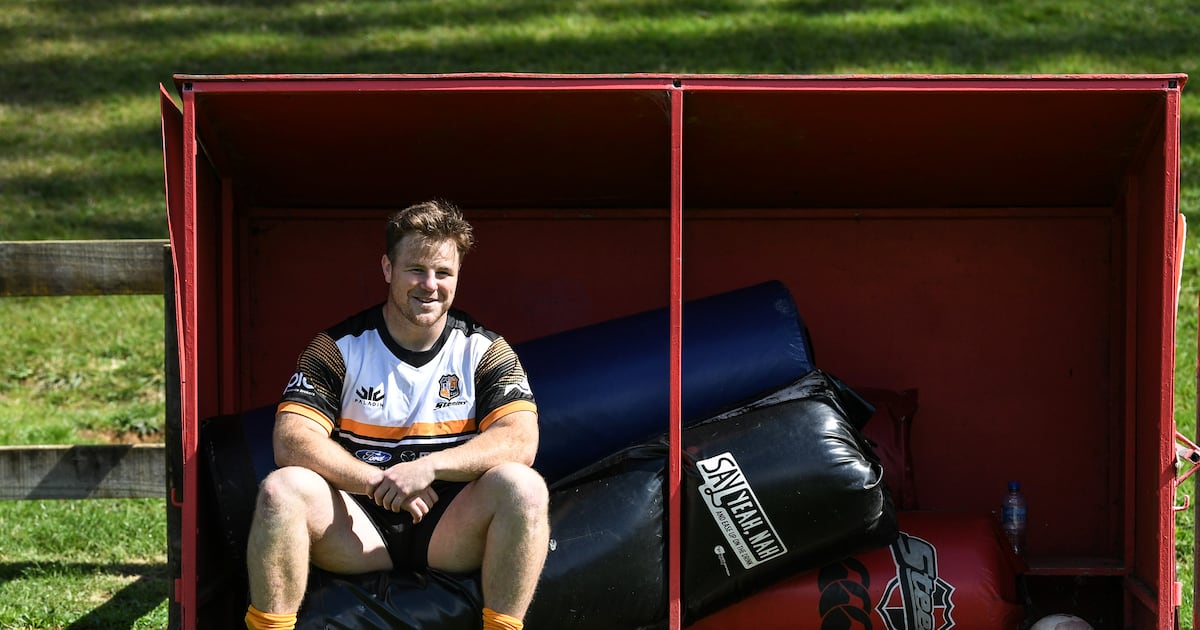
‘The Shortest Career in International History’: Conán O’Donnell and the Thin Line Between Nearly and Never
A prop who went everywhere – except the one place that really mattered
“Andy Farrell said to me, ‘Conán, this is the shortest career in international history.’”
For most professional players, a call from the Ireland head coach is the start of something. For Conán O’Donnell, it was almost the start and the abrupt end on the same night – a fleeting brush with full Test status that never made it as far as the team bus.
By then, O’Donnell had already lived a career that criss-crossed hemispheres. Between Ireland Under-20s, Connacht, Japan’s Sunwolves, New Zealand’s Highlanders and Major League Rugby side Toronto Arrows, the Sligo-born tighthead spent roughly eight years in the professional game. Yet when the improbable invitation to join up with Ireland did come, his involvement lasted barely 45 minutes inside the team hotel.
His story is a reminder of how brutally narrow the pathway can be at elite level – particularly for frontrowers, whose careers depend as much on timing, medical clearance and player welfare regulations as on scrummaging technique.
The Bent cameo that broke a prop’s heart
Part of what stings for O’Donnell is that he has already seen the fairy-tale version of his own story play out – in someone else’s boots.
During Ireland’s victorious tour of New Zealand in 2022, a shortage of fit tightheads opened the door for former Leinster prop Michael Bent, a semi-retired farmer in his mid-30s, to re-emerge as an emergency option for Andy Farrell. Bent travelled, pulled on the jersey again and got five minutes off the bench in the second midweek match against the Māori All Blacks.
Back in the changing room after an Irish win, Bent was engulfed by team-mates celebrating an unlikely late-career cap. The moment was filmed and posted online. O’Donnell did not stumble across it by chance – the clip was sent to him by his father. His reaction was simple and honest: he was sick.
It could have been him.
The Bent cameo has since become part of modern Irish rugby folklore: a story of resourcefulness by the national setup and reward for a dependable servant. For players like O’Donnell on the margins of selection, it doubled as a harsh illustration of how fine the margins really are when a Tier 1 nation goes hunting for frontrow cover under pressure.
From Connacht prospect to rugby nomad
O’Donnell’s career began conventionally enough. After emerging with Ireland Under-20s and earning multiple appearances with Connacht, he made the decision to leave his home province at 22. The move took him first to Japan, where the now-defunct Sunwolves – then part of Super Rugby – needed a medical joker.
That foothold in the southern hemisphere club system proved critical. Once inside Super Rugby, O’Donnell picked up opportunities with the Highlanders and Crusaders and played in New Zealand’s Mitre 10 Cup, the provincial competition that sits beneath Super Rugby in that country’s high-performance structure.
For an Irish tighthead, exposure to that environment – scrummaging regularly in conditions and against opponents shaped by the southern hemisphere game – is the kind of experience national selectors value. It placed O’Donnell in a rare cohort: an Irish-qualified frontrower hardened by both URC and Super Rugby systems.
Yet the path he chose also came with trade-offs. Operating on short-term deals and medical joker contracts meant frequent moves, inconsistent security and a constant need to balance rugby ambition with visa rules, seasonal work and, ultimately, the transition to life beyond the sport.
Staying put for Ireland vs All Blacks – and almost being right
In 2021, O’Donnell reached what looked like a crossroads. After several years bouncing between franchises, he considered packing his bags and returning home. Instead, he stayed in New Zealand, guided by a mixture of gut feel and calculation.
“I was probably going to go home a year earlier but I knew All Blacks were playing Ireland,” he says. “Covid was still about and New Zealand is so far away – there were barriers to getting players out there. They were playing the Maoris as well so it was a big tour. I chanced my arm, signed another contract to stay in New Zealand on the off chance anything would happen.”
That decision was built on more than blind hope. Travel restrictions, mandatory isolation and wider health protocols meant that, during that period, unions could not always fly injury replacements in at short notice. Being local, match fit and eligible carried real weight in selection modelling for touring squads.
From a governance perspective, the tour also sat inside World Rugby’s global regulation framework on player release and international windows, where clubs, unions and competitions juggle availability, welfare and logistics. In a pandemic era, those rules collided with changing border regimes to make on-the-ground cover in New Zealand unusually valuable.
O’Donnell’s gamble, then, was not reckless. It was a rational read of circumstance – and it came close to paying out in the most dramatic way possible.
The call from Nucifora and a three-hour drive into a dream
By the time Ireland’s tour began, O’Donnell was working as a teaching assistant in Northland during the gap between Super Rugby and the Mitre 10 Cup. The balance between classroom and scrum machine captured the reality for many peripheral pros: supplementing income while waiting for the next contract to land.
On the pitch, things escalated fast. In the first game of the tour against the Māori All Blacks, Jeremy Loughman suffered a concussion and Cian Healy picked up a serious ankle problem. Frontrow resources, already stretched on a multi-match itinerary, were suddenly under intense stress.
Back in the background, David Nucifora, the Ireland performance director, heard about an Irish-qualified prop with Super Rugby miles still living in New Zealand. Connacht CEO Willie Ruane passed on a phone number. A text message followed.
“I was like Billy Maddison in the corner of the class playing Lego with these little kids,” O’Donnell recalls, laughing. “On lunch break I looked at the phone and I had a text from David Nucifora. ‘We have a shortage on the prop front, would you mind coming down to be 24th man and do the warm-up [for the Maori game]?’ So I went in to the principal. ‘I could potentially play for Ireland here so I can’t work tomorrow.’”
Getting to Auckland was not straightforward. Pandemic protocols meant he first needed a Covid test, which he could not initially afford.
“There were precautions around Covid so I had to go to the pharmacy. I couldn’t afford the Covid test as my pay didn’t come in till six o’clock. The test was like two dollars more than what was in my account. Some lady stepped in to my left and paid, not having a clue what I was going through.
“I did the test; didn’t have [Covid], so I drove the three hours down to Auckland. I rang my mum and dad, ‘You’ll never believe what’s happened!’ My dad always said I was a chancer when I told him why I wanted to stay in New Zealand.”
Three hours on hilly roads through rough villages and biker territory later, he walked into the Ireland camp as an emergency prop: part teaching assistant, part Super Rugby traveller, now 24th man for a top-tier nation mid-tour.
Inside Ireland camp – haka talk, lineout calls and a quiet confession
When O’Donnell arrived, the squad were working through lineout calls. For a player who had once shared age-grade dressing rooms with several of them, it was familiar ground and a reunion rolled into one. Dinner with old Connacht and Ireland Under-20s team-mates followed.
“Then they had a meeting the night before the game,” he says. “I wasn’t sure if I was meant to be there. Peter O’Mahony was like, ‘Stay there kid, you’re involved tomorrow.’
“Keith Earls was on that tour, talking about facing the haka and how intimidating it was. Don’t let it get the best of you. Then back to my room, I get a text from Nucifora: ‘Can you come meet us in the meeting room’?”
This is the moment where his story diverges sharply from Bent’s.
Before travelling, O’Donnell had told Nucifora he was carrying an injury – just not the full extent. Ten days earlier, he had broken his cheekbone in three places during a club game. He initially suggested the injury had occurred a month beforehand, hoping time would be considered sufficient for him to at least hold tackle bags and act as last-resort cover.
Someone at Northland then contacted Ireland’s medical staff to clarify the true timeline. With World Rugby’s head injury and player welfare framework underpinning national union decision-making, there was no realistic prospect of clearing a prop with a multiple facial fracture and damaged sinus to train fully, never mind to serve as bench cover for a fixture.
The medical view was decisive. O’Donnell’s sinus was “banjaxed”, as he puts it, and heavy nasal breathing risked further damage. For Ireland’s doctors and coaches, the calculation was straightforward: international rugby – even in a warm-up role – could not come at the expense of player safety and professional duty of care.
‘I was willing to lose my contract just to hold a tackle bag’
O’Donnell did not see it that way at the time. Northland’s strength and conditioning coach, also his housemate, had already urged him to think carefully.
“Northland’s S&C coach was my housemate and he said ‘You better think twice about going down and risking your contract with an injury; it could get ripped up.’ But I was willing to lose that even if it was to only hold a tackle bag.”
That mindset is not unusual among fringe internationals. The chance to be officially capped – or even to be in the matchday 23 – can transform a career: elevating a player’s profile, altering contract conversations and creating new opportunities in Europe, Japan or North America. It also carries deep personal significance, particularly for those who have come through a national academy system and age-grade sides.
Instead of a cap, O’Donnell got a polite withdrawal. He was offered tickets to the Test match in Auckland, but already had one. Keen to salvage some practical value from the trip, he headed back to Northland, preparing to train within his medical limits and return to the classroom after an extra day away.
“On the way out, I bumped into Tom O’Toole and Ciarán Frawley in the lift. ‘What’s the craic lads? I’m off.’ I was in the building for about 45 minutes. At the end of the day I got a free dinner and caught up with friends. I drove three hours for that.”
Today, with more distance and as awareness of long-term concussion and head trauma grows, his perspective has shifted.
“I was willing to put my head on the line. Thank god, hearing awful stories about lads with long-term impact from rugby, mentally and with concussion, looking back now I’m very grateful I was caught out. It would have been nothing in the grand scheme of my life.”
In that sense, the episode underscores the role of independent medical input and strict eligibility guidelines. Even when a player is fully prepared to risk their own welfare for a jersey, systems have to be strong enough to say no.
The jersey that went to someone else
Once O’Donnell was ruled out, Ireland’s search for cover continued. With Loughman, Healy and O’Donnell all unavailable through injury, the staff once again turned to Bent.
The former Leinster prop, already capped four times by Ireland earlier in his career, flew in for the first Test as frontrow insurance. He remained in place for the second Māori match, ultimately taking the field when Finlay Bealham withdrew after a warm-up setback.
“That was meant to be me,” O’Donnell says now, half joking, half wistful. “What could have been?”
The decision to rely on a previously capped, semi-retired player rather than uncapped cover also reflects how conservative coaches can afford to be in a position as technically and physically demanding as tighthead. Under the high-intensity demands of a Test tour in New Zealand, familiarity with the international environment – and trust under pressure – counted heavily.
Missed calls, cancelled games and the randomness of a rugby life
O’Donnell’s brush with Ireland is only the most striking entry in a long catalogue of near-misses.
After a spell with the Highlanders, he found himself at a SIX60 concert outside Dunedin. Out of contract and keen to avoid late-night spending, he left his phone at home. The next morning, nursing a hangover, he discovered five missed calls and a series of messages from former team-mates: the Highlanders coach had been trying to reach him.
The team were playing in Argentina against the Jaguares and needed prop cover. O’Donnell scrambled to respond and, on the way to the airport, stopped at McDonald’s for what he now calls the “Buenos Aires special”: 20 chicken nuggets, a milkshake and three triple cheeseburgers. It never made it onto a match-day nutrition plan. As Covid restrictions tightened globally, the fixture was cancelled amid concerns about players potentially being stranded and injured overseas if New Zealand’s borders closed.
On another occasion, the Crusaders named O’Donnell to face the Blues in Auckland. Just as he was poised for a high-profile appearance in one of Super Rugby’s flagship fixtures, the city went into lockdown under renewed Covid measures. The match was cancelled, while the other two New Zealand franchises, Highlanders and Hurricanes, played each other elsewhere in the country. Despite featuring in pre-season for the Crusaders, he was never capped by the Christchurch-based powerhouse in a competitive match.
Each of those episodes highlights a structural reality for players on the margins of Super Rugby squads: selection is only one variable. Public health regulations, travel rules and competition scheduling can intervene at any moment, particularly in an era when leagues and unions are coordinating through frameworks such as the World Rugby Regulations governing player release, competition windows and welfare standards.
Landscaper, painter, teacher – and prop
Across all of this, O’Donnell has retained a sense of humour about how his sporting life intersected with everyday work.
Moving between regions and competitions in New Zealand meant supplementing income and filling gaps between contracts. He tried landscaping for a week and painting for two days. He worked as a teaching assistant. The combination of roles underlines how far removed the experience of a travelling frontrower can be from the security enjoyed by centrally contracted internationals.
In rugby terms, the near-misses should not obscure his genuine achievements. O’Donnell’s career delivered multiple appearances for Connacht and Ireland Under-20s, plus exposure to the elite club environments of Japan and New Zealand. That curriculum vitae would be the envy of many young props currently trying to navigate academy bottlenecks in Europe and beyond.
Yet he prefers self-deprecation to self-promotion.
“I nearly played for teams but nearly never milked a cow,” he says.
From scrum to sales – and a long view on nearly moments
Today, O’Donnell is based in Dublin, working in tech sales. The move reflects a broader trend among professionals in their late 20s and early 30s who step away from the full-time game: leveraging experience in high-pressure, relationship-driven environments into commercial careers.
He still has rugby in his life. The image of him celebrating Sligo RFC’s Bank of Ireland Connacht Men’s Cup final win over Galwegians speaks to the enduring pull of the club game. But he now tells his New Zealand and Ireland stories with the distance of someone who has made peace with what did – and did not – happen.
There is room for one last forecast.
“I’ll be the fellah in the pub in 20 years time back in Sligo telling everyone how I nearly played for Ireland.”
For Irish supporters and international readers alike, his tale offers more than just amusement. It lifts the curtain on a corner of elite rugby rarely documented: the players who sit just outside the frame when squads are named, whose careers are shaped as much by regulation, logistics and timing as by ability, and whose contributions to club systems in Ireland, Japan, New Zealand and North America underpin the depth that national teams ultimately rely on.
In the record books, Conán O’Donnell will not appear as an Ireland international. In the lived reality of modern professional rugby, his story might be one of the clearest examples of how close “nearly” can come to “never” – and how important it is that the structures of the game, from medical protocols to competition regulations, are robust enough to protect players even from their own desperation to be involved.
Worth a look
