
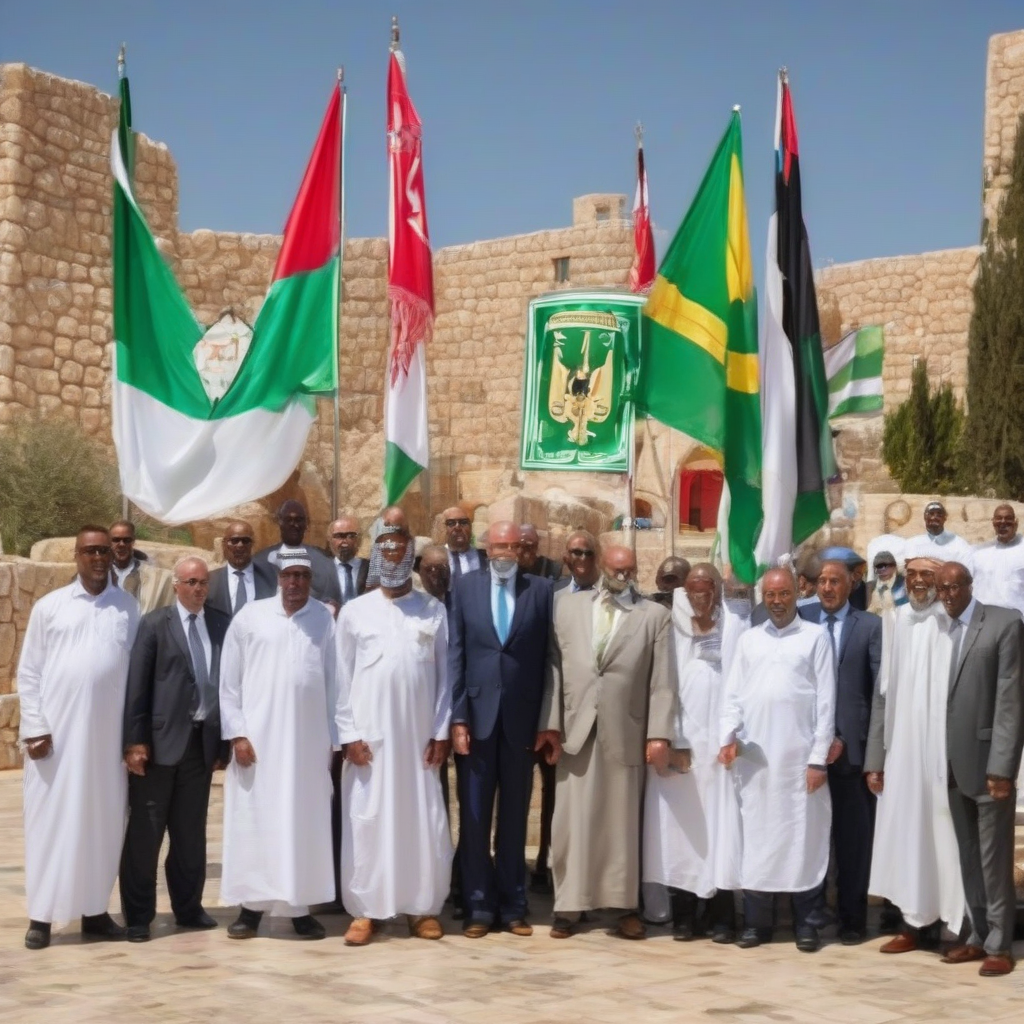
JERUSALEM – Somaliland has opened an embassy in Jerusalem, marking a significant escalation in diplomatic ties following Israel’s recognition of the breakaway state’s independence late last year.
The move establishes a formal diplomatic presence for Somaliland in a city whose status remains one of the most contested geopolitical issues globally, signaling a strategic alignment between the Israeli government and the self-governing region in the Horn of Africa.
The partnership combines Somaliland’s pursuit of international legitimacy with Israel’s objective of securing stable alliances in the strategic corridors leading to the Red Sea.
Diplomatic Exchange and Recognition
Prime Minister Benjamin Netanyahu expressed appreciation for the decision to site the embassy in Jerusalem, which he described as “our ancient capital.” Netanyahu linked Somaliland’s quest for statehood to Israel’s own claims regarding its capital.
“Just as you expect nations to recognise your sovereignty, your identity, your own rights, your own national rights. The same thing we have vis-à-vis our capital. It’s only been the capital of the Jewish people since King David. That’s only 3,000 years ago. So, for some countries, it’s a belated recognition. For you, it was instant.”
President Abdullahi of Somaliland praised the prime minister, stating that Netanyahu had shown “courage” in recognizing Somaliland’s sovereignty and in agreeing to host the mission in Jerusalem rather than in Tel Aviv.
Somaliland, which briefly enjoyed recognized independence in 1960 before voluntarily uniting with Somalia, has since 1991 claimed to have restored that sovereignty. The Jerusalem embassy is being framed by both governments as a tangible, state-to-state expression of that claim rather than a purely symbolic liaison office.
Strategic and Economic Objectives
The diplomatic tie is rooted in shared strategic interests. President Abdullahi highlighted several areas for potential cooperation:
- Natural Resources: Potential access to Somaliland’s oil and rare earth minerals, subject to future exploration rights and regulatory approvals.
- Maritime Logistics: The strategic value of Somaliland’s coastline, located near the mouth of the Red Sea, and its ports on key shipping lanes linking the Suez Canal to the Indian Ocean.
- Regional Stability: The establishment of a stable partner for Israel in a volatile region, including cooperation on counter‑piracy, counter‑terrorism and maritime security.
Israeli officials have signaled that any economic partnership will be structured through formal agreements and investment frameworks, with a focus on infrastructure, energy and technology transfers that can be presented as mutually beneficial rather than purely extractive.
International Disputes Over Jerusalem
The opening of the embassy places Somaliland among a small group of nations that recognize Jerusalem as Israel’s capital. While Israel regards the entire city as its “eternal and undivided” capital, the majority of the international community does not recognize the 1980 annexation of East Jerusalem, which was occupied during the 1967 Middle East war.
Key United Nations resolutions, including Security Council Resolution 478, deem Israel’s Basic Law declaring Jerusalem its complete and united capital a violation of international law and call on member states to withdraw their diplomatic missions from the city.
The current distribution of embassies in Jerusalem includes:
- United States (moved in 2018)
- Guatemala
- Honduras
- Kosovo
- Papua New Guinea
- Paraguay
- Fiji
Many other nations, including the United Kingdom, maintain their embassies in Tel Aviv and treat the status of Jerusalem as a final‑status issue to be resolved through negotiations between Israelis and Palestinians.
Legal and Sovereign Challenges
The move has drawn sharp condemnation from the Palestinian Authority and the government of Somalia.
The Palestinian Authority foreign ministry, via a statement quoted by the Palestinian News Agency, Wafa, condemned “the opening of the alleged embassy by the so-called ‘Somaliland’ in the occupied city of Jerusalem.” The ministry characterized the action as a “flagrant violation of international law and relevant resolutions of international legitimacy,” arguing that it rewards Israel’s unilateral measures in the city.
Simultaneously, Somalia’s foreign ministry responded to the visit by calling on “all international partners to uphold international law… and condemn actions that undermine the unity and stability of the Somali state.” Mogadishu maintains that Somaliland remains part of Somalia’s internationally recognized territory under the principle of territorial integrity embedded in the African Union’s founding norms and in broader international practice.
Diplomats in the region note that the step risks opening a new front in the long‑running debate over recognition of breakaway territories. While some governments treat Somaliland as a pragmatic partner, they stop short of formal recognition to avoid setting precedents for other secessionist claims.
Somaliland’s Governance Status
Somaliland has operated as a self-governing entity since 1991, when it broke away from Somalia following the collapse of the central government in Mogadishu.
Since its declaration of independence, the region has established the following state functions:
- Independent security forces
- A national currency
- A system of regular elections
Somaliland’s leaders argue that these institutions, along with a comparatively stable political environment and a written constitution adopted by referendum, justify international recognition. The territory’s history as the former British Somaliland protectorate, which had a distinct colonial administration before unification with Italian Somalia, is frequently cited as part of that case.
Despite maintaining relative stability compared to southern Somalia, Somaliland’s declaration of independence lacked broad international recognition until the move by Israel at the end of last year. No major multilateral body, including the African Union, has accepted Somaliland as a member state, and the United Nations continues to list it as part of Somalia.
Somalia continues to maintain its claim over the territory as part of its sovereign state, and insists that any future settlement must be negotiated within the framework of Somali national law and international norms on secession. For now, the Jerusalem embassy underscores the gap between Somaliland’s de facto governance and its contested de jure status – and places that tension at the heart of one of the world’s most sensitive diplomatic cities.
