
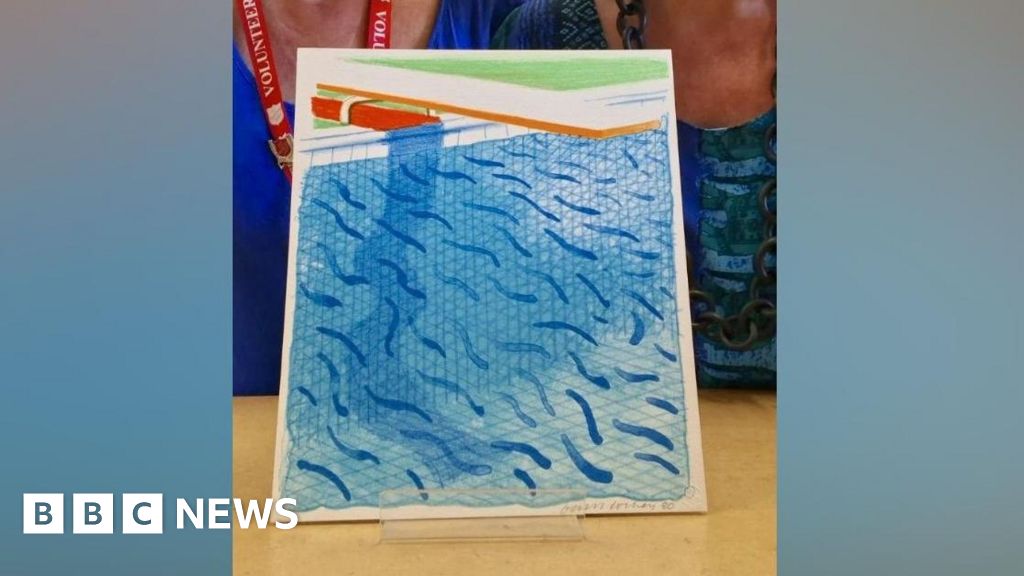
A signed print by David Hockney has been recovered from within a book discovered by a Salvation Army volunteer.
The find involves a genuine signed lithograph that had remained undisturbed for 46 years. The discovery of authentic signed works within second-hand inventory highlights the continuing market for limited-edition prints and the logistical role of charitable repositories in the circulation of art.
Recovery of Lithographic Work
Jemma Banks, a local artist and long-serving Salvation Army volunteer, identified the print while processing items at a community donation centre. The work had been stored inside a book, which preserved the paper and ink from environmental degradation and casual handling that typically occur in open storage or display.
“It was a privilege to hold a genuine signed David Hockney print in my hands, and I was amazed that it had remained safely inside the book for 46 years, looking as fresh as the day it came off the lithographic press.”
Lithography is a printing process used extensively by high-profile artists to create limited editions. Signed prints are categorized as originals in the art market, as the artist’s signature validates the specific edition and maintains its commercial value. In the UK, such discoveries also move quickly into a more formal process: higher-value donations are usually referred to professional valuers and, where appropriate, handled under charity trustees’ duties set out in the Charities Act 2011, which requires boards to obtain the best reasonable return when disposing of significant assets.
Industry and Sector Impact of Signed Editions
The value of a David Hockney print is contingent upon its provenance, the specific series it belongs to, and its physical condition. Because the print was stored inside a book, it avoided the typical oxidation and light damage that affects works on paper, factors that can materially change both auction estimates and insurance valuations.
In the global art market, signed lithographs serve as a primary entry point for collectors, offering a verifiable link to the artist’s hand without the price point of a unique canvas. The preservation of a work for nearly five decades without exposure to air or light typically ensures a higher grade of authentication and valuation, making such pieces attractive to both institutional buyers and private collectors.
The identification of the work by an artist and volunteer underscores the importance of expertise in the sorting and appraisal of donated assets within the non-profit sector. For charities, unexpected high-value art finds can translate into substantial, unrestricted income at a time of rising demand for social services, while also reinforcing the case for basic due diligence, staff training and transparent asset-disposal policies across the wider voluntary sector.
Hockney, one of the most influential British artists of the 20th and 21st centuries, died in June 2026, a development that has already sharpened collector focus on authenticated works from across his career. Against that backdrop, the emergence of a previously undocumented signed print from long-term private obscurity is likely to attract attention from specialist dealers once the piece has passed through formal valuation channels, such as those used by the UK’s government-backed Arts Council and its network of accredited museums and advisers.
The print has been identified as a genuine signed work, and charity officials are now considering options for sale or loan that would maximise its benefit to frontline programmes while keeping decision-making consistent with their legal and governance obligations.
Keep reading
- Interactive Storytelling and Immersive Audio: How Next-Gen Gaming Engines Are Transforming Contemporary Television Production
- Independent Cinema’s New Distribution Paradigms: How Direct-to-Consumer Micro-Premiers Are Shifting Box Office Dynamics
- A 42% Cut in Melanoma Relapse Means 12 More Per 100 at Two Years (daybreakwire.com)
- Three men jailed for 158 years each for murdering Australian and US surfers in Mexico (globallypulse.com)
