
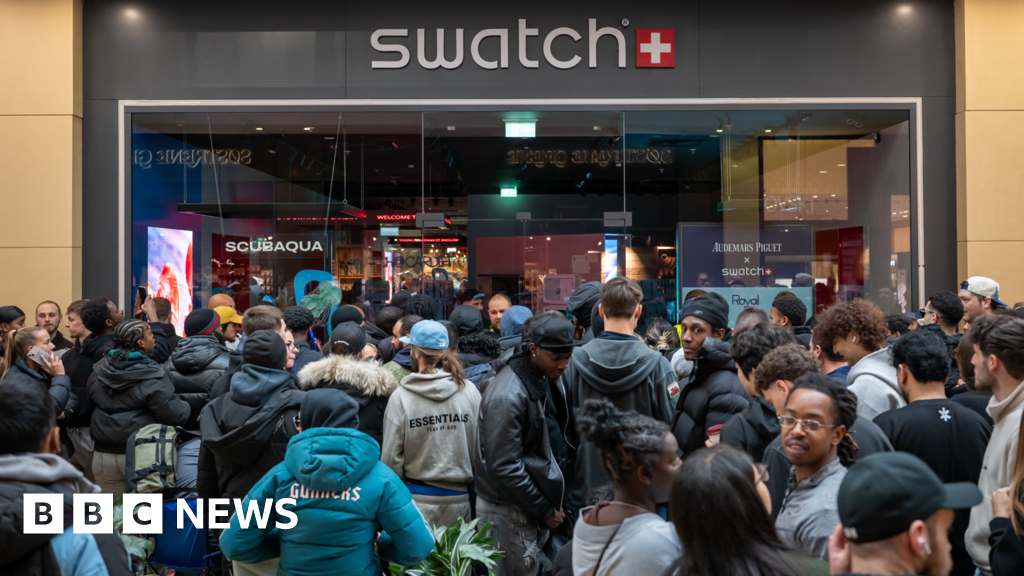
LONDON – Swatch stores have suspended operations across several locations following unprecedented consumer demand for a new collaboration with luxury watchmaker Audemars Piguet.
The surge in foot traffic, which saw shoppers camping for days to secure the product, necessitated police intervention at major retail hubs, including the Liverpool ONE shopping center, where stores were forced to close to manage crowd safety. Local authorities framed the move as a crowd-control measure rather than a commercial decision, underscoring how a private-sector product launch briefly became a public-order issue.
This operational volatility reflects a broader strategic tension in the luxury goods sector. The partnership bridges the gap between mass-market accessibility and ultra-high-end exclusivity, a move that generates significant short-term volume but creates friction within the traditional horological ecosystem and raises questions for regulators about how retailers manage large, premeditated queues in confined urban spaces. In the United Kingdom, such events are increasingly viewed through the lens of public safety obligations set out in guidance from the Health and Safety Executive, placing additional scrutiny on how brands plan and execute high-intensity launches.
The Swatch Group, a diversified conglomerate with a portfolio ranging from Tissot to Omega, has utilized this “masstige” strategy to capture younger demographics and drive brand engagement through high-frequency, limited-release drops. The collaboration with Audemars Piguet, branded “Royal Pop,” reprises a playbook previously seen in Swatch’s tie-ups with other luxury maisons, where high-design cues are translated into affordable quartz-based products for a global audience.[[1]]
In contrast, Audemars Piguet operates as an independent, family-owned manufacture. The company focuses on high-complication watches and maintains a strict scarcity model to preserve the value of its primary collections. Its Royal Oak line, widely regarded as one of the most coveted sports-luxury designs, typically sells through tightly controlled allocations and wait lists, a system that has historically insulated the brand from the volatility of mass retail. The decision to license that aesthetic language into an accessible collaboration therefore marks a calculated departure from its traditional, low-volume approach.[[2]]
Market Integration and Brand Dilution
The release of the Royal Pop model introduces a mass-produced interpretation of one of the most exclusive silhouettes in the industry. While the collaboration expands the brand’s reach, it has created a divide among industry professionals and collectors regarding the impact on brand equity and resale dynamics.
Positioned as a “disruptive collaboration” between two icons of Swiss watchmaking, the line is offered in multiple colorways and references, designed to be worn on the wrist or as a pocket watch, and sold through Swatch’s global store network and selected retail partners.[[3]] The collection is framed by both companies as an exercise in “joyful boldness” rather than a permanent repositioning of Audemars Piguet’s core catalogue, but its scale places it squarely in the mass-market spotlight.
The strategic goals of the partnership include:
- Diversification of the consumer base through lower price points, allowing first-time buyers to access the design language associated with a six-figure watch.
- Increased visibility of the Audemars Piguet aesthetic in non-traditional luxury markets, particularly among younger consumers who interact with the brand first through social media and streetwear culture rather than traditional retail channels.
- Leveraging Swatch’s global distribution infrastructure for rapid market penetration and timed, theatre-like “drop” events that generate queues, social content and immediate secondary-market activity.
The disruption in retail environments indicates a misalignment between the available inventory and the speculative demand driven by the secondary market. Resellers arriving with the intention of flipping watches at a premium have intensified pressure on store staff and security, exacerbating scarcity for end consumers and shifting what was marketed as a playful collaboration into a flashpoint for frustration among local shoppers and long-time collectors.
The Swatch collaboration is dividing the watch industry.
The conflict centers on whether the democratization of a luxury icon enhances the brand’s cultural relevance or erodes the prestige associated with the original high-end product. Some analysts argue that the collaboration cements Audemars Piguet’s status as a cultural touchstone, comparable to the way sneaker collaborations have reshaped sportswear, while others warn that frequent mass-market reinterpretations risk blurring the line between the flagship mechanical pieces and their plastic counterparts.
Retail and Operational Impact
The scale of the demand has transitioned from a retail event to a public order concern. In Liverpool, the police were required to surround queues as the volume of shoppers exceeded the physical capacity of the retail spaces, prompting temporary closures and raising questions about contingency planning. Similar scenes have been reported at other flagship Swatch locations, where security personnel have been tasked with managing both disappointed customers and opportunistic resellers.
The collaboration’s rollout follows a pattern of “hype” marketing, where controlled scarcity is used to accelerate demand. However, the physical manifestation of this demand-characterized by multi-day camping, forced store closures and heavy reliance on on-site security and police-presents significant liability and operational challenges for the Swatch Group. Retailers now face a trade-off between cultivating spectacle and protecting staff, customers and neighbouring tenants in crowded urban shopping centres.
The current market condition is characterized by high speculative volatility, as the Royal Pop continues to be traded on secondary platforms immediately following its retail release. Prices listed well above the original retail level have reinforced perceptions that supply constraints are structural rather than incidental, feeding a cycle in which each new drop is treated less as a fashion event and more as a short-term trading opportunity.
For now, the Swatch Group and Audemars Piguet maintain their current distribution strategy for the collaboration, relying on in-person releases and limited daily allocations rather than broad online distribution. That posture suggests both brands are willing to tolerate a degree of disorder and controversy to protect the narrative of scarcity-at least until regulators, landlords or public-safety authorities insist that the spectacle be brought firmly under control.
Related reading
