
DENVER – The transition of quantum computing from laboratory experimentation to industrial-scale application is increasingly dependent on the stability of cryogenic infrastructure. As firms race to develop utility-scale systems, the management of mechanical vibration has emerged as a primary technical barrier to maintaining the coherence of superconducting qubits.
The economic viability of quantum computing relies on the ability to perform complex calculations without disruption from thermal noise or mechanical interference. To achieve this, superconducting qubits must be cooled to milli-Kelvin temperatures using dilution refrigerators, which employ a mixture of helium-3 and helium-4 to reach near absolute zero. At these temperatures, even small mechanical disturbances can shorten qubit lifetimes and reduce the effective computational power of next-generation machines.
While these refrigerators provide necessary cooling, they introduce internal vibrations via pulse tubes, compressors, and pumps. External factors, including building HVAC systems, elevators, and urban traffic, further compromise the stability of the quantum state, leading to computational errors and increased overhead in error correction. For operators planning to scale from laboratory prototypes to commercial data center environments, controlling these low-frequency disturbances has become a core engineering and investment question.
Standard decoupling methods-such as flexible bellows, cryogenic spring pendulums, and active piezoelectric cancellation-often fail to address low-frequency vibrations, specifically those near the 0.5 Hz threshold. These low frequencies are particularly challenging because they overlap with structural resonances in buildings and infrastructure and are harder to suppress without introducing significant complexity and maintenance.
Minus K Technology has addressed this gap through Negative-Stiffness vibration isolation. This passive mechanical system operates without electricity or compressed air, removing the maintenance requirements associated with motors or pumps. Its adoption spans more than 300 universities and government laboratories across 53 countries, positioning the technology as a de facto reference point for ultra-sensitive measurements in fields ranging from materials science to quantum information.
“Vertical-motion isolation is provided by a stiff spring that supports a weight load, combined with a Negative-Stiffness mechanism,” said Erik Runge, Vice President of Engineering at Minus K. “The net vertical stiffness is made very low without affecting the static load-supporting capability of the spring. Beam-columns connected in series with the vertical-motion isolator provide horizontal-motion isolation. A beam-column behaves as a spring combined with a negative-stiffness mechanism. The result is a compact passive isolator capable of very low vertical and horizontal natural frequencies and high internal structural frequencies.”
Negative-Stiffness isolators can be tailored to a 0.5 Hz resonant frequency. At this setting, the systems achieve 93 percent isolation efficiency at 2 Hz, 99 percent at 5 Hz, and 99.7 percent at 10 Hz. For quantum hardware designers, those performance levels translate directly into more stable qubits, longer experiment runtimes, and potentially lower operating costs, because fewer runs are lost to environmental noise.
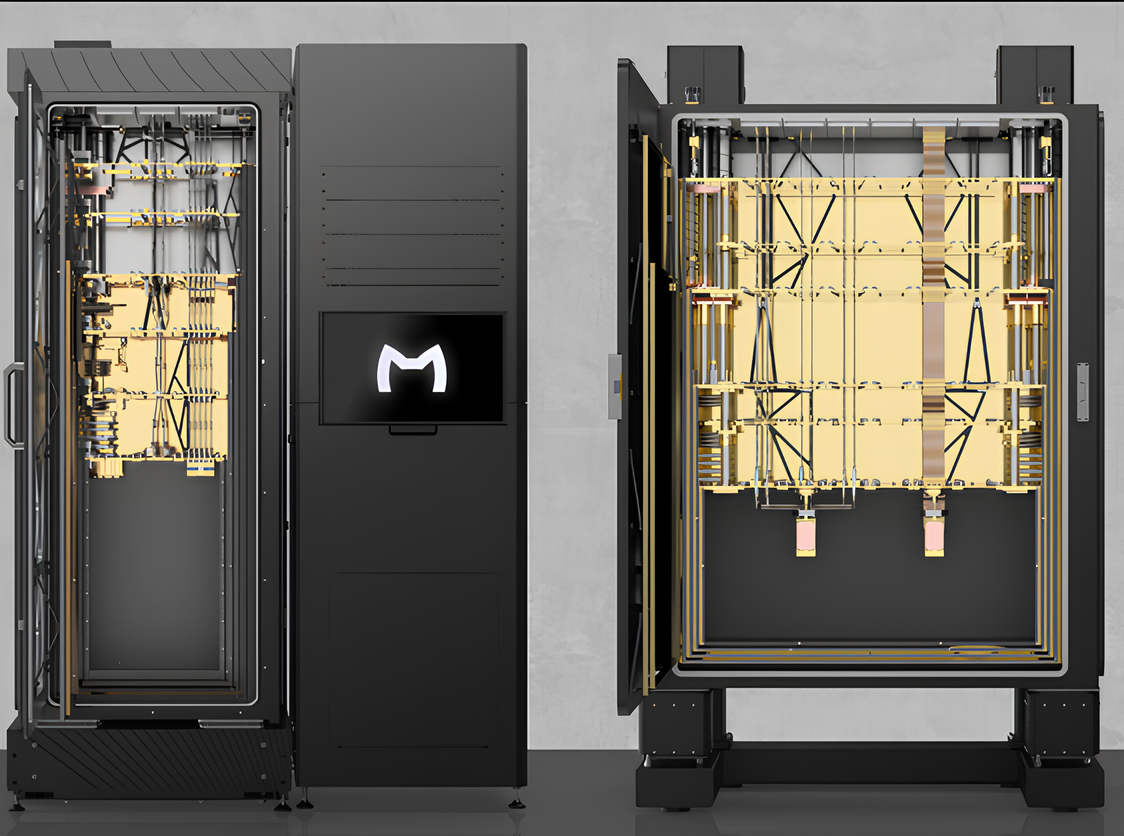
Maybell Quantum Industries, a Denver-based quantum infrastructure provider, has integrated this technology into its “The Big Fridge” model to eliminate energy transfer at low frequencies. The company is part of a growing cluster of firms building the specialized cooling and infrastructure that large cloud providers, national laboratories, and regulated critical-infrastructure operators will depend on if they purchase quantum systems at scale.
“Vibration on modern dilution refrigerators is mostly driven by two different sources,” said Kyle Thompson PhD, Founder and CTO with Maybell. “One of them is external low Hz vibrations. The other is the pulse tube refrigerator which pre-cools the cryostat. High pressure helium flows through the pulse tube at about one Hz (150 psi) creates low Hz vibrations. Both have the potential to be very detrimental to the qubits.”
Thompson noted that finding a transfer function of one Hz was a significant challenge, stating, “The only one we found capable of isolating below one Hz was Negative-Stiffness vibration isolation developed by Minus K Technology. Their isolators have a 0.5 resonant frequency.”
To support demanding research, The Big Fridge operates with a base temperature below 10 milli-Kelvin and a sample volume exceeding 130 L, accommodating more than 10,000 Flexline traces. Maybell has redesigned the cryogenic platforms to reduce operational downtime by replacing traditional components known for failure:
- Micro roots blowers replaced maintenance-heavy circulation scroll pumps to extend operational lifespans.
- Welded joints and metal-to-metal flanges replaced KF flanges and rubber components to eliminate leak rates.
- Elimination of acid-flux solder to prevent corrosion and solder failure during extended cryogenic use.
- Self-cleaning cycling helium traps to remove the need for liquid nitrogen topping.
“On The Big Fridge we bolted the pulse tube to our chassis, then we floated the entire pulse tube and chassis on top of the Negative-Stiffness isolators,” Thompson said. “The Minus K isolators are what is separating our dilution refrigerator from internal and external vibrations and performing exceptionally well.”
The hardware race around cryogenic stability is unfolding alongside a quiet build-out of governance and standards. In the United States, agencies such as the National Institute of Standards and Technology and the White House Office of Science and Technology Policy are working under the broader National Quantum Initiative Act to shape guidelines for secure, reliable quantum infrastructure in federally funded laboratories and, increasingly, in commercial deployments. As quantum systems move closer to critical roles in finance, energy, and defense, regulators and institutional buyers are expected to scrutinize not only algorithmic performance but also hardware resilience, uptime, and maintainability.
The shift toward industrial-grade hardware reflects a broader market trend where infrastructure must precede widespread commercial utility. That includes robust cryogenic baselines that data center operators can treat as predictable, auditable platforms rather than experimental one-offs.
“Quantum computers right now are very much still in technical development,” Thompson said. “But the market is growing very fast and in five years it will be considerably bigger. Whether or not it will be at utility scale by then – performing commercial and industrial work that classical computers cannot – is yet to be seen.”
Maybell has aligned its engineering requirements with commercial and industrial applications rather than specific scientific research to prepare for this scale, emphasizing low-maintenance, passively stabilized systems that can meet uptime and reliability expectations similar to those applied to other regulated high-performance infrastructure.
The current market for quantum infrastructure is characterized by a transition toward maintenance-free, passive stabilization systems to support the projected increase in commercial deployments over the next five years. For policymakers, standards bodies, and institutional buyers, the way vendors solve “invisible” engineering problems such as sub-Hertz vibration isolation will increasingly shape which platforms are trusted to carry early quantum workloads.
