
BRUSSELS —
European scientific and monitoring networks have delivered a concentrated tranche of data and reference products between 2021 and 2025 that are now informing corporate risk models, public-sector resilience planning and market assessments across forestry, agriculture and energy supply chains.
Lede — The consolidation of continent-scale drought inventories, atlases and policy briefs — including the European Drought Risk Atlas (2023), the European Drought Observatory for Resilience and Adaptation (EDORA, 2024) and national and sector-specific impact databases — provides the standardized inputs that investors, insurers and infrastructure operators need to reprice exposure to hydrological stress at a time when much of Europe is already experiencing recurrent drought conditions.[1]
Nut graph — Why this matters economically: peer-reviewed work in the set shows both ecological vulnerability (for example, to boreal tree species) and rising economic losses from drought; those findings have been translated into operational resources used by EU technical services and international risk bodies. The result is a clearer evidence base for underwriting decisions, capital allocation in forest and agricultural supply chains, and regulatory stress-testing of water-dependent infrastructure. It also feeds directly into European climate adaptation priorities set under the EU Strategy on Adaptation to Climate Change, anchoring corporate risk models in the same datasets used by policymakers.
New datasets and the institutions behind them
A sequence of datasets and syntheses published between 2021 and 2025 has widened the factual basis for impact-aware decision making and given governments and markets a shared reference frame for drought risk.
| Product | Year | Owner / Publisher (as listed) |
|---|---|---|
| GAR Special Report on Drought | 2021 | United Nations Office for Disaster Risk Reduction |
| EDII V2.0 (European Drought Impact report Inventory) | 2022 | FreiDok plus (dataset) |
| European Drought Risk Atlas | 2023 | Publications Office of the European Union |
| EDORA — Science for Policy Brief | 2024 | European Commission, JRC |
| World drought atlas (EU edition) | 2024 | Publications Office of the European Union |
| Near-real-time and national impact databases (examples) | 2022–2025 | Academic repositories, national centres (e.g., NDMC access noted 10 January 2025) |
These reference products are published alongside targeted academic studies: Aldea et al. (2024) reported current and future drought vulnerability for three dominant boreal tree species, and Naumann et al. (2021) documented increased economic drought impacts in Europe associated with anthropogenic warming. The European Drought Impact report Inventory (EDII V2.0) is available as a dataset (2022), and the National Drought Mitigation Center’s National Drought Impact Reporter was last accessed for this dataset on 10 January 2025.
Together, the institutional reports, atlases and impact repositories begin to close a longstanding gap between hydrological observation and the kind of standardized, machine-readable data that regulators, auditors and financial institutions can embed in models and due-diligence processes.
How market actors use the new evidence base
As Europe faces more frequent and intense dry spells, the new datasets are filtering quickly into front-line risk decisions in both the private and public sectors.
Risk transfer and reinsurance: The aggregation of impact reports and the atlas products gives underwriters reproducible exposure layers. Reinsurers and primary insurers rely on standardized hazard and impact metrics to calibrate catastrophe models and policy terms; the new continental atlases and inventories supply the spatially consistent inputs needed for portfolio-wide loss estimation and scenario work. That, in turn, supports more transparent pricing of drought riders in agricultural, infrastructure and business interruption policies.
Forestry and timber markets: Peer-reviewed vulnerability analysis of boreal tree species (Aldea et al., 2024) supplies timber owners, forest investment funds and corporate forest managers with species-level risk signals that feed harvest scheduling, replanting strategy and timber supply forecasts. For investors holding long-rotation forest assets, those signals are an input to valuation models that factor biological mortality risk into long-term yield assumptions and feed into stewardship conversations with portfolio companies.
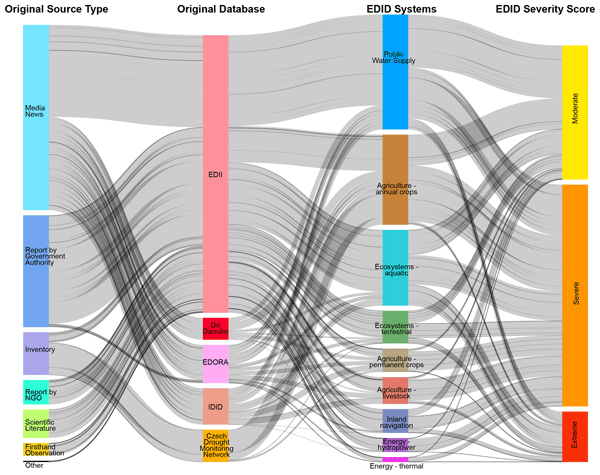
Agriculture and commodity supply chains: Socioeconomic analysis of past drought episodes and impact databases (for example, studies covering regional agricultural impacts and the EDII/other national databases) underpin stress-testing of supply nodes for cereals, fodder and dairy supply chains. Traders and processors increasingly reference impact inventories when hedging seasonal shortfalls, while cooperatives use them to benchmark members’ exposure against regional baselines.
Energy and infrastructure: The European Drought Risk Atlas and related datasets supply hydrological baseline data used by utilities and grid operators to assess hydropower availability and cooling-water risk for thermal plants. Where drought indices and impact reports align, procurement and operational contracts can be adjusted to reflect persistent hydrological stress, influencing everything from dispatch planning and reservoir management to the sizing of emergency back-up capacity.
Regulatory and policy implications
The European Commission’s science service has translated atlas and inventory material into a Science for Policy brief (EDORA, 2024), creating a formalized bridge between observational evidence and EU-level adaptation planning. That bridge matters for emerging rules on climate risk disclosure, supervisory climate stress tests and the integration of physical risk into state-aid and cohesion funding decisions.
International-level reporting — notably the United Nations Office for Disaster Risk Reduction’s GAR Special Report on Drought (2021) — provides authoritative context for multilateral resilience programmes and donor prioritization, positioning European drought experience within a wider global pattern of water stress.
Publicly accessible impact inventories (EDII V2.0 and national counterparts) support more consistent reporting frameworks and enable comparison across jurisdictions for regulatory stress tests and infrastructure permitting decisions. Where national drought monitors and media-based impact databases operate in near-real-time or long-term archives, regulators and procurement authorities can reference comparable event catalogues when setting resilience conditions for public contracts, concession tenders and public–private partnerships.
Operationalising impact data in corporate governance
Boards and risk committees are presented with increasingly granular evidence of drought exposure. The new datasets enable a shift from hazard-only metrics to impact-aware metrics described in the academic literature on drought impact functions — a change that brings internal risk reporting closer to the expectations of financial supervisors and sustainability standard-setters.
Firms subject to disclosure requirements or sustainability reporting standards can cite the consolidated inventories and atlases when documenting exposure and mitigation steps. That strengthens the audit trail behind materiality assessments and climate-risk notes in annual reports.
Supply-chain managers with exposure to fodder crops, timber, irrigation-dependent produce or hydropower-linked electricity purchases now have public datasets to underpin contract renegotiation and contingency sourcing strategies. Institutional investors with mandates that consider physical climate risks can incorporate the atlas layers into fiduciary risk dashboards without relying solely on proprietary vendor feeds, supporting more consistent engagement with portfolio companies on adaptation.
Implications for capital markets and deal activity
While direct transactional figures are not supplied by the referenced studies, the aggregation and standardization of impact data lower a barrier for market participants to price drought-related risks. Standardized, authoritative data products make it feasible to:
- Calibrate scenario-based stress tests for corporate debt and project finance where water exposure is material, including long-lived assets such as dams, power plants and industrial parks.
- Structure parametric insurance products tied to established indices and impact inventories, shortening claims cycles and improving transparency for insured parties.
- Inform warranty and indemnity clauses in M&A negotiations for agribusinesses and forest assets where historical drought impact records exist, sharpening due-diligence questions around water rights, irrigation infrastructure and contingent liabilities.
For lenders and bond investors, the same data enable more granular covenants and key performance indicators linked to water resilience, potentially affecting pricing for borrowers in high-risk watersheds.
Data quality, limitations and next procedural steps noted in the literature
The academic and institutional work in this set highlights both methodological advances and limits. Text-based impact databases and media-derived inventories have been extended and transformed to structured databases, and guidelines for such transformations have been advanced. Work on drought impact functions and near-real-time detection underscores the move from hazard-focused monitoring toward operational impact forecasting that can feed daily operational decisions as well as long-term planning.
Timeline of notable outputs in the record:
- 2021 — GAR Special Report on Drought, United Nations Office for Disaster Risk Reduction.
- 2022 — European Drought Impact report Inventory (EDII V2.0), dataset release.
- 2023 — European Drought Risk Atlas, Publications Office of the European Union.
- 2024 — EDORA Science for Policy Brief, European Commission Joint Research Centre.
- 2024 — World drought atlas, Publications Office of the European Union.
- 2025 — Further methodological and database transformation guidance noted in academic releases.
Limitations remain: impact reporting is still uneven across sectors and member states, some national databases are constrained by under-reporting of smaller events, and not all utilities or municipalities have the capacity to translate complex metrics into day-to-day operational rules. Nevertheless, procedural guidance emerging from this body of work is gradually standardizing how drought impacts are classified, verified and communicated.
Corporate due diligence and procurement adjustments
Firms integrating the new inventories into procurement and hedging practices are able to reference long-term event repositories and impact catalogues when evaluating supplier resilience. Agricultural cooperatives and large commodity processors can use sector-specific impact typologies present in the literature to refine contingency and sourcing clauses, link premiums or discounts to drought resilience, and predefine triggers for volume reallocations.
Forest owners and timber processors can apply the species-level vulnerability evidence to operational planning and insurance placement, including decisions on diversification of species, rotation length and investments in fire and pest management that are indirectly affected by drought stress.
The European Commission’s Joint Research Centre provides a policy interface for the translation of these products into EU-level guidance and adaptation tools; the United Nations Office for Disaster Risk Reduction’s GAR report supplies an international policy benchmark that donors and development banks can reference when prioritizing cross-border resilience projects.
Market condition — peer-reviewed and institutional products in the 2021–2025 record indicate increased economic drought impacts in Europe associated with anthropogenic warming; these standardized atlases and inventories are now the operational inputs public and private actors use for risk assessment, underwriting and regulatory reporting. As the datasets mature, they are likely to become embedded not just in scientific assessments, but in the legal, contractual and supervisory infrastructure that governs how Europe manages water risk.
Related reading
- Private Equity in Clean Technology: Where Institutional Capital Is Flowing in Late 2026
- Commercial Real Estate Restructuring: The Maturation of Hybrid Work and Capital Adaptation in 2026
- Why Leaves Are Changing Color Early: What Drought Stress Means (daybreakwire.com)
- Ann Widdecombe murder suspect charged with planning terror act against Nigel Farage (globallypulse.com)
