
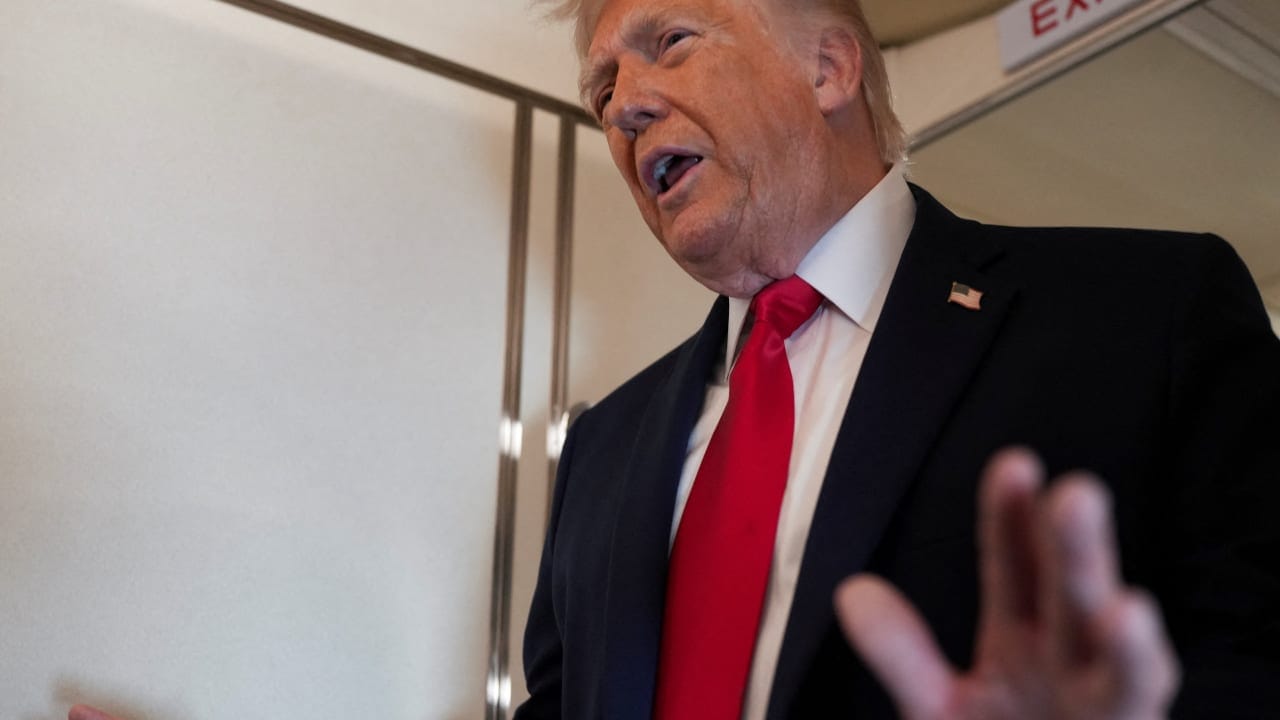
WASHINGTON – US President Donald Trump has signaled a shift in the parameters of a potential diplomatic settlement with Tehran, stating that he is not requiring Lebanon’s inclusion as a prerequisite for a peace deal with Iran.
The revelation, delivered during an interview with NBC’s “Meet the Press,” arrives amid a volatile security environment in the Levant, where the intersection of Iranian influence and Israeli military operations continues to threaten a broader regional escalation.
The comments underscore a transactional approach to Middle Eastern diplomacy, attempting to decouple the nuclear ambitions of the Islamic Republic from the operational activities of its primary proxy, Hezbollah, even as the United States maintains a posture of “maximum pressure” regarding frozen financial assets.
Nuclear Concessions and Diplomatic Proximity
Trump asserted that the United States and Iran are “very close” to reaching a formal agreement, claiming that Tehran has effectively conceded it will not pursue nuclear weapons.
“We’re very close to having a deal, and if we don’t have a deal, we’ll do it one way or the other. Either way, we win,” Trump said.
This claim regarding nuclear concessions marks a significant point of contention. For years, the diplomatic framework-previously defined by the 2015 Joint Comprehensive Plan of Action (JCPOA)-has struggled to balance Iran’s enrichment capabilities with international guarantees against weaponization. The JCPOA, endorsed by the UN Security Council in Resolution 2231, set the baseline for international verification and sanctions relief mechanisms that Trump withdrew from during his first term.
Trump’s insistence that a deal is imminent suggests a willingness to bypass traditional multilateral channels in favor of a direct, bilateral arrangement with Tehran, potentially sidelining European signatories and international monitoring bodies that have previously served as guarantors of compliance.
The Lebanon Equation and Hezbollah
The President’s willingness to exclude Lebanon from the immediate scope of a peace deal comes at a critical moment. The Israel Defense Forces (IDF) conducted strikes against Hezbollah targets in the Dahiyeh district of Beirut on Sunday, a stronghold of the Iranian-backed militant group.
Trump clarified his stance on the Lebanese front: “I think they’d like to see it, but I’m not demanding,” he said, referring to the inclusion of Lebanon in a broader Iran-US settlement. By decoupling Lebanon from the core nuclear track, the administration is effectively signaling that constraints on Hezbollah’s activities along Israel’s northern border may be pursued through parallel channels rather than as a formal condition of any Iran agreement.
This diplomatic flexibility follows a recent, unsuccessful attempt by the Trump administration to broker a ceasefire between Israel and Lebanon-an agreement that Hezbollah subsequently refused to recognize. The failure has reinforced concerns among regional diplomats that battlefield dynamics in southern Lebanon and Gaza could undercut any paper guarantees negotiated with Tehran.
Financial Leverage and Frozen Assets
A primary sticking point in the ongoing negotiations remains the status of Iranian capital held in foreign accounts. Iran has demanded the release of $12 billion in frozen assets currently held in Qatar as a non-negotiable precondition for further talks.
Trump rejected this demand, stating he would not unfreeze assets before a finalized deal is reached, framing the funds as a central instrument of US leverage in any post-conflict architecture.
- Iranian Position: The release of the $12 billion is a “non-starter” requirement for continuing diplomatic engagement, presented in Tehran as a test of US seriousness.
- US Position: Assets remain frozen as enforcement leverage to ensure compliance with treaty terms and to guard against rapid reconstitution of military capabilities.
- Trump’s Stance: “If they behave, if they do a good job, we start talking.”
The reliance on asset freezes, sanctions designations and banking restrictions reflects the long-standing US use of financial statecraft, administered primarily through the Treasury Department’s sanctions authorities, as a substitute for large-scale ground deployments. In the current talks, those tools have effectively become the enforcement backbone of any future understanding with Tehran.
The President attributed the lack of a ceasefire to the “pride” of the Iranian regime, suggesting that Tehran’s leadership is resistant to the concessions required for peace. He further claimed that “Operation Epic Fury” had resulted in the total destruction of Iran’s military capabilities, a characterization that US officials have not independently substantiated in detail and that regional analysts view as, at minimum, an overstatement given Iran’s residual missile and proxy capacities.
The Khamenei Succession and Intelligence Divergence
In a departure from standard diplomatic protocol, Trump expressed an openness to direct negotiations with Mojtaba Khamenei, the son of Supreme Leader Ayatollah Ali Khamenei.
Trump described Mojtaba as “more rational” than his father and predecessor, while confirming that the younger Khamenei is alive and actively involved in the decision-making process.
“I would [meet] if he’d like to, but I have not spoken to him directly,” Trump stated. He further noted that Mojtaba is “very seriously injured,” interpreting his continued political activity despite these injuries as a sign of “bravery.”
However, this assessment is not shared by the intelligence community. Neither US nor Israeli intelligence agencies perceive Mojtaba Khamenei as a more rational or moderate actor than Ayatollah Ali Khamenei, according to officials briefed on their assessments. Analysts warn that framing Mojtaba as a potential moderating force risks misreading the internal dynamics of Iran’s clerical establishment, where power is tightly bound to the office of the Supreme Leader and the structures defined in Iran’s own constitution.
The current diplomatic status remains deadlocked over the release of Qatari-held assets, while military operations continue in the Dahiyeh district of Beirut. For now, Trump’s recalibrated red lines-dropping Lebanon as an explicit precondition, insisting on nuclear guarantees and retaining control over frozen funds-have clarified the contours of US policy without yet resolving the fundamental gap between Washington and Tehran over what a “win” actually looks like.
Worth a look
- Global Food Security Alliances: How Climate-Resilient Agricultural Corridors Are Stabilizing Wheat and Rice Supplies
- Cross-Border Renewable Energy Grids: North Sea and Mediterranean Subsea Cable Networks Enter Phase Two
- Jay Clayton named White House AI czar by Trump to lead task force (globallypulse.com)
