
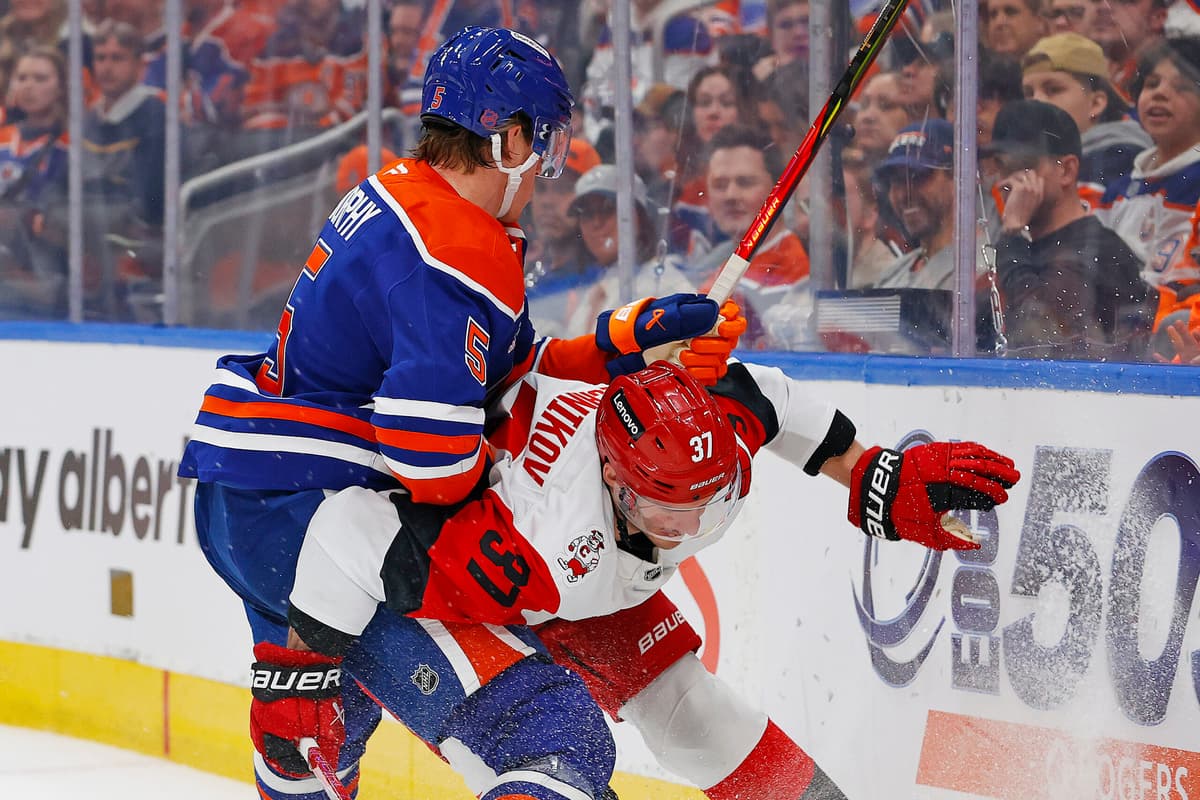
Edmonton recalibrates its spine with Chicago deals: Dickinson and Murphy arrive to steady the minutes that decide playoff series
Edmonton moved this week to address its most persistent vulnerabilities, completing a pair of transactions with Chicago to add centre Jason Dickinson, defenceman Connor Murphy and forward Colton Dach. For a club operating under the spending and roster constraints of the league’s salary-cap and collective bargaining framework, the emphasis is clear: optimise the “middle” of the lineup without disturbing the core. Dickinson and Murphy arrive as established defensive pieces; Dach, 23, profiles as a big, physical depth option with longer-term upside.
Third-line centre built for heavy lifting
The third line has been a pressure point for Edmonton, particularly down the middle and particularly against deeper Western Conference opponents. Dickinson, a left-shot centre long trusted in demanding assignments, gives the coaching staff a reliable option for defensive-zone starts and matchups against top forwards. His track record in Chicago was defined by conscientious play without the puck and the willingness to keep games low event, attributes that directly relieve strain on the club’s top line and its marquee pivots.
That has practical consequences late in the season and into the postseason, when officials tend to “let them play” more and coaches lean harder on trusted matchup pieces. With a specialist to handle tougher starts, Edmonton can limit the accumulation of taxing minutes on its marquee forwards and better exploit the home-ice last-change advantage to chase favourable looks under the formal rule book. It also supports a more balanced bench rhythm, protecting leads and stabilising swings when whistle sequences compress shifts.
Stylistically, Dickinson’s utility grows beside wingers who exit cleanly and forecheck in layers. A defensively responsible left wing who can skate pucks out under pressure complements his ability to break cycles; a right wing with straight-line speed and board strength rounds out the forecheck and supports controlled entries. In a conference where travel, time zones and back-to-backs are a constant management issue for coaching staffs, that profile is designed to tilt third-line minutes toward safety, even if offence runs modest.
A stay-at-home partner to free Walman
Murphy, a 6-foot-4 right-shot defenceman, projects as the steadying partner Jake Walman has lacked on his natural left side. Walman is at his best advancing play in transition and stepping into the rush; Murphy’s value is built around box-outs, crease protection and winning net-front body position. Together, the blend aims to reduce rebounds and inner-slot chances while still enabling Walman to push pace when the read is on.
The knock-on effect is structural: a calmer second pair allows the staff to keep the Ekholm-Bouchard minutes optimised without overextending them into every tough shift. It also clarifies Darnell Nurse’s deployment alongside a partner who can close rushes with speed, keeping pairings aligned to distinct jobs rather than overlapping responsibilities. For a front office that has spent seasons searching for a sustainable balance between its offensive stars and its defensive architecture, Murphy’s arrival is as much a governance decision about how the blue line is organised as it is a talent play.
Penalty-kill ramifications and energy budgeting
Both newcomers carry value on the penalty kill, an area that often swings postseason series more than any single even-strength tactic. Murphy’s range and net-front strength translate cleanly to shorthanded work, where sealing sticks and clearing second-chance traffic have been problem areas. Dickinson can anchor a forward pair that prioritises lanes and seams rather than gambling for short-handed breaks, aligning with how modern teams increasingly treat the penalty kill as a risk-managed, system-driven phase rather than an opportunistic one.
Just as important is who they can protect. If Dickinson absorbs a share of shorthanded shifts, the staff can trim penalty-kill minutes for top-line scorers, banking fresher legs for five-on-five and the power play. Over a seven-game series, that energy budgeting matters as much as any single adjustment, and it feeds into broader organisational priorities: protecting franchise assets over an 82-game schedule plus playoffs, complying with workload tracking standards, and demonstrating to ownership and fans that the club is stewarding its stars responsibly.
The competitive calculus
Depth down the middle and a low-event second pair are not headline-grabbing moves, but they influence the moments that decide tight games: defensive-zone faceoffs after icings, late-period kills, and protecting one-goal leads under playoff officiating. Edmonton has chased consistency in those pockets all season; Dickinson and Murphy are intended to lower volatility there and give the coaching staff cleaner, more predictable matchup trees.
The acquisitions do not guarantee a surge in bottom-six scoring, and they will not, on their own, determine goaltending form. What they can do is change the environment: fewer broken plays off the wall, cleaner exits under forecheck pressure, and less traffic at the top of the crease. If those shifts materialise, they can be worth points down the stretch and, more importantly, high-leverage minutes when the bracket tightens and every deployment decision is effectively a small policy choice about risk tolerance.
Dach’s inclusion adds size and competitiveness to the depth chart, with the developmental runway to grow into a stable role and cost-controlled flexibility as the cap environment evolves. For now, the immediate bet is clear: cooler, more controllable minutes in the middle of the lineup and a defence pair that brings order to the chaos. In a league where small margins rule and matchups are magnified, that is exactly where value accumulates for front offices trying to convert regular-season strength into postseason resilience.
Related reading
