
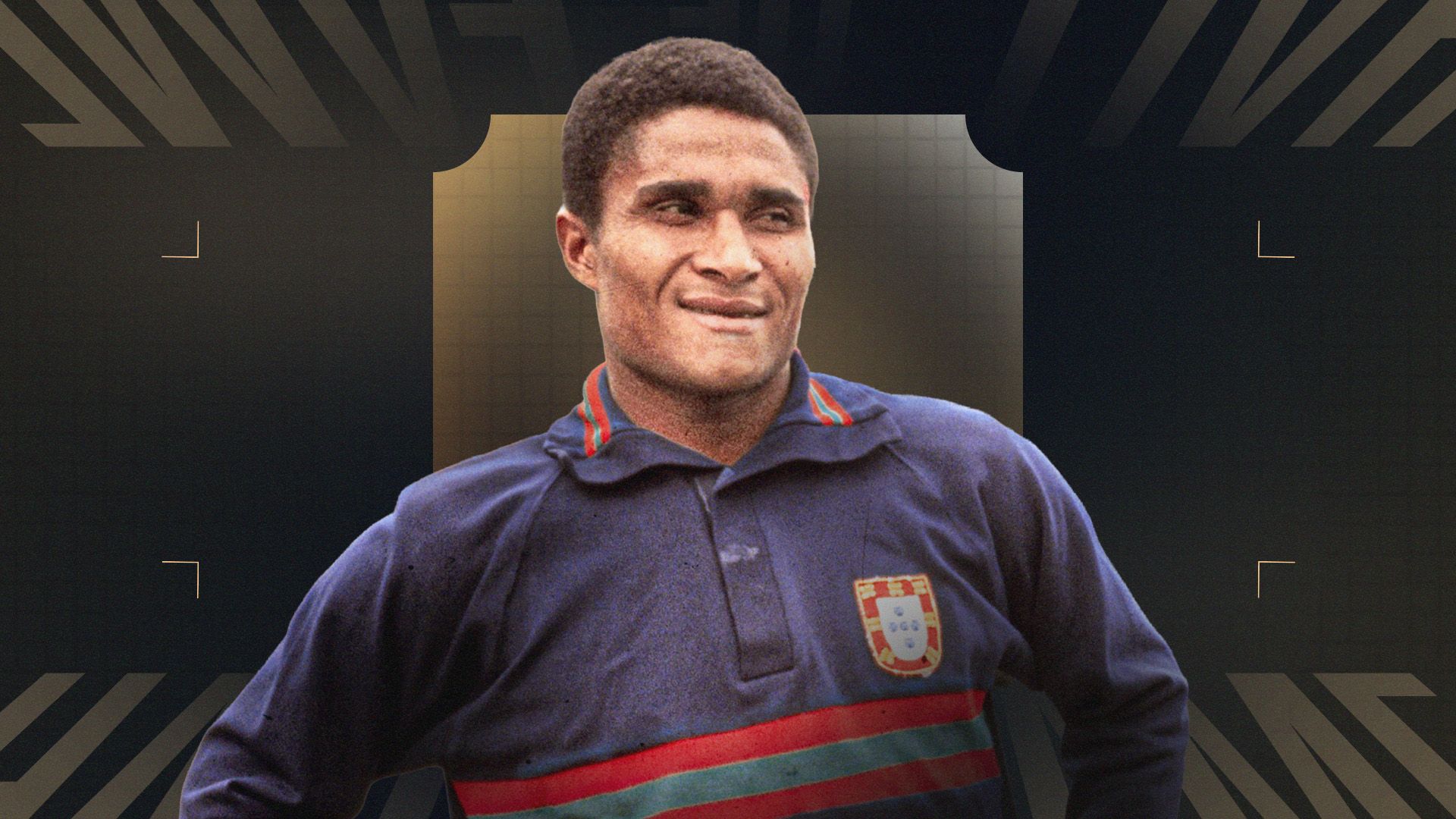
Eusébio and the Italian Door That Never Opened
How political borders, league rules and one forward’s loyalty reshaped European football
Serie A clubs tried hard to prise him away from Benfica. Juventus pursued him first, then Angelo Moratti’s Inter came very close to signing him. Eusébio and his wife Flora had already found a house near Lake Como, a move that would have placed one of Europe’s most feared centre-forwards at the heart of Italy’s tactical revolution.
Instead, the transfer collapsed in the aftermath of the 1966 World Cup. In response to Italy’s shock elimination in the group stage, the Italian authorities introduced a closure of the borders to foreigners, blocking new non-Italian signings. North Korea had knocked Italy out of the tournament, only to lose to Eusébio’s Portugal in the quarter-final. Now that same North Korean upset indirectly blocked his path to Serie A, shaping not only one player’s career but also the competitive balance of Europe’s major leagues for years to come.
Power, politics and a transfer that never happened
The scale of the Inter proposal later prompted Eusébio to joke in a 2008 interview: “I could have bought half of Lisbon,” reflecting on how much he would have earned had the deal gone through. In a separate reflection on Juventus’s earlier interest, he said that Salazar’s intervention had prevented him from leaving because the dictator considered him an asset of the state. In the Portugal of the time, footballing icons could be drawn into the logic of national prestige as much as trophies.
That version of events has not gone unchallenged. Historian Ricardo Serrado has disputed that account, attributing the failed move to Turin to the player’s military obligations. The disagreement underlines how, in mid‑20th‑century European football, transfers at the highest level were rarely decided by sporting considerations alone. They intersected with conscription rules, domestic labour laws and authoritarian politics.
The Italian episode also highlights the era’s regulatory environment. Foreign player limits, later reshaped in part by rulings such as the Bosman decision decades on, were then a fundamental strategic constraint. A Serie A club’s choice to use a precious foreign slot on a striker like Eusébio had implications for squad building, domestic title races and European Cup campaigns. Conversely, Portugal’s domestic competition retained its dominant star far longer than many contemporaries in Italy, Spain or England, reinforcing Benfica’s position at the top of the national game.
The wider framework for such restrictions now falls under the remit of bodies such as FIFA, whose regulations govern international transfers and eligibility across member associations. In Eusébio’s time, however, national decisions like Italy’s post‑1966 foreign player closure could still decisively alter the trajectory of a global icon.
Staying at Benfica and carrying the burden of expectation
Denied a move to Juventus or Inter, Eusébio remained at Benfica until 1975. By then his knees, worn out by years of heavy workloads on demanding pitches, had begun to hamper the latter part of his career. Even so, he continued to score, sustaining Benfica’s domestic power and helping keep Portuguese football visible on the European stage.
In practical terms, the blocked Serie A transfers meant:
- Benfica retained a forward around whom their attack and commercial profile had been built.
- The Portuguese league continued to showcase one of the world’s leading players, bolstering attendances and interest.
- Italian clubs missed the chance to add a player capable of altering title races and European Cup dynamics.
For international readers, this is a reminder that transfer sagas are not only stories of negotiation and finance. In certain eras they also reflect national priorities and institutional power, which can determine whether a player becomes a symbol of a single club, as Eusébio did at Benfica, or a wandering star across multiple elite leagues.
A transatlantic final chapter: from Lisbon to North America
When his prime years in Portugal ended, Eusébio’s career mapped onto football’s early globalisation. He crossed the Atlantic to play for the Boston Minutemen in the NASL, part of a wave of marquee arrivals used to promote the sport in North America.
He then moved to Monterrey in Mexico, before continuing his career in Canada. In 1976, he won the North American title with Toronto Metros-Croatia, scoring in the final and finishing with 18 goals in 25 appearances. That season offered a late‑career demonstration of his effectiveness: even with diminished mobility, his finishing and positional intelligence could still decide championships.
Over the following years, he continued to divide his time between Portugal and the United States, playing for:
- Beira-Mar in Portugal
- Las Vegas Quicksilvers in the United States
- União de Tomar back in Portugal
- New Jersey Americans in the United States
He then concluded his professional journey with one final spell in indoor football with the Buffalo Stallions. That progression, from European Cup finals to North American expansion franchises and indoor arenas, tells a broader story about football’s commercial experimentation and the search for new audiences in the 1970s.
From dressing room to touchline: Eusébio the Benfica ambassador
After retiring, Eusébio’s relationship with Benfica evolved but never broke. Back at Benfica, he joined the coaching staff before becoming an ambassador for the club that had become his home. In an era when clubs were beginning to understand the value of global branding, having a universally recognised former player as an official representative strengthened Benfica’s international profile.
The club honoured him while he was still alive. On 25 January 1992, his 50th birthday, Eusébio unveiled a statue of himself outside the old Estádio da Luz. His wife and daughters stood beside him that day. The bronze figure did not simply commemorate a striker; it anchored Benfica’s identity in a player whose loyalty had been reinforced by events beyond his control.
Today, his bronze figure welcomes supporters outside the new stadium, a visible reminder to each generation of what a club icon means in practical, sporting and cultural terms. For a side competing regularly in European competitions, that symbolism helps connect contemporary squads to a history of competing with-and often beating-the continent’s best.
National mourning and a place in Portugal’s Pantheon
Eusébio’s death confirmed the scale of his impact far beyond the pitch. When he died on 5 January 2014, aged 71, Portugal declared three days of national mourning. His coffin was carried across the pitch at Estádio da Luz, a stadium he had once dominated as a player.
On 3 July 2015 his remains were transferred to the National Pantheon, a rare honour that underlined how deeply football success can be woven into a country’s modern story. For international observers, it placed Eusébio alongside cultural and political figures rather than merely sporting greats, illustrating how a forward from Mozambique came to embody a significant part of Portuguese identity.
“My home”: the forward who chose Benfica, and who could not always choose
Years before his death, Eusébio articulated the emotional bond that framed his entire career. “If I could choose, I would like to die there, in Benfica’s stadium. It is my home.” The centre-forward who had come from Mozambique explained in 1997: “That is where I became a man. That is where I have lived since I was 18. Of course I cannot choose, but I would like to… And during an intense, hard-fought match ending in a Benfica victory, too.”
Those words capture the paradox of his journey. At key moments, he could not fully choose: not when national policy influenced his chances of joining Juventus or Inter, nor when foreign player rules sealed off Italy at the moment his move appeared imminent. Yet within those constraints, he built a career that helped define Benfica, lifted Portuguese football onto the world stage and contributed to the early internationalisation of the club game.
For modern readers used to global superstars changing leagues with relative freedom under today’s regulatory structures-overseen by organisations such as FIFA and regional confederations-the story of Eusébio’s near‑miss in Serie A is more than a historical curiosity. It is a reminder that the path of an all‑time great can hinge on decisions taken in boardrooms and ministries as much as in dressing rooms and dugouts, and that a blocked transfer can, in time, strengthen the bond between a player, a club and an entire country.
Worth a look
