
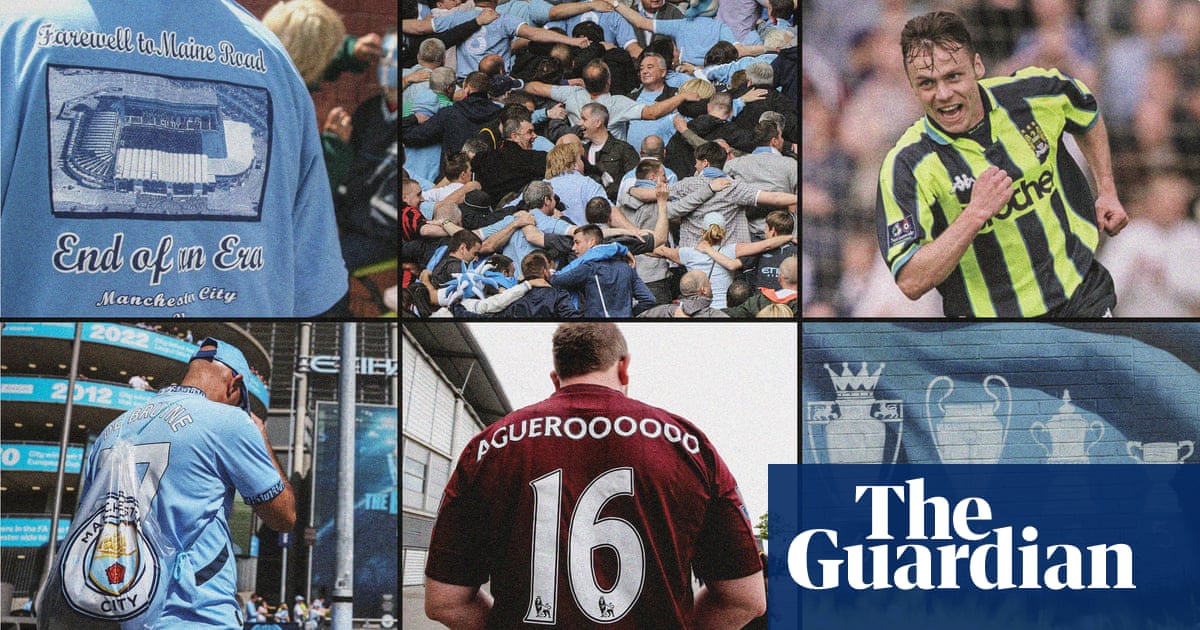
‘City till we die’: Manchester City fans wrestle with loyalty, anger and the fallout from financial breaches
The collapse of trust between Manchester City’s hierarchy and parts of its fanbase has turned a long‑running financial case into something far more personal. For supporters who lived through relegation to English football’s third tier and the subsequent rise to domestic and European dominance, the latest revelations about systemic rule‑breaking feel less like a dispute over regulations and more like a test of identity.
The voices of fans from Manchester, the rest of England and the United States reveal a shared tension: how to hold on to memories of Paul Dickov at Wembley in 1999, Sergio Agüero’s stoppage‑time title winner in 2012 and a night in Istanbul, while processing the knowledge that many of those highs are now framed by confirmed cheating on an industrial scale.
A fanbase that once united in relegation now fears fracture
Nicola Schofield, City fan for more than 40 years: One of my (million) concerns, as someone who feels angry with the owners, is if the owners’ strategy causes a split in the fanbase. I think everyone wants to get behind the club and team, but this is different to the experience of a relegation of the type I experienced in the 90s. We all shared that, and we stood by the club down to League One and as we came back up. This threatens to be messier, with those who may want the owners out (which is its own minefield) to those who will back them all the way. I think ultimately all fans want to ensure our club still exists, but I do worry at divisions this could cause and that might be hard to heal.
For supporters like Schofield, the comparison with relegation in the 1990s is not nostalgic; it is structural. Then, the crisis was sporting and collective. Now, the damage is rooted in governance and the conduct of the people running the club. The risk is that instead of the fanbase rallying around survival on the pitch, it is pulled apart by arguments about ownership, ethics and the long‑term future of the institution.
The stakes go beyond sentiment. Depending on how sanctions are applied under the Premier League’s financial rules framework, consequences such as points deductions or limits on future spending could reshape City’s place in the title race, European qualification and their ability to retain or attract elite players in coming seasons. That uncertainty feeds directly into supporters’ anxiety about what, exactly, they will be uniting behind.
Fifteen golden years, and a trust that has shattered
Ben, season-ticket holder: I don’t think I have fully processed the news yet. I trusted the club completely and believed every word they said in response to the charges, so this has hit hard. I still think the FFP [financial fair play] rules aren’t fair and never have been. I know that won’t get much sympathy from other fans, and I understand why. Most of them have been waiting for this day for years. Whatever happens, nobody can take the last 15 years away from us. We lived every moment: [Sergio] Agüero in 2012, the centurions, the treble, Istanbul. Those memories are ours and no verdict changes that. Right now I just feel confused. One thing won’t change, though: whatever happens, I’ll still support the team. This is character-building, as my parents used to say to me.
Ben’s reflection encapsulates a core tension running through the fanbase. On one side are indelible football memories: the stoppage‑time winner against Queens Park Rangers that sealed City’s first league title since 1968, a record‑breaking 100‑point domestic campaign, a treble, and a Champions League triumph in Istanbul. On the other is the sense of having been misled by a club hierarchy that repeatedly insisted it had complied with financial rules.
For international readers, “FFP” in this context refers both to UEFA’s former Financial Fair Play system and to the domestic profitability and sustainability framework overseen by the Premier League. These regulations were designed to limit unsustainable spending and promote competitive balance, but they have also been criticised by some clubs and supporters as entrenching the power of established giants. That tension is central to how City fans are processing both the scale of the club’s breaches and the severity of the sanctions.
From Dickov to Agüero: when historic moments are recast
James Blakey, fan for more than 40 years: I was 13 in 1999 when Paul Dickov scored a 95th-minute equaliser at Wembley to take the Second Division playoff final to extra time and Nicky Weaver’s heroics in the shootout saw us promoted. That was the first year I had a season ticket at Maine Road. When Agüero scored in the 93rd minute against QPR – 13 years later – I was in a pub in Manchester that was split 50-50 between us City fans and the United fans who seconds earlier believed they had won the title. The Dickov and Agüero goals are very alike: the elation, the sweetness, the togetherness and the pride in my club; the club that would always be there no matter what else changed in my life.
Now I know that the second of these moments, and so many more moments that followed, Istanbul included, would not have happened without my club cheating on a systemic, industrial scale. And I don’t know what to do with that. I can’t give those memories back. But I do know that the richest people in the world thinking that the rules don’t apply to them, that they can cheat and then arrogantly chuck endless money at the situation, has nothing to do with what I love about football, nothing to do with what I love about Manchester, nothing to do with what I love about my club and the glorious fans doing the conga in the aisles and the Poznan in the stands. I’m really sad.
The ‘Agüero moment’ in 2012, which earned Manchester City their first title since 1968. Photograph: Phil Noble/Reuters
Blakey’s story illustrates how the same supporter can hold two parallel truths. The 1999 playoff final comeback at Wembley, secured by Dickov’s late goal and Nicky Weaver’s saves in the shootout, predates the current ownership. It stands as a symbol of a community club clawing its way back from the brink, long before state‑backed wealth arrived.
The late winner against QPR, by contrast, sits firmly in the era now tainted by proven financial wrongdoing. For fans, the ball still hit the net at the same time; the noise, the celebrations and the shared chaos remain real. Yet the context has changed. Those moments are being reinterpreted not as pure football miracles, but as the sharpest edge of a project built on rule‑breaking. That recalibration is at the heart of supporters’ emotional dislocation.
Routine, relationships and a sense of normality under threat
David Mayor, season-ticket holder and attender of York away in 1998: I keep wondering, when (if) the dust finally settles, how it will feel as a fan. But we’ve gone through many changes in my 40 years supporting the club – relegations, stadium move, ownership, etc – and it ultimately reverts to the norm. You see the same faces and my dad’s still moaning about a wayward pass regardless of how the team’s playing. This last week has felt a serious danger to this. For a long time I’ve thought the game at the highest level was morally bankrupt so the actions of the club haven’t particularly bothered me. When they stated they were going to join a super league I thought I could walk away, but for whatever reason, maybe defiance in the face of what opposition fans are telling me I should do/feel, I can’t foresee that I will regardless of how it all ends.
Mayor’s reference to “York away in 1998” is a reminder that for many long‑term supporters, the central constant is not the trophy count but the ritual: the same turnstiles, the same travelling companions, even the same family complaints about misplaced passes. Ownership and league status have changed repeatedly. The threat posed by recent events feels different because it touches the very idea of what elite football represents and whether supporters can reconcile their ethics with backing a club found to have broken the rules.
The mention of the aborted European super league project underscores how repeated governance controversies have worn down trust not only in individual clubs but in the broader competitive structure. For City, any fresh sanctions will land on a supporter base that has already processed the shock of that attempted breakaway.
A global fanbase, shared disillusionment
Jon Ashley, Washington DC-based fan: Being outside Manchester – and the UK – definitely has a numbing effect when it comes to bad things happening to your football team. Part of me does feel betrayed by and angry at the City higher-ups who have clearly misled the fans for a long time, particularly when you look at the extent of the “sham”. But there remains a part of me that remembers the abject misery of being a City fan at school during the 1990s and 2000s and the seemingly impossible dream of one day seeing them compete for trophies. The severity and duration of City’s offences warrant significant punishment, but the verdict that it took this much sustained rule-breaking and money to prevent United, Arsenal and Liverpool adding to their own trophy cabinets is an indictment on the Premier League.
Ashley’s perspective from the United States highlights both distance and proximity. Time zones and geography soften the immediate impact, but the emotional arc is similar: early‑years suffering, followed by an era of unprecedented success, now overshadowed by the knowledge that those achievements were underpinned by a sustained pattern of rule‑breaking.
His final observation touches on a broader competitive question. That so much sustained spending and non‑compliance was required to disrupt the dominance of England’s traditional powers invites scrutiny of the league’s economic landscape as a whole. For neutral observers, this case is not just about one club’s punishment; it is a lens into how financial power, regulation and sporting integrity intersect at the top of the game.
Between transformation and mistrust in east Manchester
Chris Stalker, chair of New York Sky Blues, speaking in a personal capacity: At the New York Sky Blues we have close to 400 members and its caused a lot of discussion and debate. First around FFP, and the consensus is it needs challenging, not just by City but other clubs, too, such as Newcastle, Aston Villa and Everton, because the aim seems to be to maintain the status quo. We accept rules have been broken but there are legitimate concerns about why they exist. Second, the ownership maintains a lot of credit because when we travel to home matches, we see the transformation they have made in east Manchester. It is not just the stadium but the whole area has changed with the investment. They have also given many fans the best days of their lives. Never did I expect to see a better player than Colin Bell but I’ve got to witness David Silva and Kevin De Bruyne.
There is, however, a growing uneasiness with how we feel about the ownership. We have as a fan group invested a lot of trust in them and that looks unwarranted. A relationship with fans should be built on honesty and integrity and could be lost. We try to align our support for the club with our principles and values, carrying out charity work in New York, raising $25,000 (£19,000) last year for New York Common Pantry, which is a food bank. It reflects the work done by City supporters outside the Etihad Stadium and strengthens the links through values and ethics. As Manchester City we won’t be defined by the owners. Owners come and go but we’re City till we die. So let’s act in solidarity and stand together.
Stalker’s comments sharpen a key faultline. On one side is the visible regeneration around the Etihad Stadium and the calibre of players brought to Manchester City: talents such as David Silva and Kevin De Bruyne, following in the lineage of club greats like Colin Bell. On the other is the sense that a social contract has been broken, that the price of transformation has been secrecy and deception.
For international supporters’ clubs like New York Sky Blues, the response has been to double down on their own values, using charity work and community initiatives to define what being “City” means beyond the ownership model. That distinction may prove critical in the years ahead as the club navigates reputational repair on and off the pitch.
What the fallout means for competition and for supporters
For the Premier League and European competitions, the City case has immediate implications. Any sporting sanctions – whether points deductions, fines or squad‑building restrictions – affect not only City’s pursuit of domestic titles and European qualification but also the balance of competition for rivals aiming for top‑four places or chasing silverware.
Clubs competing with City will study both the legal reasoning and the scale of punishment as a precedent for future enforcement. Supporters of those clubs will see this as a test of whether financial regulations are genuinely applied, or whether elite institutions are effectively too big to face full sporting consequences.
For Manchester City’s own fans, the impact is more intimate and longer‑term. The voices here show a fanbase trying to reconcile several realities at once:
- lifelong attachment to a club that existed long before its current owners
- profound pride in iconic on‑pitch moments and in the regeneration of parts of east Manchester
- anger, sadness and embarrassment at confirmed systemic cheating and at being misled
- a determination, in many cases, to separate support for the team and community from support for the ownership
Whatever the competitive outcomes in the coming seasons, from title races to European campaigns, the deeper contest – for trust, integrity and unity within the Manchester City fanbase – is only just beginning. For supporters like Schofield, Ben, Blakey, Mayor, Ashley and Stalker, it is a struggle to protect the meaning of “City till we die” in a world where the club’s greatest era has been permanently complicated by how it was built.
