
WASHINGTON – US President Donald Trump on Tuesday refused to spell out how far he intends to go in Greenland, hinting he could “make a deal” as European leaders warned that any move to seize the vast Arctic territory from US ally Denmark would reverberate through NATO and global markets.
Asked how far he would go, Mr Trump replied only: “You’ll find out.”
Hours before departing for the World Economic Forum in Davos, Switzerland, Mr Trump told reporters: “We have a lot of meetings scheduled on Greenland, and I think things are going to work out pretty well.” Denmark has warned that the entire NATO alliance is at risk if he moves forward, as European capitals braced for a parallel trade clash after Mr Trump vowed fresh tariffs on Britain, France and Germany. “I think that we will work something out where NATO is going to be very happy and where we’re going to be very happy,” he said. “But we need it for security purposes. We need it for national security and even world security,” Mr Trump added of Greenland.
Allies bridle as Washington raises the stakes
Copenhagen and Nuuk reiterated that Greenland is not for sale and that the island’s status cannot be altered without the consent of Greenlanders, who are recognized in Danish law as a distinct people with the right to decide their own constitutional future. Greenland’s elected leadership has repeatedly stated the territory “is not for sale,” and Denmark’s government has publicly closed the door on any transfer of sovereignty. In televised remarks this evening, Ireland’s Tánaiste Simon Harris said “everything is on the table” in terms of a coordinated European response if the US were to “annex” Greenland or part of Greenland, while cautioning against a “spiral” of “tit-for-tat tariffs.” European officials have framed the dispute as a test of international law and alliance discipline, warning privately that a NATO member even threatening to absorb allied territory would be without precedent in the history of the alliance.
Mr Trump over the weekend threatened new duties on key European economies, a lever he has used before. In 2018 the United States imposed national-security tariffs on steel and aluminum under Section 232 of the Trade Expansion Act and separately levied duties on EU goods in the long-running Airbus-Boeing dispute, steps later partially converted to tariff-rate quotas or suspended via negotiated arrangements. The White House has signaled it could revive or expand such tools if Europe resists US moves on Greenland, sharpening the link between the administration’s trade authorities and its approach to alliance politics.
Greenland’s status, law and alliance obligations
Greenland is a self-governing territory within the Kingdom of Denmark. The Greenland Self-Government Act, adopted by the Danish parliament on June 12, 2009, recognizes that “the Greenlandic people are entitled to self-determination by international law,” and devolves broad legislative and executive powers to Nuuk; Denmark retains responsibility for foreign, security and defense policy unless otherwise agreed with Greenland. The act also sets out a pathway under which Greenlanders could, in principle, decide on independence in a future referendum, underscoring that any change in status is a matter for Copenhagen and Nuuk, not third countries.
Under the North Atlantic Treaty, to which both Denmark and the United States are parties, Greenland falls within NATO’s collective-defense area as “islands under the jurisdiction of any of the Parties in the North Atlantic area north of the Tropic of Cancer.” Any armed attack there would engage Article 5 consultations and potential collective response, meaning that an attempt by one ally to use force on another’s territory would collide directly with the treaty logic designed to deter external aggression.
International law prohibits acquiring territory by force. The UN Charter’s Article 2(4) bars the threat or use of force against the territorial integrity or political independence of any state, and the UN General Assembly’s 1970 Friendly Relations Declaration states that “No territorial acquisition resulting from the threat or use of force shall be recognized as legal.” For European diplomats, Mr Trump’s rhetoric therefore touches not only on NATO cohesion but also on the core post-1945 rule that borders cannot be changed by coercion.
The US military presence in Greenland rests on treaty arrangements with Denmark. A 1951 bilateral agreement, concluded within the NATO framework, authorizes US defense activities on the island and remains in force for the duration of the North Atlantic Treaty. Today, the Pentagon’s northernmost installation-Pituffik Space Base, renamed from Thule Air Base in 2023-hosts missile-warning radars and space-domain awareness missions critical to the Arctic and North Atlantic, making the island central to US early-warning and space tracking architectures.
Why the island matters in the Arctic
Greenland’s location astride the great-circle routes between North America and Eurasia and near Arctic sea lanes makes it a strategic outpost for missile warning, satellite tracking and trans-Atlantic logistics. As climate change thins sea ice, commercial and military interest in Arctic passages has grown, with Russia expanding its northern posture and China declaring itself a “near-Arctic state” in a 2018 white paper outlining a “Polar Silk Road.” For planners in Washington and European capitals, control of infrastructure on Greenland is therefore not an abstract cartographic question but a concrete factor in future shipping, undersea cables and over-the-pole flight routes.
The island’s population stands at roughly 56,700, concentrated in the capital Nuuk and coastal towns. Its economy is dominated by fisheries-over 90% of exports-and is supported by an annual block grant from Denmark; Greenland maintains a special association with the European Union as an Overseas Country and Territory, receiving dedicated EU funding and fisheries-market access despite having left the European Economic Community in 1985. That dependence on a narrow export base and external budget support means any shock to trade or security ties-whether through tariffs or a wider rupture between Washington and Europe-would be felt quickly in local public finances.
From Truman’s offer to a canceled state visit
Washington’s interest in Greenland is not new. In 1946, President Harry Truman’s administration formally offered Denmark $100 million in gold to purchase the territory-an approach Copenhagen rejected-arguing that US control would improve North Atlantic defense at the dawn of the Cold War. More recently, in August 2019, Mr Trump canceled a planned visit to Denmark after Prime Minister Mette Frederiksen called the notion of selling Greenland an “absurd discussion,” underscoring how quickly Greenland can strain otherwise close transatlantic ties and how questions over the island’s status can spill into high-level diplomacy.
- 1867-1910: US officials intermittently explore ideas to acquire or swap for Greenland; no formal deal emerges.
- 1941-1951: US-Danish defense accords during and after World War II underpin an enduring US military presence on the island.
- 1946: Truman offers $100 million in gold; Denmark declines.
- 2019: Trump cancels Denmark visit after Copenhagen rejects sale; Nuuk reiterates “not for sale.”
- 2023: Thule Air Base becomes Pituffik Space Base under the US Space Force, reflecting the island’s growing role in space and missile defense.
A combustible backdrop in Washington
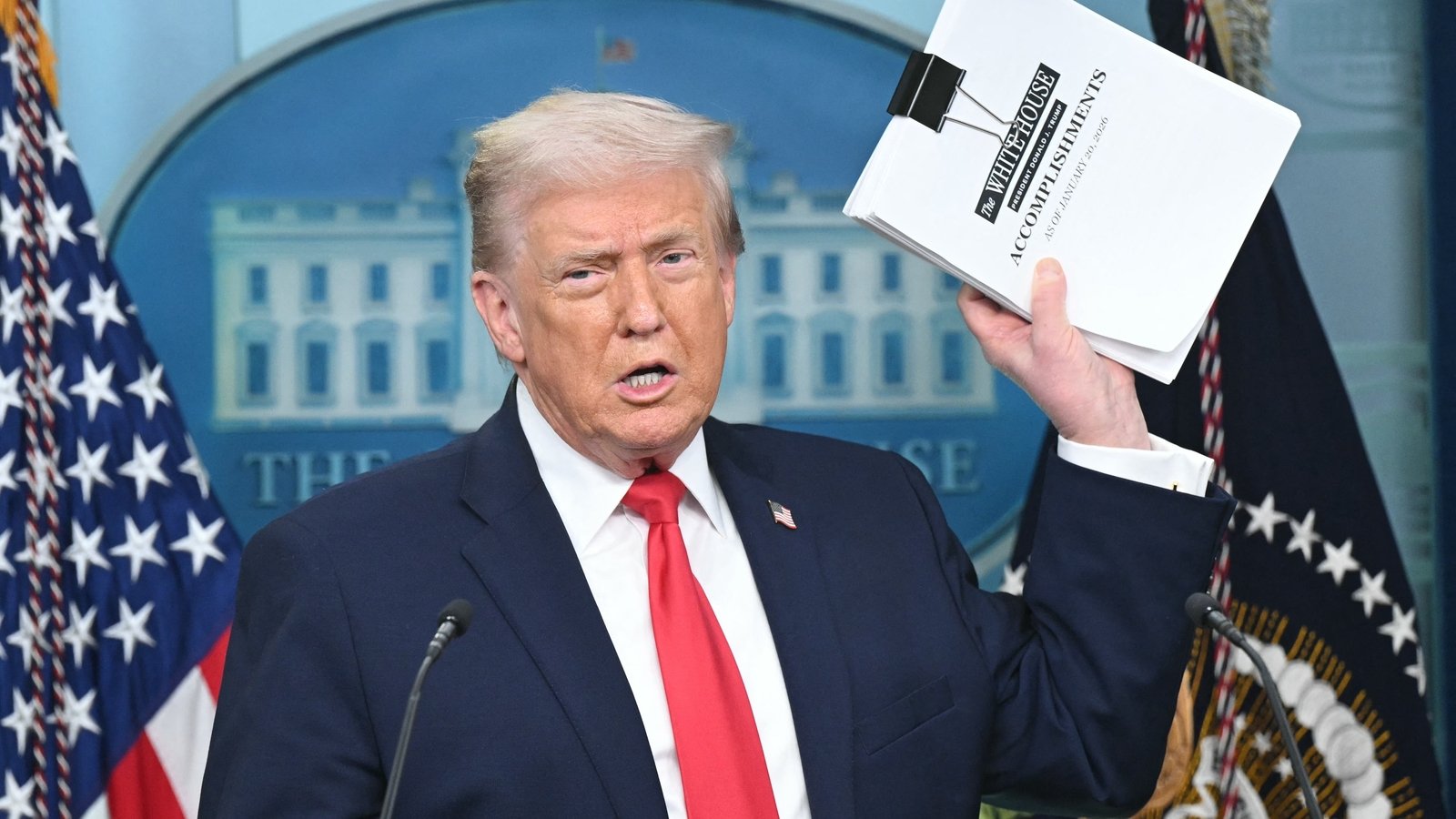
Mr Trump marked the first anniversary of his return to the White House with an extended, often downbeat news conference that leaned heavily on long-standing grievances. Opening with a broadside on illegal immigration, he ranged across topics-from US military action in Venezuela and welfare fraud by Somali immigrants in Minnesota to renewed attacks on his predecessor, Joe Biden. As he moved from one subject to another, the appearance resembled a reprise of the campaign that preceded his return to office, including his false claim to have won the 2020 election.
“We’ve done more than any other administration has done, by far, in terms of military, in terms of ending wars, in terms of completing wars,” he said, as aides circulated a 31-page list of 365 claimed “wins.” On foreign affairs, he said of Venezuelan opposition leader Maria Corina Machado, “We’re talking to her. Maybe we can get her involved in some way. I’d love to be able to do that,” adding that she had given him her Nobel Peace Prize medal. The freewheeling performance reinforced for European officials that his Greenland remarks were part of a broader willingness to test institutional boundaries in public, complicating efforts by US diplomats and defense officials to reassure allies behind closed doors.
What Europe hears in Washington’s Greenland talk
For European leaders, the signals are double-edged: an American president asserting that “security” justifies a unilateral change in Arctic geography, and the prospect of tariffs targeting major EU economies. Denmark insists any discussion over defense cooperation in Greenland must respect both Danish sovereignty and Greenlanders’ right to self-determination-principles embedded in the Self-Government Act and in UN instruments-and that NATO’s credibility depends on members eschewing threats against each other’s territory. Senior EU officials also note that the dispute lands as Europe is trying to finalise its own Arctic strategies and critical-minerals rules, raising the risk that a clash over Greenland could bleed into wider regulatory cooperation with Washington.
Greenland’s government, for its part, has engaged the EU to deepen ties on education, critical raw materials and fisheries as the island navigates heightened external pressure, seeking to anchor its autonomy in a web of economic and governance arrangements rather than in a transactional sale. As of Tuesday, January 20, 2026, Greenland remains a self-governing part of the Kingdom of Denmark under the 2009 Self-Government Act; the 1951 US-Denmark defense agreement and the North Atlantic Treaty remain in force, and no change to Greenland’s status has been announced.
Related reading
- Global Food Security Alliances: How Climate-Resilient Agricultural Corridors Are Stabilizing Wheat and Rice Supplies
- Cross-Border Renewable Energy Grids: North Sea and Mediterranean Subsea Cable Networks Enter Phase Two
- Jay Clayton named White House AI czar by Trump to lead task force (globallypulse.com)
