
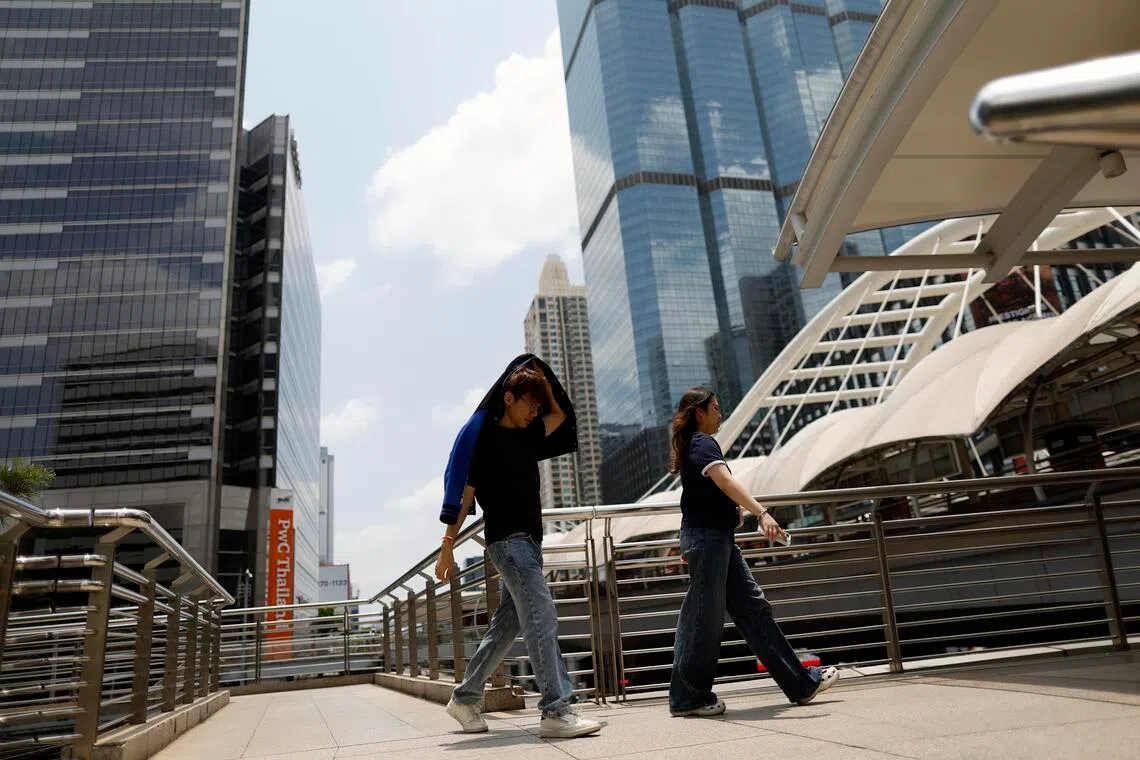
BANGKOK – Thailand could face extreme heat conditions comparable to those currently seen in the Sahara by 2070, according to climate research suggesting that global warming is pushing various regions beyond the temperature ranges in which human societies have historically flourished.
The projection underscores a critical shift in global habitability, highlighting a growing gap between the climates humans have evolved to withstand and the trajectory of current planetary warming. This vulnerability is particularly acute in Southeast Asia, where high humidity and rising baseline temperatures are converging to create an increasingly hostile environment for human physiology and economic stability.
The warning was highlighted by Tara Buakamsri, director of the Climate Connectors programme, in a discussion regarding the influential 2020 study Future Of The Human Climate Niche by Xu and colleagues, as well as analysis provided in Owen Mulhern’s article Too-Hot-to-Live-In.
The Human Climate Niche
At the center of this analysis is the “human climate niche,” a theoretical framework describing the relatively narrow temperature band in which human populations have historically settled, evolved, and built civilizations over millennia, from early agrarian societies to modern megacities.
According to the research, the vast majority of human populations have historically clustered around a mean annual temperature of approximately 11°C to 15°C. While many modern populations live in regions warmer than this historical average, they remain within a range to which social and technological systems can broadly adapt, provided that infrastructure, governance, and public health systems keep pace.
The threshold of concern occurs when the mean annual temperature rises above 29°C. Currently, such conditions exist on only about 0.8 percent of the Earth’s land surface, primarily within the Sahara Desert.
Under high-emissions scenarios, researchers warn that this zone could expand dramatically. Such a shift would expose roughly one-third of the global population to heat levels that are currently found only in the world’s most extreme desert environments, with serious implications for internal migration, labor markets, and long-term urban planning.
Thailand’s Trajectory Toward the Threshold
For Thailand, the data presents a precarious outlook. The country’s current mean annual temperature is approximately 26°C, placing it uncomfortably close to the 29°C danger zone.
Climate projections suggest that by the end of the century, Thailand could cross this critical threshold under continued high-emissions pathways. Such a transition would represent more than a series of hotter summers; it would signal a structural shift into a climate regime fundamentally incompatible with the conditions that have allowed Thai agriculture, tourism, and urban centers to prosper.
Evidence of this shift is already appearing in historical data:
- From March to May, Thailand routinely records temperatures exceeding 40°C, particularly in the North and Northeast.
- During the severe heatwave of 2016, NASA Earth Observatory reported that land surface temperatures in parts of the country were as much as 12°C above average.
- In April 2016, more than 50 towns and cities broke daily records, with Mae Hong Son recording 44.6°C on April 28-at the time, the highest air temperature ever observed in the kingdom.
The prospect is that future “mild” heatwaves may mirror the intensity of today’s most dangerous anomalies, transforming extreme heat from an occasional crisis into a permanent feature of daily life. For Thai authorities, that implies a need to redesign everything from working hours and school calendars to building codes and disaster-response protocols.
Socio-Economic and Public Health Cascades
The crossing of the 29°C mean annual temperature threshold would trigger cascading failures across health and economic sectors. Rising temperatures directly correlate with increased incidences of heart disease, respiratory illness, kidney stress, and the spread of infectious diseases, particularly those transmitted by mosquitoes and other vectors that thrive in warmer, wetter conditions.
The burden is not distributed evenly. Low-income households, the elderly, and outdoor laborers-particularly those in Thailand’s vast agricultural sector, construction industry, and informal urban economy-face the highest risk. Rural communities, which often lack the infrastructure for mechanical cooling and robust healthcare, are especially exposed.
Beyond health, the heat poses a systemic threat to national productivity and fiscal stability:
| Sector | Impact of Extreme Heat |
|---|---|
| Labor | Reduced efficiency, shorter working hours, and increased morbidity for outdoor and factory workers, with implications for wage growth and competitiveness. |
| Agriculture | Decreased crop yields and livestock stress, threatening food security, rural livelihoods, and export revenue for key commodities such as rice and rubber. |
| Energy | Surging demand for cooling, straining national grids and exposing gaps in investment planning, especially during peak hot seasons. |
Economists warn that, without adaptation, lost labor hours and heat-related damage could erode a meaningful share of Thailand’s annual GDP, complicating fiscal planning and widening inequality between regions and social groups.
The Adaptation Paradox
While air conditioning is frequently cited as a primary survival strategy, experts warn that reliance on mechanical cooling creates a dangerous feedback loop.
Expanding cooling access across the population would require massive investments in energy infrastructure. If this energy continues to be derived from fossil fuels, the resulting emissions further accelerate the warming that makes the cooling necessary, locking Thailand into higher operating costs and deeper climate risk.
“It is a form of adaptation, but one that risks deepening the crisis if it is not paired with systemic reform,” Buakamsri noted.
This heat crisis does not exist in isolation. In Thailand, it is intertwined with intensifying droughts, more destructive flooding, and rising sea levels that threaten the Bangkok Metropolitan Administration’s coastal economic zones and critical infrastructure, including ports, industrial estates, and transport corridors. These overlapping risks create a “poly-crisis” that makes adaptation more expensive and technically difficult, and that tests the capacity of existing planning and regulatory institutions.
Policy Response and Regional Diplomacy
The transition to a low-carbon economy and the redesign of urban centers-incorporating green architecture, expanded tree cover, reflective materials, and heat-resilient infrastructure-will require significant political resolve, regulatory reform, and international investment.
Bangkok’s planners are already under pressure to integrate heat risk into zoning rules, building standards, and drainage and transport projects, while the national government weighs incentives for renewable energy and climate-smart agriculture. Effective implementation will depend on enforcement capacity and the alignment of national development plans with climate targets.
The current global climate trajectory suggests that if greenhouse gas emissions remain high, the habitable space for human civilization will continue to shrink, leaving tropical nations like Thailand on the front line of the transition. Under the Paris Agreement, Thailand is required to submit and periodically strengthen its nationally determined contributions (NDCs), which now increasingly incorporate heat and health considerations alongside traditional mitigation goals.
Thailand continues to coordinate with ASEAN partners and international climate bodies to align its NDCs and domestic energy policies with these escalating thermal risks. Regional initiatives on power grid interconnection, early-warning systems, and joint adaptation projects are viewed in Bangkok as critical tools for sharing costs and expertise. Independent analysts note that Thailand’s next cycle of NDC updates, and the policies that follow, will be a key test of whether the country can stay ahead of the climate curve rather than be overwhelmed by it.
Keep reading
