
WASHINGTON –
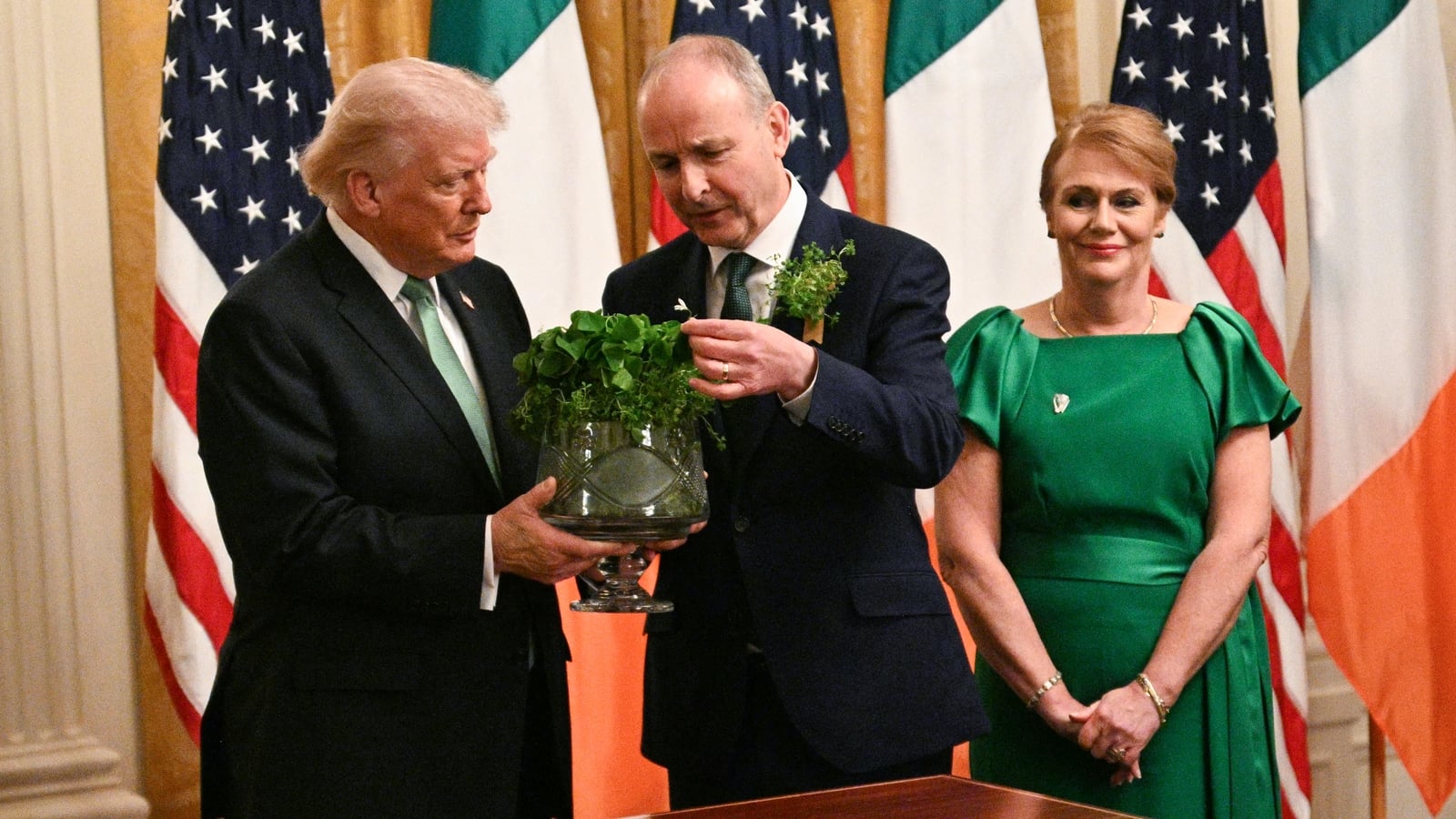
Ireland’s Taoiseach, Micheál Martin, presented U.S. President Donald Trump with the traditional bowl of shamrock at the White House, a centerpiece of annual St. Patrick’s Day diplomacy that drew hundreds of guests and the most senior figures across the U.S. government.
“It’s been a special time. I feel like I have Irish blood. I’m not too far [with] Scottish blood,” Donald Trump told those in attendance, casting the celebration as a personal as well as political tradition.
With the Taoiseach onstage, the president used portions of his remarks to hail “the operation in Iran” and to restate domestic priorities, including proposed measures on voter ID and policies affecting transgender participation in sports. He also paid tribute to Irish Americans in his administration, naming Transportation Secretary Sean Duffy and Education Secretary Linda McMahon. Those in the audience included Attorney General Pam Bondi and House Speaker Mike Johnson, underscoring the ceremony’s reach across the executive and legislative branches.
“We find Irish Americans embody the best of our country and point us toward excellence and great success. And nobody has had, I would say, as a group, more success than people from Ireland,” Mr. Trump said.
A ritual of diaspora diplomacy
The shamrock presentation is among the longest-running ceremonial exchanges between Ireland and the United States. What began in 1952, when Irish ambassador John J. Hearne sent a modest box of shamrock to President Harry S. Truman, evolved within a few years into a formal White House tradition-often featuring a Waterford crystal bowl-and has continued, with rare adaptations, through successive administrations.
The annual exchange is now a fixture of the U.S. political calendar, sitting alongside state visits and National Security Council briefings as one of the few recurring moments when a foreign leader addresses the full breadth of Washington’s power structure in a largely celebratory setting. Its prominence reflects the political and cultural weight of Irish America. By recent American Community Survey estimates, roughly one in ten U.S. residents reports Irish ancestry-amounting to more than 30 million people nationwide-sustaining a transatlantic constituency that shows up in parades, philanthropy, and politics from city councils to Congress.
Economic ties with strategic reach
The United States and Ireland now anchor one of the richest two‑way investment relationships in the Atlantic economy. Business groups estimate a commercial relationship on the order of $1 trillion, with about 970 U.S. companies operating in Ireland and hundreds of Irish firms investing and hiring across all 50 U.S. states. Those flows run in both directions: American multinationals see Ireland as a platform into the European market, while Irish investors rank among the top sources of foreign direct investment into the United States by jobs supported.
For both governments, St. Patrick’s week in Washington has become a de facto economic summit. Senior officials and business leaders use the visit to press for stable tax and regulatory regimes, signal their expectations on trade policy in Brussels and Washington, and reassure investors that cross‑border operations will remain shielded as far as possible from sudden shifts in industrial or tariff policy.
- Tradition formalized: Shamrock first reached the White House in 1952; the presentation soon shifted to a ceremonial Waterford bowl, giving the exchange a recognizable visual identity.
- Diaspora scale: Around one in ten Americans reports Irish ancestry, according to federal survey data, anchoring a network of lawmakers and local officials who routinely engage Dublin on issues from visas to cultural programming.
- Two‑way commerce: The U.S.-Ireland business relationship is widely assessed at roughly $1 trillion, spanning investment, trade, and services and giving both sides a direct stake in each other’s regulatory choices.
Peace process and policy bandwidth
Taoisigh have long used St. Patrick’s week in Washington to raise issues that reach beyond pageantry, from trade to transatlantic security and the Northern Ireland peace architecture. The 1998 Belfast/Good Friday Agreement-an accord the United States helped facilitate-remains the bedrock for power‑sharing, rights protections, and cross‑border institutions on the island of Ireland. That framework, set out in the Belfast Agreement, continues to shape how successive U.S. administrations and members of Congress assess developments in British‑Irish relations and evaluate any policy moves that could unsettle the open border on the island.
Against that backdrop, Mr. Martin’s language was calibrated for both domestic and international audiences. “Let the USA always be that beacon on the hill, holding firm to those founding values… and let Ireland and the United States continue to work together to defend them and to build a better world, one that is free, secure and at peace,” he said.
Mr. Martin called the shamrock exchange “always a uniquely special moment,” framing it as a platform to “inspire and to sustain those who today yearn for peace, justice and freedom.”
“It is a symbol of friendship, a friendship between our peoples, which is older than our republics,” he said, casting the ritual as continuity at a time of shifting global alignments.
The Taoiseach also underscored the economic dimension. “The United States is the largest economy in the world. Ireland is small. We need free and open trade to make our way to the world, and we like to see as few barriers and tariffs get in the way of that as possible,” he said, aligning Dublin firmly with the rules‑based trading order that underpins U.S.-EU commerce.
Politics in the room
Beyond the bowl, the guest list signaled the standing of the bilateral relationship on Capitol Hill and within the administration. Irish leaders’ St. Patrick’s Day programs typically combine ceremonial moments with closed‑door policy meetings, outreach to the diaspora, and commercial diplomacy with U.S. business. Those optics-particularly the Speaker and Cabinet‑level presence-track with decades of White House practice that elevates Ireland’s visit into a full day of East Room, Oval Office, and congressional engagements.
For lawmakers, the events offer an annual touchpoint with a close ally whose interests intersect with U.S. policy on corporate taxation, digital regulation and Atlantic security. For the administration, they are a stage on which to showcase domestic priorities to an international audience-as Mr. Trump did with his references to voter ID and transgender participation in sports-while reaffirming support for one of Washington’s most durable diplomatic relationships.
Mr. Trump’s brief reference to “the operation in Iran” introduced a note of global security into the festivities; no additional details were provided during the event, leaving it as a reminder that even Washington’s most ritualized celebrations unfold against a backdrop of live foreign‑policy decisions.
Related reading
- Global Food Security Alliances: How Climate-Resilient Agricultural Corridors Are Stabilizing Wheat and Rice Supplies
- Cross-Border Renewable Energy Grids: North Sea and Mediterranean Subsea Cable Networks Enter Phase Two
- Jay Clayton named White House AI czar by Trump to lead task force (globallypulse.com)
- Lacoste presents Spring-Summer 2027 collection at Roland-Garros, Marie Claire reports (archysport.com)
