
GENEVA —
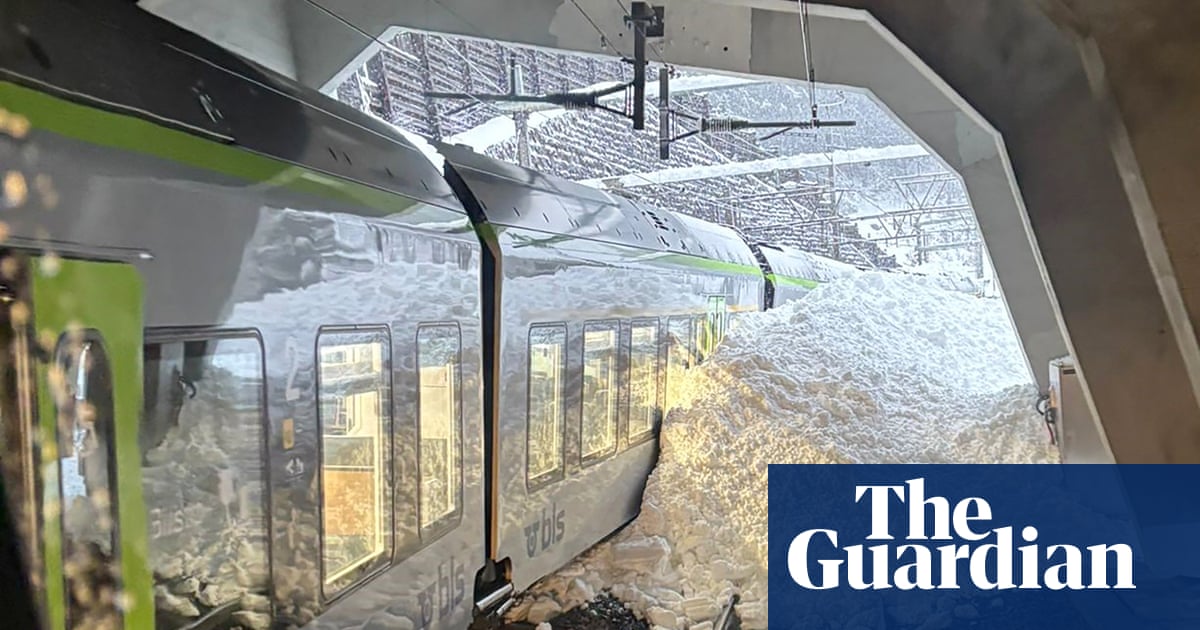
Avalanches unleashed by days of heavy snowfall across the western Alps derailed a Swiss regional train and forced closures and evacuations around the Mont Blanc massif, as rescue agencies confirmed multiple skier deaths in France and Italy since Friday. Swiss police said five people were injured when a BLS train came off the tracks near Goppenstein on Monday, 16 February, amid high avalanche danger. Authorities in France and Italy reported continuing operational restrictions around Chamonix and Courmayeur as snow instability persisted.
The risk level in large Alpine sectors reached the top of Europe’s five-step avalanche scale late last week, an “extraordinary” condition under which numerous very large natural avalanches are expected and even valley infrastructure can be threatened. Forecasters warned that, though some alerts have since eased, the snowpack remains unusually fragile after successive storms and strong winds.
Train off the rails in Valais as danger stays high
Valais cantonal police said the BLS service derailed at about 7 a.m. local time between Goppenstein and Hohtenn with 29 people aboard; one person was taken to Sion hospital and four were treated at the scene. Prosecutors opened an investigation as initial findings indicated a slide had crossed the line shortly before the convoy passed. Replacement buses were laid on while rail traffic between Goppenstein and Brig was interrupted, cutting one of the main north–south links under the Lötschberg massif at the start of a key holiday week.
In adjoining French and Italian valleys ringed by Mont Blanc, local authorities restricted mountain access, closed upper ski sectors and, in places, ordered evacuations and road closures as snow continued to accumulate and drift. Chamonix officials limited trains to Argentière and reported multiple local road closures; tourist notices warned residents and visitors to remain indoors in designated zones during peak danger as civil protection services carried out pre‑emptive evacuations in exposed corridors.
Fatal slides hit Val d’Isère and Courmayeur
In France, three skiers died late Friday morning, 13 February, in Val d’Isère: two Britons who were in a group of five with an instructor, and a French national who was skiing alone at higher altitude. The instructor, who escaped injury, “tested negative after taking blood and drug tests,” Albertville prosecutor Benoît Bachelet said; another Briton sustained minor injuries. A manslaughter inquiry—standard after fatal mountain accidents—was opened as officials noted a rare red avalanche alert had been issued the day before. Under France’s criminal code, such probes examine whether professional guides, resort operators or public authorities respected their legal duties of care and information toward clients and the public.
On Sunday, 15 February, two skiers were killed and a third injured on the Italian side of Mont Blanc when an avalanche struck the Couloir Vesses, a popular off‑piste route above Courmayeur’s Val Veny, around 11 a.m. Fifteen rescuers, three dog teams and two helicopters responded; one of the injured later died in hospital. Italian mountain rescue officials said the victims were equipped with safety gear but were skiing in steep, unmanaged terrain categorized as high risk under the prevailing bulletin.
Those deaths came days after Italy’s Alpine Rescue recorded a grim weekly toll: 13 off‑piste skiers, climbers and hikers died in the Italian mountains in the week ending 8 February, including 10 in avalanches linked to an exceptionally unstable snowpack. “Under such conditions, the passage of a single skier, or natural overloading from the weight of snow, can be sufficient to trigger an avalanche,’’ said Federico Catania, a spokesperson for Italy’s Alpine Rescue Corps.
Why the snowpack is failing
Forecasters across the Alps attribute the instability to deep weak layers buried beneath successive storms and powerful winds that have drifted meters of new snow onto brittle foundations—a “mille‑feuille” of hidden fragility. “We have had some very complicated, very unstable snow since the beginning of the season,” said Luc Nicolino, slope manager at La Plagne. “It’s a kind of mille-feuille with many hidden, fragile layers.” The structure means even low‑angle slopes and terrain considered relatively benign in a typical season can propagate large slabs once triggered.
Under the European Avalanche Warning Services (EAWS) scale, Level 5—“very high”—reflects extraordinary conditions when numerous very large and even extremely large natural avalanches are expected, often beyond classic steep terrain. Even at Level 4 (“high”), both natural and human‑triggered avalanches are likely across many aspects, and backcountry travel is strongly discouraged. These danger ratings, used by national agencies across the Alpine arc, feed directly into municipal decisions on school closures, transport restrictions and controlled evacuations.
Meteorological services reported 60 cm to more than a metre of fresh snow in parts of the northern French Alps through 12–13 February, with additional 40–60 cm forecast at 1,500 m and above in Savoie as the disturbance persisted. Strong winds at altitude further increased loading, a key trigger for large natural releases, and hampered helicopter operations for both rescue and preventive blasting.
Resorts shuttered, routes cut around Mont Blanc
Resorts across Savoie curtailed lift operations; La Plagne announced a rare full closure during the peak holiday week, and the Chamonix valley restricted access to upper-mountain sectors while scaling up avalanche control. Local transport notices recorded closures on the road from Argentière towards Le Tour and the Col des Montets link to Vallorcine, with train and bus services curtailed in the upper valley. The measures, coordinated through local crisis cells chaired by mayors and prefectural representatives, aimed to keep essential mobility corridors open while limiting non‑essential travel into exposed zones.
- In Chamonix, municipal updates cited “maximum” avalanche risk at moments last week, with confinement orders and evacuations affecting selected high‑risk dwellings as authorities cleared accumulations and awaited stabilization. Local officials stressed that property‑level risk maps drawn up after previous disasters are now guiding which chalets and apartment blocks must be temporarily emptied.
- In Valais, the SLF avalanche bulletin moved to Level 4 (“high”) as fresh and wind‑blown snow accumulated on weak old layers, threatening exposed transport corridors. Cantonal authorities activated emergency plans for key roads and rail lines, including the Lötschberg axis, and reminded communes that they are legally empowered to close access routes pre‑emptively when danger levels rise.
A long Alpine memory of catastrophic avalanches
The present emergency echoes landmark Alpine disasters that reshaped policy. On 10 February 1970, a massive avalanche struck a youth center in Val d’Isère, killing 39 and prompting modern French hazard zoning, mapping and defenses. In Austria, the 23 February 1999 Galtür catastrophe killed 31 and triggered sweeping upgrades to barriers, dams and evacuation protocols. Those events pushed Alpine states to systematize risk mapping, oblige municipalities to restrict building in red‑zoned areas and invest heavily in civil‑protection infrastructure, from snow sheds over roads to remote‑controlled release systems above villages.
Travel, liability and cross‑border coordination
EAWS members—Météo‑France, Switzerland’s SLF, Italy’s AINEVA and others—issue harmonized bulletins, while municipalities implement road closures, evacuations and controlled releases. In the European Union, civil‑protection cooperation is framed by mechanisms such as the Union Civil Protection Mechanism, which sets common principles for disaster‑risk prevention, preparedness and response in cross‑border emergencies. In practice, this means neighboring regions share data and, when necessary, can request additional helicopters, rescue teams or specialist engineers from partner states.
The UK’s Foreign, Commonwealth & Development Office advises winter sports travelers in France to check mountain avalanche bulletins, heed local restrictions and carry search equipment if they venture off‑piste. In France, prosecutors routinely open inquiries after fatal incidents; the Albertville probe into Friday’s Val d’Isère avalanche is ongoing and will look at whether warnings issued by state meteorological services and local authorities were properly communicated and respected by commercial operators.
‘I made a very bad decision’
As the weekend’s toll mounted, British skier Daniel Matthews, who survived an avalanche in neighboring Tignes on Friday, posted a stark warning, which has since been widely shared by ski instructors and rescue services as an informal cautionary tale.
“I don’t really know what I’m doing here but I have been getting asked so many questions about the avalanche on Friday and to be honest I don’t know how to answer them and maybe could help people not to make the mistake I made,” Matthews wrote on Instagram.
“I made a very bad decision and uneducated decision to ski Skimans [sic] Couloir just off the Palafour lift in Tignes. I dropped in and did one turn the whole couloir collapsed underneath me and I immediately tried to pull my [avalanche] airbag but as I fell I fell forward making it impossible to reach my toggle, I was then quickly thrown into what felt like a washing machine and I just remember falling for about 35 seconds (about 400m) and then coming to a very quick stop.
“I hope I and other[s] may be able to learn some things. I didn’t follow the signs that day that were clearly there! and I paid for it. The only person to blame is myself,” he added.
Rescue professionals say such first‑person accounts can reinforce official messaging that, under Level 4 and 5 bulletins, “freeride” and side‑country descents immediately beyond marked pistes effectively carry the same risks as more remote backcountry tours.
Known facts and timings
- Friday, 13 February 2026, about 11:30 a.m.: three skiers—two Britons with a group and a solo French national—died in Val d’Isère; a manslaughter investigation was opened; the instructor tested negative for alcohol and drugs.
- Sunday, 15 February 2026, around 11 a.m.: two skiers were killed, one injured, in the Couloir Vesses above Courmayeur on Italy’s Mont Blanc side.
- Monday, 16 February 2026, about 7 a.m.: a BLS regional train derailed near Goppenstein, Valais; five injured; 29 on board; prosecutors opened an investigation; service between Goppenstein and Brig was interrupted with buses in place.
As of Tuesday, 17 February, Valais prosecutors’ inquiry into the Goppenstein derailment is ongoing and avalanche danger remains rated high in parts of the western Alps, with Savoie under an orange avalanche alert and transport restrictions in effect where local authorities deem necessary. Regional governments are urging travelers to treat official bulletins as binding safety guidance rather than advice, underscoring that in much of Europe’s high country, the line between leisure landscape and regulated risk zone has rarely been thinner.
Keep reading
