
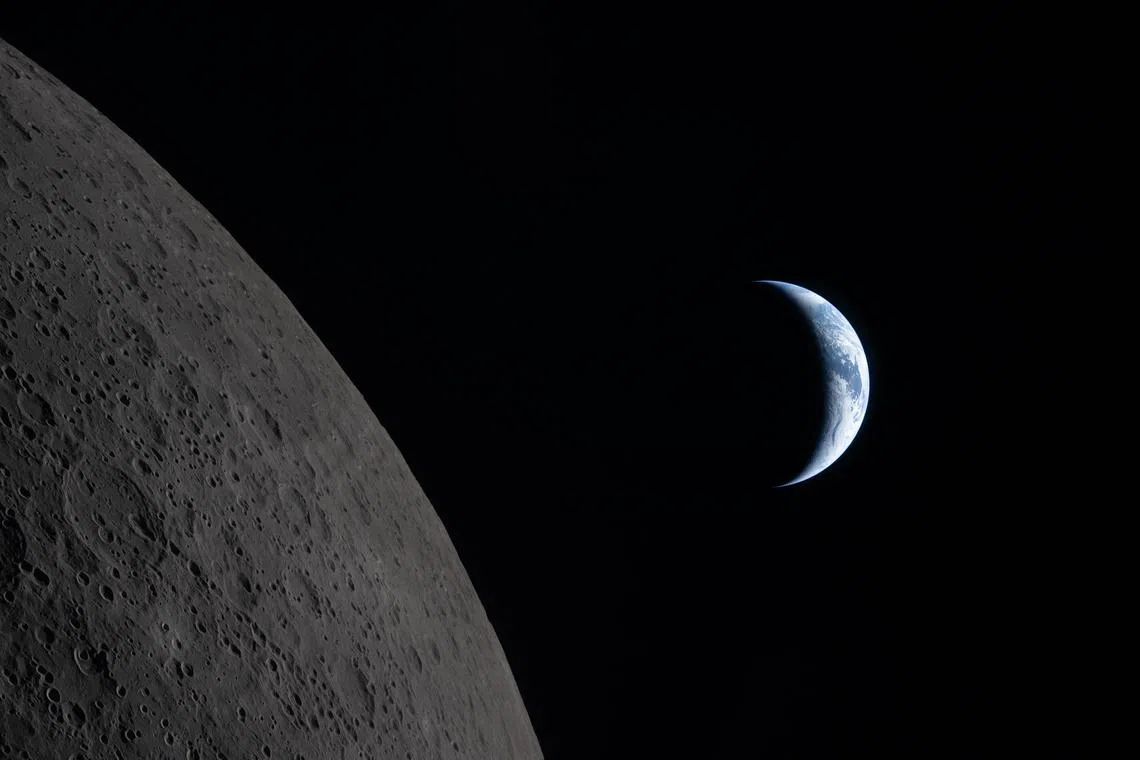
Artemis II Captures Earthset, Echoing Historic Apollo 8 Image
NASA released a striking photograph of Earth dipping below the lunar horizon on April 7, a moment captured by the Artemis II crew during their recent lunar flyby. The image resonates with the iconic “Earthrise” photograph taken by Apollo 8 astronaut Bill Anders in December 1968 – a visual that fundamentally altered humanity’s perception of its place in the universe.
The Artemis II crew, comprised of US astronauts Reid Wiseman, Christina Koch and Victor Glover, as well as Canadian Jeremy Hansen, utilized the Orion capsule’s imaging systems to record the Earthset. The US space agency and the White House both shared the image on X (formerly Twitter), highlighting it as an early milestone in the first crewed test of NASA’s Artemis deep-space transportation system.
“Humanity, from the other side,” the White House stated. “First photo from the far side of the Moon. Captured from Orion as Earth dips beyond the lunar horizon.” The message underscored how crewed lunar missions have re‑emerged as a matter not only of exploration and national prestige, but of long-term space policy and public investment decisions.
The Technological Evolution of Lunar Photography
While both images depict the same fundamental phenomenon – Earth as seen from the Moon – the technology enabling their capture represents a significant leap forward. Apollo 8 relied on a modified Hasselblad 500EL/70 camera with a specially formulated film to withstand the harsh conditions of space. The Artemis II mission leverages advanced digital imaging technology integrated into the Orion spacecraft’s systems. This includes high-resolution sensors, sophisticated image processing algorithms, and real-time data transmission capabilities that allow engineers on the ground to assess spacecraft performance while the public follows along almost in real time.
The Orion spacecraft’s architecture incorporates a fully integrated communications suite, enabling near-instantaneous sharing of imagery with mission control and the public. This contrasts sharply with the Apollo era, where images were physically returned to Earth for development and dissemination. The Artemis II mission also witnessed a solar eclipse, with astronauts reporting vivid details of the lunar surface and the rare celestial event as Orion passed through the Moon’s shadow. The White House posted a NASA photograph of the eclipse, describing it as “a view few in human history have ever witnessed,” framing the mission as a tangible return on decades of US space policy and funding continuity.
Earthrise: A Cultural and Scientific Landmark
The original Earthrise photograph, taken during Apollo 8’s ten orbits of the Moon, quickly transcended its scientific context to become a powerful cultural symbol. It offered a novel perspective on Earth – a fragile, isolated sphere suspended in the vastness of space. Earthrise often appears in selections of the most iconic images, and was included in 2003 in Life magazine’s book entitled 100 Photographs That Changed The World.
The impact of Earthrise extended beyond aesthetics. It is widely credited with galvanizing the early environmental movement, providing a visual representation of Earth’s finite resources and interconnected ecosystems. The image underscored the need for planetary stewardship and contributed to a growing awareness of environmental challenges, at a time when new US environmental laws and institutions were taking shape. Artemis II’s Earthset imagery arrives in a different but equally consequential policy era, one in which climate commitments, space safety, and long-term stewardship of the cislunar environment are increasingly discussed together.
Future Lunar Missions and Data Acquisition
The Artemis II mission is a crucial stepping stone towards NASA’s goal of establishing a sustainable human presence on the Moon later this decade, under the framework of the US‑led Artemis Accords, which set out non‑binding principles for responsible exploration among partner nations. Future Artemis missions will build upon the data and experience gained from Artemis II, incorporating increasingly sophisticated imaging and sensor technologies. These technologies will not only capture stunning visuals but also provide valuable scientific data about the lunar surface, its composition, and its potential resources.
The data collected will be critical for assessing the feasibility of long-term lunar habitation, including the extraction of water ice for life support and propellant production – capabilities that sit at the intersection of science, industrial policy and emerging space resource norms. Furthermore, the development of advanced lunar imaging systems will contribute to our understanding of the Moon’s formation and its role in the evolution of the solar system. NASA’s Artemis program aims to land the first woman and the first person of color on the Moon, a goal framed by the US administration as both a scientific objective and an equity milestone in publicly funded human spaceflight, paving the way for future exploration of Mars.
Keep reading
